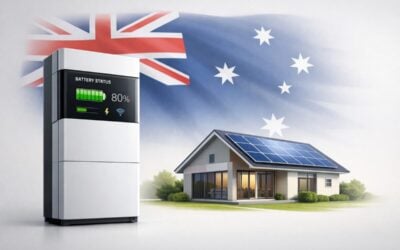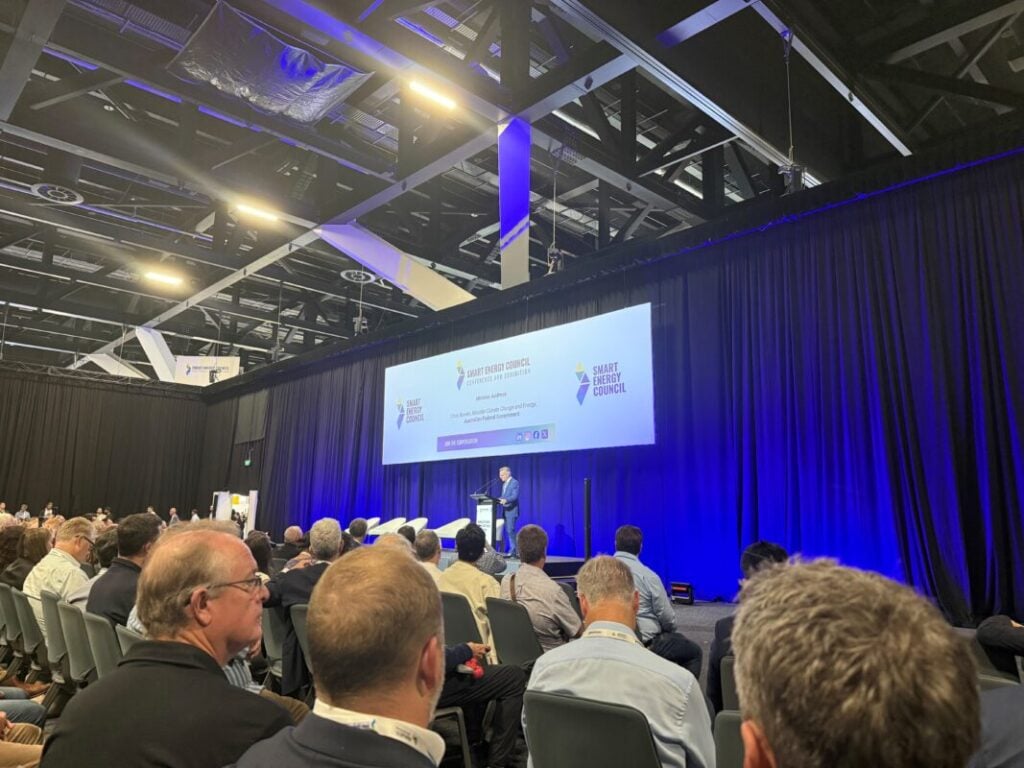
Australia has installed 380,712 home battery storage systems, representing 10.7GWh of storage capacity, since the introduction of the Cheaper Home Batteries Program last year, Chris Bowen, Australia’s minister for climate change and energy, has disclosed.
Speaking at the Smart Energy Conference 2026 in Sydney yesterday (6 May), Bowen said the uptake of the subsidy scheme has exceeded that of the government’s electric vehicle (EV) tax discount, describing the response from households as taken up “with gusto by the Australian people.”
“The take-up of EVs pales in comparison to the alacrity with which Australians have taken up cheaper home batteries,” Bowen said.
“There was a lot of excitement here in this room last year when we announced our Cheaper Home Batteries Program.”
Try Premium for just $1
- Full premium access for the first month at only $1
- Converts to an annual rate after 30 days unless cancelled
- Cancel anytime during the trial period
Premium Benefits
- Expert industry analysis and interviews
- Digital access to PV Tech Power journal
- Exclusive event discounts
Or get the full Premium subscription right away
Or continue reading this article for free
The Australian government launched the Cheaper Home Batteries Program subsidy last year following the 2025 federal election. Initial estimates of AU$2.3 billion (US$1.63 billion) in support through the scheme grew to AU$7.2 billion by 2030, representing more than a threefold increase from the original projections announced.
Speaking at the All-Energy Australia 2025 conference in November, Carl Binning, executive general manager at the Clean Energy Regulator, said that roughly 8,000 Cheaper Home Batteries Program applications per week were being processed.
In early March, rumours began circulating that the government was exploring additional modifications to its Cheaper Home Batteries Program, including the possibility of an early wind-up, ahead of the May Budget, which is set to be released next week.
Bowen said renewable energy supplied more than half of Australia’s electricity in the last quarter of 2025, marking the first quarter in which renewables exceeded 50% of generation.
Bowen characterised the government’s approach as “sensible common-sense policies to build more of the fastest to deploy the cheapest form of energy, which is also more sovereign, more reliable, and happens to be the lowest emissions as well.”
Fuel security amid the Iran crisis
Bowen addressed the recent energy crisis stemming from conflict in Iran, which IEA Executive Director Fatih Birol has described as “as big as the 1970s crisis and the 2022 crisis combined.”
He noted that Singapore’s Foreign Minister Vivian Balakrishnan has described the conflict as “an Asian crisis, because of the dependence on the straits [of Hormuz] of Asian supply chains,” according to Bowen.
The minister said Australia now holds 43 days’ worth of petrol, 33 days of diesel, and 28 days of jet fuel domestically, with an additional 400 million litres of diesel and 100 million litres of jet fuel procured through government intervention and industry partnerships.
The minister criticised opposition responses to the crisis, stating they “have had no constructive suggestions to make since 28 February” and are “using every opportunity to argue against renewable energy.”
“They’re losing the argument domestically, with the Australian people embracing this transition. They’re losing the argument in the outer suburbs and regions, with regional Australians and suburban Australians taking up this transition with huge energy, with greater speed than anyone else, and they’re losing the argument in the rest of the world as well,” Bowen said.
The crisis in the Middle East has sent shockwaves across the international markets. Speaking to ESN Premium in March at the Energy Storage Summit Australia 2026, Climate Energy Finance’s Tim Buckley said that geopolitical instability exposes Australia’s oil dependency and positions the country as a safe haven for international renewable energy capital.
The climate finance expert, whose public-interest think tank operates without government or corporate funding, argues that sustained oil price spikes above US$100 per barrel should serve as a catalyst for the Australian government to accelerate investment in battery storage, EVs, and firm renewable energy infrastructure, rather than retreating into short-term crisis management.
“I would hope with the supermajority that the Albanese government has got, that they will show some real spine and realise that this is a great opportunity to actually invest in getting off our addiction to imported oil,” Buckley said.
Andrew Forrest, chairman of Australian mining company Fortescue, declared at the Smart Energy Conference that “the Strait of Hormuz is not opening up anytime soon,” whilst urging the government to remove Australia’s diesel fuel rebate for large industrial users, arguing the subsidy removes economic incentive for decarbonisation.
Forrest believes the fuel tax credit system has cost AU$122 billion since 2006, with AU$55 billion allocated to miners, and that it will reach AU$184 billion by 2030 if current policy continues.
“More is spent on diesel rebates than on the army or the Air Force of our nation,” he said.
EV adoption accelerates in outer suburbs
Bowen also provided updated figures on EV adoption, stating that 27.5% of light vehicle sales in April 2026 were EVs or plug-in hybrids, up from 1.9% in April 2022.
Nearly half of all new light vehicles sold in Australia in April 2026 were electric, plug-in hybrid or hybrid, up from one in 10 in April 2022.
He said 515 Australians bought an EV each day in April, compared to 29 per day in April 2022.
“Australians went from buying roughly one EV every 50 minutes just four years ago to buying one EV every three minutes in April 2026,” Bowen said.
“Four years ago, one in 50 new cars sold in Australia was an EV or a plug-in hybrid. Today, we can say that the figure is one in four.”
The minister confirmed that the EV tax discount will continue unchanged this year, with the full discount from 2027 applying to all EVs under AU$75,000. He said the policy adjustment reflects the success of vehicle efficiency standards in bringing more affordable models to the Australian market, with around 10 EV models now available under AU$40,000 compared to none when the government took office.
“It’s only because of the success of the New Vehicle Efficiency Standard in encouraging more affordable models into Australia that we can focus the EV tax discount on those more affordable models,” Bowen said.
The minister emphasised that EV uptake has been particularly strong in outer suburban areas.
“This is a story of the outer suburbs and the [outer] suburbs,” Bowen said. “The highest take-up of our EV discount in New South Wales is in Kellyville and Rouse Hill. Parramatta is Polestar Parade. Blacktown is BYD Boulevard. I live in Smithfield, Western Sydney, and there are EVs all around you.”
Bowen said the shift represents “a combination of good government policy, but also an enthusiastic public.”
“You can have all the incentives you like. If the public doesn’t want to take up an offer, they will not take it up,” he said.
“Australian people voted with their ballots last year, but they’re voting with their decisions each and every day.”
Interested in Australia? Read Energy-Storage.news’ Energy Storage Summit Australia coverage and related content.