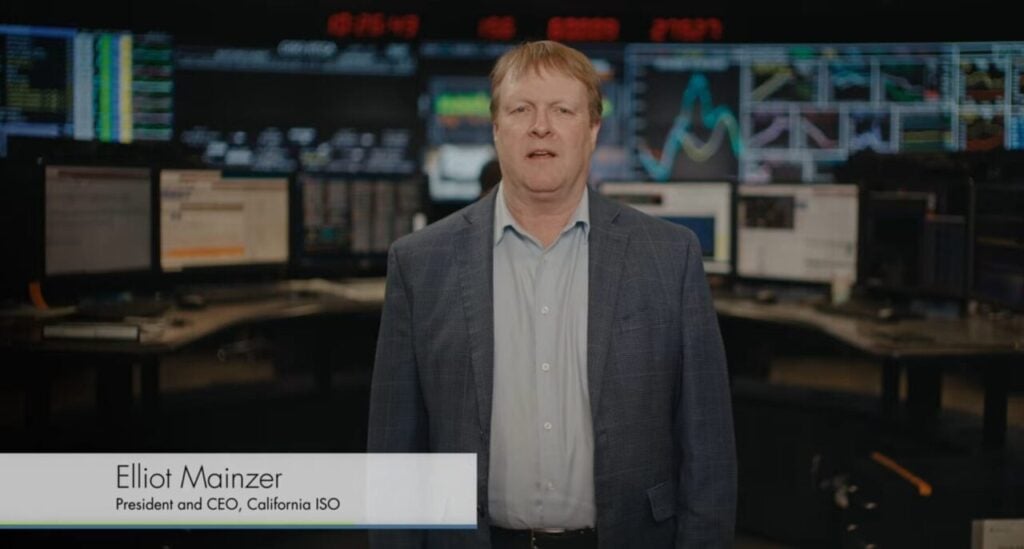
Energy-Storage.news speaks with Elliot Mainzer, president and CEO of CAISO, about the ISO’s newly launched Extended Day-Ahead Market.
The California Independent System Operator (CAISO) launched its Extended Day-Ahead Market (EDAM) on 1 May, with its first participant, utility PacifiCorp.
According to CAISO, EDAM builds on the success of the ISO’s Western Energy Imbalance Market (WEIM), which has delivered “US$8.5 billion in financial benefits” to participants since launching in 2014.
WEIM extends CAISO’s real-time market to areas in California, Arizona, New Mexico, Texas, Oregon, Washington, Nevada, Idaho, Montana, Utah, and Wyoming, with additional participants set to join in the future.
Try Premium for just $1
- Full premium access for the first month at only $1
- Converts to an annual rate after 30 days unless cancelled
- Cancel anytime during the trial period
Premium Benefits
- Expert industry analysis and interviews
- Digital access to PV Tech Power journal
- Exclusive event discounts
Or get the full Premium subscription right away
Or continue reading this article for free
Participants in WEIM, including CAISO, benefit from economic, operational, and environmental advantages by trading energy across a large area in real time.
The newly launched EDAM applies those same principles, wide-area optimisation, resource diversity, and economic dispatch, to day-ahead planning, to give system operators greater visibility into next-day conditions.
“The market’s been designed to deliver very significant reliability and affordability results for market participants and their customers,” says Mainzer. “We feel confident about this because we’ve been delivering these results in the real-time WEIM for over 12 years.”
PacifiCorp, which Mainzer says has saved more than US$1 billion through WEIM participation, will be the first utility to join EDAM. Oregon-based utility Portland General Electric (PGE) will follow in October, with additional entities expected to join in 2027 and 2028.
Battery participation
Battery operators will be able to participate in the full suite of market products, including energy scheduling on a day-ahead basis, frequency regulation, frequency response, and a new product called imbalance reserves designed to manage uncertainty between day-ahead and real-time operations.
“We really encourage full participation in the full suite of market products, and are expecting batteries to play a really important role in EDAM, not only for resources located in California, but for resources located across the western United States,” Mainzer says.
The day-ahead timeframe is particularly well-suited for battery optimisation around the Western US grid’s pronounced duck curve, the pattern of low midday prices driven by solar generation and high evening prices as the sun sets and demand peaks.
Mainzer explains, “You’re able to schedule your battery into the system on a day-ahead basis and be dispatched across the course of the day, taking advantage of the duck curve, effectively purchasing and charging with lower-cost electricity during the middle of the day and then turning it around and offering it into the energy market in the evening to help with net peak.”
EDAM expands on WEIM’s concept of extending energy beyond California’s borders. CAISO noted that other WEIM balancing authorities outside California now have 8,500MW of batteries on their systems, in addition to California’s substantial storage fleet.
“The market itself is designed to optimise a very diverse fleet of resources,” Mainzer notes. “WEIM was always on that 5-, 10-, 15-minute time step. Now we have the ability to go into a much deeper optimisation in day-ahead, and really support each other.”
Reliability protections
As extreme weather events increasingly affect multiple regions simultaneously, EDAM includes specific protections to help ensure no single balancing authority is put at risk by market operations.
The market incorporates “net export constraints” that “Prevent a market solution from effectively putting any one of the balancing authorities in distress by exporting more than they actually can carry, more than they could support to maintain reliability within their system,” Mainzer explains.
He further notes, “The market solution is designed to take advantage of economic optimisation, but not to let entities lean on each other or put any balancing authority in distress because of its market activity.”
Additionally, every participating entity must pass a resource sufficiency evaluation on a day-ahead basis, demonstrating it has adequate energy capacity and flexibility to participate without unnecessarily relying on others.
Notably, EDAM’s day-ahead visibility is also expected to reduce the frequency of energy emergency alerts that become more common during stressed grid conditions.
As Mainzer explains, “That day-ahead visibility is going to significantly enhance state awareness and understanding and the ability for the system to be dispatched efficiently. That’s going to basically lower the general stress level, that will reduce, over time, the incidence of energy emergency alerts and things like that that are often declared just because there is uncertainty about what will happen in real-time.”
GHG Policies
One of EDAM’s more complex challenges involves accommodating the diverse greenhouse gas (GHG) policies across participating states.
Starting 6 May, when utility Black Hills Energy in South Dakota and Berkshire Hathaway’s PacifiCorp balancing authority in Montana join WEIM, its footprint will span 12 states with vastly different approaches to carbon regulation, from the California Air Resources Board’s Cap-and-Invest Programme to states with no GHG policies at all.
The CAISO CEO says this diverse range of regulations in WEIM has assisted with the GHG framework for EDAM.
“The market has been designed in a way that’s able to appropriately capture and price GHG and account for imports and exports for a state like California that has a fairly rigorous approach,” Mainzer says. “Then for other states that don’t have those or have different types of reporting requirements, like up in Oregon, for example, they’ll be able to provide information that can be used for compliance reporting.”
Mainzer says the goal is to prevent GHG policies from distorting market signals or unintentionally impacting participants beyond the intent of those policies.
One element of EDAM that won’t go live on 1 May, the GHG net export constraint, is a feature designed to ensure accurate accounting of imports and exports under California’s GHG framework.
Mainzer explains, “We saw a few results in parallel operations that just convinced us that we needed to look at that a little bit more and watch it in production and look at the design a little bit more. I think we’ve got about the best design we possibly have, but we’re going to continue to evolve that as well over time.”
Lessons from WEIM implementation
CAISO’s approach to the EDAM launch largely reflects lessons learned from its more than a decade of operating WEIM.
The ISO has conducted parallel operations testing over recent months, examining price formation, congestion management, the new imbalance reserve product, and settlement processes. The testing included participation from PacifiCorp and other market participants who have been engaging in CAISO markets in recent years.
“I would say we’re generally very confident that we’re going to have a good go-live,” Mainzer notes. “But the reality is that you’re out of parallel operations. The market will be fully live and be fully binding. You’re not dealing with any sort of synthesised information anymore.”
To address any issues that may emerge, CAISO has established a rapid response team. It will also produce daily videos for the first several days after launch with the goal of keeping participants informed.
“We don’t anticipate specifically any issues, but we will be watching very carefully all of the different elements as the market actually operates live out of the simulated environment, and if we do see things, we’ll run them down as efficiently as possible,” Mainzer says.