After reporting a record 112GW of global non-pumped hydro energy storage installations in 2025, BloombergNEF (BNEF) expects to see a 41% increase this year.
BNEF launched its Energy Storage Outlook H1 2026 report this week. The market intelligence firm counted 112GW/307GWh of new additions last year, and forecasts 158GW/459GWh of deployments worldwide for 2026. This is despite a global slowdown in solar PV and wind additions.
Although the rate of increase will have slowed from a 48% jump in megawatt terms (power) from 2024, BNEF has predicted that annual additions will almost double over the next 10 years, reaching 308GW by 2036. By the end of that year, cumulative capacity will reach 2.9TW/10.5TWh, the firm’s report said.
The 2025 total surpassed the 92GW/247GWh BNEF had forecast for the year as recently as the previous, H2 2025 edition of the same report, which would itself have been a record. The firm has since upped its expectations for both this year and the period through 2036.
Try Premium for just $1
- Full premium access for the first month at only $1
- Converts to an annual rate after 30 days unless cancelled
- Cancel anytime during the trial period
Premium Benefits
- Expert industry analysis and interviews
- Digital access to PV Tech Power journal
- Exclusive event discounts
Or get the full Premium subscription right away
Or continue reading this article for free
BNEF head of global energy storage analysis Isshu Kikuma, posting to the company’s blog, noted that it only took four years from annual energy storage additions to grow from 10GW to more than 100GW, much faster than the eight years it took solar PV to achieve the same and the 15 years it took for wind.
“This record underscores growing market momentum and increased industry maturity,” Kikuma wrote.
However, Kikuma also wrote that war in the Middle East could have “varied implications for the industry.”
Although BNEF has not updated its forecasts based on these, due to the uncertain nature of long-term impacts and the ongoing status of the Iran war, the report said that rising oil prices could impact shipping and manufacturing costs for equipment, although as of mid-April, impacts were limited given that most inputs and production capacity in the industry’s China-dominated supply chains are not in directly affected regions of the world.
On the other hand, rising oil prices due to geopolitical tensions could create significant opportunities for low-carbon energy resources. According to the report, this would depend on how each market assesses the impact on energy security, how long the situation persists, and whether they, in turn, implement regulatory and market structures that provide businesses with sufficient long-term certainty to invest.
“Markets that rely on oil-linked gas, such as those in Asia and Europe, are experiencing elevated power prices,” Kikuma told ESN Premium in an article in April, speaking alongside fellow market experts Iola Hughes of Benchmark and Dan Finn-Foley of Intertek CEA in an in-depth piece about the industry implications of the Strait of Hormuz closure.
“Higher power prices, driven by spot gas prices, can improve the economics of energy storage, particularly in markets with high renewable penetration, especially solar, due to a wider intraday power price spread.”
US, China accounted for 70% of 2025’s record-breaking total
The world’s two biggest markets by country, the US and China, accounted for around 70% of all 2025 deployments. Despite recent policy changes in both, BNEF expects them to remain big players through the next decade.
China installed 61.1GW/173.1GWh in 2025, BNEF said, a 54% increase from the previous year. Its cumulative capacity is expected to reach 1.3TW/5.2TWh by 2036. Meanwhile, the US added 18GW/54.6GWh in 2025, a 46% increase from 2024 and cumulative capacity is expected to hit 334GW/1.3TWh by 2036, after its growth of domestic battery manufacturing takes effect.
Some other notable regional statistics, trends and forecasts from the report included:
- Annual installations quadrupled in Sub-Saharan Africa year-over-year from 2024, with 4.3GW/8.8GWh of additions in 2025. BNEF predicted that the region’s cumulative installations will reach 155GW/439GWh by 2036.
- While Germany emerged as a leading European market for utility-scale installations last year, residential batteries still comprise the bulk of deployments. Of the 3.8GW/7.6GWh total installations in Germany in 2025, 2.9GW/5.8GWh were residential.
- India is expected to emerge as the world’s sixth-largest market by 2036, with 1.8GW/5.4GWh expected in 2026 as projects awarded in government-led auctions start to come online, versus just 0.5GW/0.9GWh installed in 2025. BNEF forecasted cumulative capacity in India to hit 107GW/393GWh in 2036.
- Saudi Arabia led capacity additions in the Middle East in 2025, installing 2.1GW/7.8GWh, accounting for around 87% of the region’s total 2.4GW/8.6GWh of new additions last year. BNEF expects markets in the United Arab Emirates (UAE) and Egypt to begin to scale in 2027, with cumulative capacity in the Middle East forecast to reach 79GW/299GWh by 2036, a massive climb from 4.2GW/15.3GWh cumulative installs as of the end of last year.
Applications and technologies evolve
In terms of the mix of applications energy storage systems provide, BNEF said that, based on energy capacity, 79% of 2025 additions were for the purpose of short-duration energy shifting, typically front-of-the-meter (FTM) utility-scale systems performing arbitrage and providing reliable capacity to meet peak load.
These applications of up to around 4-hour duration are, however, being increasingly complemented by a share of long-duration energy storage (LDES) for energy shifting. While that share was tiny in 2025 at around 3% of energy capacity deployed, it is forecast to grow to 13% by 2026.
Ancillary services, which comprised 10% in 2021, fell to just 2% in 2025 and will fall to 1% this year, remaining at that level through 2036.
Transmission-level energy storage assets, while currently at that sort of level, will grow significantly in the 2030s, largely off the back of demand in China, to represent 8% of the annual market by capacity, BNEF forecasted.
Meanwhile, BNEF has tracked 12.9GW/51.5GWh of announced, operational or under construction on-site energy storage at data centre complexes, although a significant share does not have a commissioning date. Once that share is excluded, the number comes down to 8.9GW/12.1GWh.
In another emerging application, energy storage for EV charging, BNEF has tracked around 1GWh of batteries installed at charging stations globally, while another 12GWh of project capacity has been referred to by company press releases and submissions.
While data is inconclusive, BNEF said most major charging operators have installed battery storage on at least one site, with China the leader, and significant rollouts also noted in France, the US and the UK.
In terms of battery technology, BNEF said it expected lithium iron phosphate (LFP) to remain the most popular chemistry through 2035, while the combined market share for nickel manganese cobalt (NMC) and nickel cobalt aluminium oxide (NCA) batteries will plummet to just 1% by 2029, from comprising 50% of the total market as recently as 2021.
Within LFP, BNEF noted a trend toward manufacturers rolling out larger-format prismatic cells for BESS applications, with 5MWh enclosures in 20-foot ISO containers becoming standard in 2025, using 300Ah+ cells. The battery energy density and format race has continued, with companies in China launching ever-larger cells that may, after a typical six-month gap, find their way into international markets.
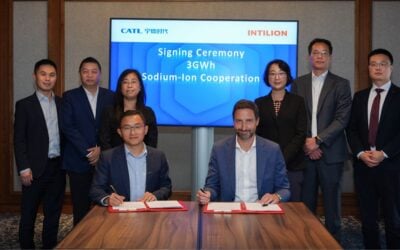
The company does expect sodium-ion (Na-ion) batteries to continue making inroads and gaining market share, with analyst Isshu Kikuma referring to the recent 60GWh Na-ion supply agreement and technology collaboration between Chinese battery OEM CATL and system integrator HyperStrong and a 5GWh agreement between US sodium battery startup Peak Energy and developer Jupiter Power as examples of recent deals in the space.