
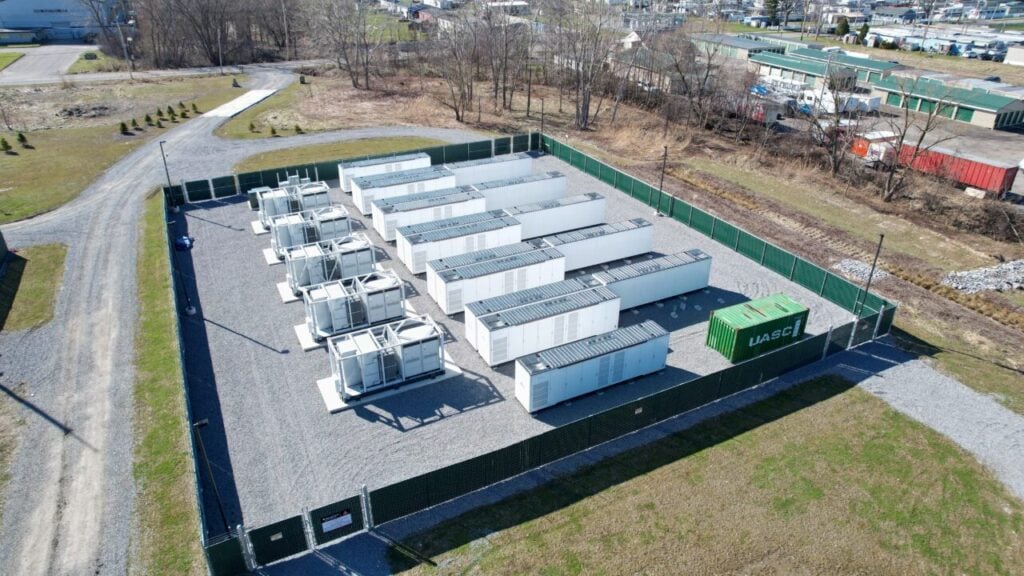
ESN Premium examines likely reasons why owner SK Innovation E&S is seeking financing options for Key Capture Energy (KCE), including a potential sale.
South Korea’s SK Group acquired the Albany, New York-headquartered developer back in 2021, through its energy subsidiary, amid reports that the new owner would invest around a billion dollars into it.
Just over a week ago, following reports that KCE was up for sale, a spokesperson for PassKey, SK Innovation E&S’s investment arm in the US, issued a statement to media, including Energy-Storage.news, that PassKey is “exploring various strategic options to bring in a financial partner that will work alongside the PassKey team to support Key Capture Energy’s growth in markets across the US.”
“We remain committed to Key Capture Energy’s success as we expand battery energy storage to strengthen grid reliability and resilience.”
Try Premium for just $1
- Full premium access for the first month at only $1
- Converts to an annual rate after 30 days unless cancelled
- Cancel anytime during the trial period
Premium Benefits
- Expert industry analysis and interviews
- Digital access to PV Tech Power journal
- Exclusive event discounts
Or get the full Premium subscription right away
Or continue reading this article for free
So, the picture is a little more nuanced than KCE being simply up for sale. That said, although the statement notes a continued commitment to the developer’s success, “various strategic options” doesn’t explicitly rule out a sale either.
The background
Key Capture Energy first featured on the site back in September 2019, when it brought the first grid-scale BESS in New York into commercial operation.
After facing the numerous well-documented challenges developers had faced in the state, the 20MW project created “a foundation from which many more energy storage systems can be developed and deployed,” then-COO Dan Fitzgerald told the site.
The project, KCE NY1, was one of the very few that got through the New York State Energy Research and Development Agency (NYSERDA) incentive programme for large-scale storage.
And it still remains one of only a handful of utility-scale projects in New York, which has been working to unravel a tangled web of wholesale market regulation and design, permitting and safety rules, and, latterly, community engagement issues.
With the state targeting 6GW of energy storage deployments by the end of this decade, NYSERDA is going back again and running a new revenue underwriting programme, the Index Storage Credit (ISC) mechanism, soliciting project bids from utility-scale developers.
With KCE understood to be staking a significant portion of a claimed 8GW company development pipeline in the US on NYISO projects, it has bid into the ISC and is awaiting the results. NYSERDA is expected to select and disclose those later this year, likely in cooperation with utilities in the state to determine the best-sited projects from a grid standpoint.
KCE also has two projects in New York, contracted through the Long Island Power Authority (LIPA), which already issued its own RFP, driven by the need to replace a polluting, expensive peaker plant fleet.
In a September 2025 interview, KCE CEO Brian Hayes told Energy-Storage.news that New York would be the company’s “next big move,” and was “pretty well-positioned there.”
Capital-intensive IPP business model
KCE’s energy storage independent power producer (IPP) business model is based on developing projects to own and operate for the long term, including an in-house operations team and route-to-market optimisation software, both of which Hayes’ predecessor, Jeff Bishop, had been keen to emphasise as differentiators.
That means KCE needs an operating portfolio to generate income, and that currently stands at 623MW. Of this, 580MW is in the ERCOT market in Texas, including two 100MW projects that went online at the beginning of 2025.
Those were the most recent of KCE’s projects to go into commercial operation, and it is no secret that ERCOT’s energy-only market design has compressed volatility-dependent revenues for batteries due to relatively mild weather, while, at the same time, the fleet of assets competing with one another to capture volatility grows.
One industry source ESN Premium spoke to speculated that KCE’s selection of Powin as system integrator for multiple Texas projects may be a factor in its parent company’s need for financing or possible divestment. Powin went out of business last year, with most of its assets acquired by rival FlexGen, which committed to servicing Powin’s 11GW of deployed systems.
However, a source close to the matter said there was no relation between Powin’s bankruptcy and KCE’s need for capital raising ahead of this article.
Another aspect of the business model former CEO Bishop discussed is that KCE seeks to be an early mover in US transmission and wholesale markets as they emerge. So, for instance, it was early in the New York market, then early in Texas, and, through Bishop’s and then Hayes’s leadership, it has also been planting its flag in the Midwest MISO market, with assets in development.
Hayes said in September that KCE was “pretty excited about MISO, particularly Michigan, Indiana, Illinois,” where it was “starting to see lots of action.”
“We’re starting to see much more positivity in MISO, and I think it’s really around the data centres and the AI. They’re coming to that area of the country, and so as a result, they’re figuring out that storage is a good way to shorten the time to power,” Hayes said.
Since Hayes took over in early 2024, the company’s focus has shifted towards contracted assets, aiming to sign tolling agreements or similar long-term contracts with utilities and other offtakers.
The company has also sought to develop more projects outside Texas, including MISO in the Midwest and non-California projects in the Western Electricity Coordinating Council (WECC) service area.
However, KCE has not publicly announced the start of commercial operations of any new projects for over a year, and in the meantime, although SK reportedly pledged a billion dollars in investment into the company when taking it over, its development activities will cost money and take time.
Key Capture Energy looks to parlay first-mover advantage into contracted revenues
So, in short, it’s likely that three or perhaps four factors are driving SK Innovation E&S investment arm PassKey to seek fresh financing for Key Capture Energy.
- The company’s operational projects are generating income, but perhaps not as much as might have been expected in the mature ERCOT market. At the same time, projects in emerging markets like New York have taken time to come to fruition.
- Being ahead of the market means seeking out fundamental drivers for energy storage for the grid in otherwise untapped RTOs and ISOs. This is, in itself, capital-intensive and can mean playing the long game.
- Amid revenue compression in ERCOT and an increasingly competitive market based on sophisticated trading strategies and AI-backed algorithms, the strategy of developing route-to-market operations, including software, while competitors look to third-party solutions, may drive a need for funding.
- External factors, such as policy changes, or perhaps more pertinently, the ongoing cost of long lead times for permitting and grid connection agreements. KCE is unlikely to be the only developer out there seeing this as a driver of capital investment, which means we could see more owners exploring their options in the coming months.
While it may be expensive to establish, a first-mover advantage can be exactly that, an advantage. So, if, or more likely when, Midwestern US load growth does parlay into opportunities for battery storage, Key Capture Energy will hope that it can benefit from that, ditto New York, where it already has an established footprint, while most of its competitors do not.
Of course, since then, much has changed in the US energy sector with the Trump administration taking office for the president’s second term. Energy storage emerged with its tax credit support intact, albeit heavily modified to favour domestic and otherwise non-Chinese equipment, materials and investment.
It will, therefore, also be interesting to see whether KCE can benefit directly from SK’s battery manufacturing arm, SK On, becoming a domestic manufacturer of lithium iron phosphate (LFP) cells for battery storage in the US. So far, that connection has not been made explicit by either party, but it would, on the face of it, be a natural advantage that KCE could perhaps leverage to secure a supply chain compliant with foreign entity of concern (FEOC) rules.
Divestment or otherwise, KCE strategy likely to remain unchanged
With little else said publicly so far beyond PassKey’s brief statement, it must be understood that the topics outlined in this article are largely speculative.
However, the alignment of the parent company’s “long-term commitment” to KCE’s success with the developer’s goal to generate long-term contracted revenues from an operational portfolio still largely in development implies that Key Capture Energy will likely continue to operate under the same or similar business model, regardless of the option its owner eventually chooses.
