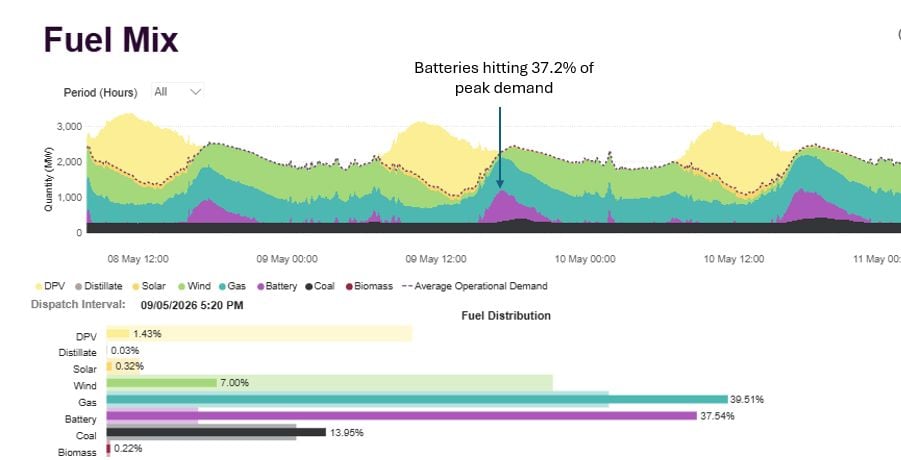
Utility-scale battery storage systems in Western Australia supplied 37.2% of peak demand on 9 May, marking one of the highest battery storage penetration levels recorded in an isolated grid globally.
The milestone was documented by Jai Thomas, coordinator of energy at Energy Policy WA, who noted on LinkedIn that the record occurred on Saturday evening following a day in which renewables supplied 78% of generation, with renewable energy accounting for 53% of supply across the weekend.
The figures apply to the South West Interconnected System (SWIS), Western Australia’s main grid, which covers approximately 350,000 square kilometres and operates independently of Australia’s National Electricity Market (NEM).
Thomas noted that the 37.2% figure excludes behind-the-meter battery contributions, “so the contribution [of batteries] is understated if anything,” he wrote on LinkedIn.
Try Premium for just $1
- Full premium access for the first month at only $1
- Converts to an annual rate after 30 days unless cancelled
- Cancel anytime during the trial period
Premium Benefits
- Expert industry analysis and interviews
- Digital access to PV Tech Power journal
- Exclusive event discounts
Or get the full Premium subscription right away
Or continue reading this article for free
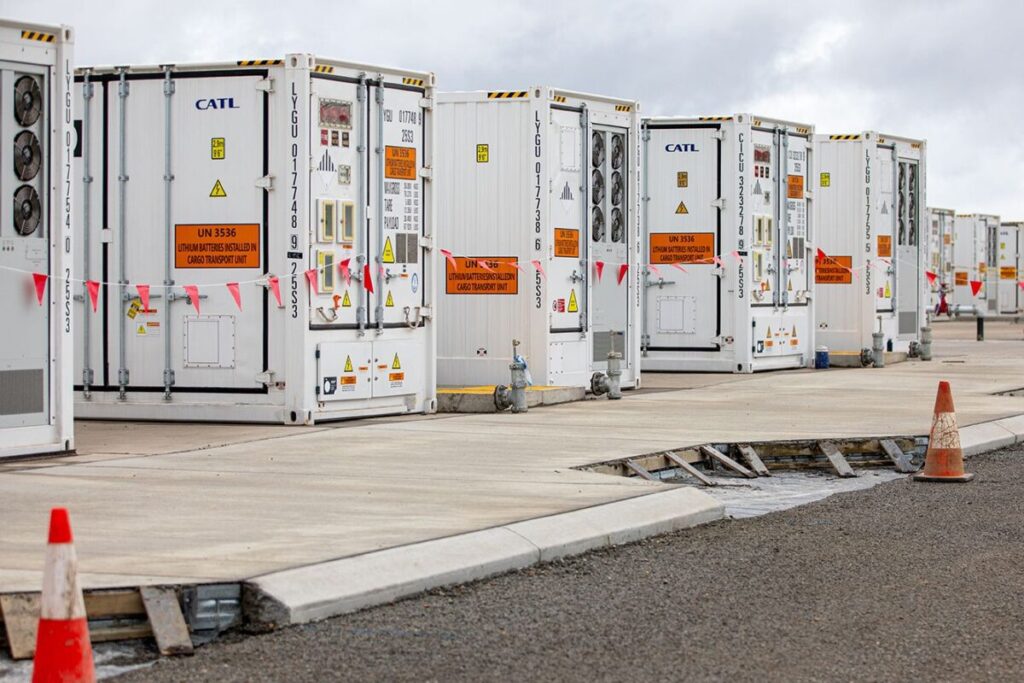
Western Australia’s battery storage capacity has expanded rapidly over the past two years. The largest installations include two systems at Collie, a 2,400MWh system owned by Synergy and Neoen’s own Collie Battery, sized at 2,200MWh. Collie is the state’s coal generation hub, which is scheduled to close by the end of the decade.
The 9 May record places Western Australia alongside South Australia and California as jurisdictions that have achieved battery storage penetration above 35% of peak demand, though the SWIS is distinguished as the largest isolated grid to reach this level.
Policy frameworks driving storage deployment
Western Australia’s battery storage expansion has been supported by federal and state policy mechanisms designed to accelerate the transition from coal and gas generation.
The federal government’s Capacity Investment Scheme (CIS) has allocated support to multiple battery storage projects in the state, including four systems totalling 654MW and 2.6GWh under the first Western Australian tender, with projects at Boddington, Merredin, Muchea and Waroona scheduled for completion by October 2027.
More recently, CIS Tenders 5 and 6 awarded contracts to 1.9GW of renewable energy generation and 3.7GWh of battery storage across 10 projects in regional Western Australia, with commercial operation targeted for 2030 to coincide with the retirement of state-owned coal plants.
The projects include Trinasolar’s 350MW solar PV power plant with 2.1GWh of integrated battery storage, Neoen’s 200MW/1.6GWh Yathroo BESS, and a 200MW/1.5GWh battery storage system at Collie paired with a 66MW solar PV power plant.
Western Australia’s battery storage development contrasts with deployment patterns in the NEM, where battery storage systems have focused on shorter-duration arbitrage and frequency control services.
Across the NEM, battery storage systems in New South Wales captured 11.9% of state consumption during a charging event on 2 May, while Queensland recently became the first NEM state to discharge over 100GWh from battery storage in a single month in April 2026.