Australia’s energy market regulator has opened consultation on two competing rule change proposals that would reshape how the National Electricity Market (NEM) handles periods of excess solar generation, with battery storage investment at the centre of the policy debate.
Last week (9 July), the Australian Energy Market Commission (AEMC) published its consultation paper inviting stakeholder feedback on proposals from the AEMC Reliability Panel and the Clean Energy Council (CEC).
The paper seeks to address minimum system load (MSL), in which rooftop solar generation offsets underlying consumer demand to the point that grid demand falls below a safe level for system operation.
MSL conditions arise because grid operators need a minimum level of demand to keep synchronous generators running online for voltage stability and system strength.
Try Premium for just $1
- Full premium access for the first month at only $1
- Converts to an annual rate after 30 days unless cancelled
- Cancel anytime during the trial period
Premium Benefits
- Expert industry analysis and interviews
- Digital access to PV Tech Power journal
- Exclusive event discounts
Or get the full Premium subscription right away
Or continue reading this article for free
Rooftop solar, which does not respond to wholesale electricity prices, can sharply reduce grid demand on mild, sunny days, particularly on spring weekends and public holidays.
AEMO currently manages these conditions through a combination of market notices, directions to battery storage operators and, as a last resort, curtailment of rooftop solar exports through emergency backstop mechanisms.
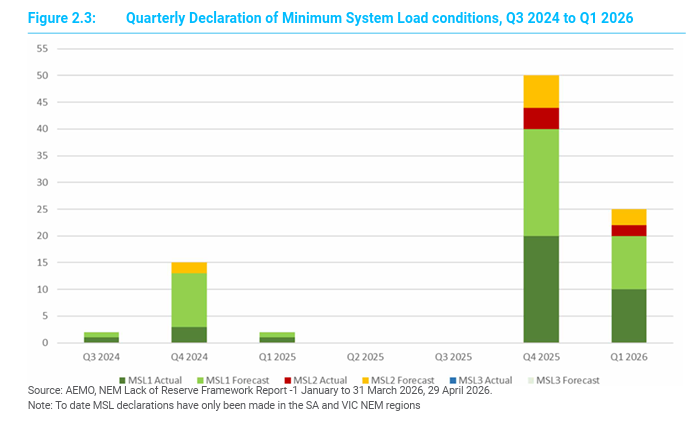
Under worst-case projections from AEMO’s 2025 Transition Plan for System Security, South Australia could face up to 135 days per year of conditions exceeding the most critical MSL (MSL3) threshold by 2031 if transition-point actions are delayed.
The two rule change requests before the AEMC propose different fixes. The Reliability Panel wants the NEM’s wholesale energy spot price to be automatically set to the market floor price of -AU$1,000/MWh (-US$693/MWh) when AEMO declares an MSL3 event, on the basis that this would sharpen the market signal for generators to withdraw and for flexible loads and storage to increase consumption, reducing reliance on AEMO intervention.
The CEC, meanwhile, is proposing a new paid market ancillary service that would allow battery storage systems, pumped hydro and other flexible loads to bid into a dedicated market for load reserves, giving AEMO a transparent, contractual mechanism to secure demand response in advance of forecast MSL periods, modelled on how frequency control ancillary services already operate.
The investment case question
For battery storage operators, the stakes of the outcome go beyond operational inconvenience.
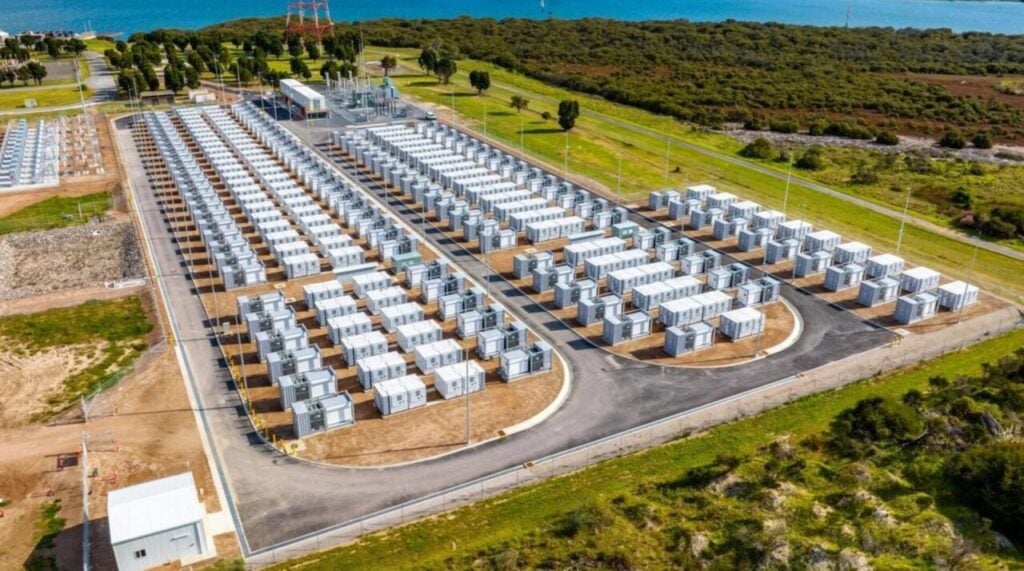
AEMO directed AGL’s 250MW Torrens Island BESS in South Australia on multiple occasions in late 2025 and early 2026 to remain synchronised and follow dispatch targets for MSL management, preventing it from operating on economic merit and charging during the cheapest windows.
November 2025 events alone cost the facility thousands of dollars in lost arbitrage revenue, while the compensation framework, designed for conventional generators, proved difficult to apply to a storage asset with different operating economics.
The CEC’s submission to the AEMC frames this directly as an investment risk. It argues that the current reliance on ad hoc AEMO directions and short-term transitional contracts, which cannot run beyond December 2029, is undermining the business case for new battery storage at precisely the moment the NEM needs more of it.
A transparent, open market with predictable pricing, the CEC contends, would lower the cost of capital for storage investment and draw a broader pool of providers than the current procurement process, which has favoured incumbents.
The AEMC has also identified a range of complementary or alternative mechanisms for the provision of load reserves, including extending transitional contracts, adapting the existing wholesale demand response mechanism for a two-way load-increase response, and reconfiguring existing frequency control ancillary service markets.
A widening reform agenda
The MSL consultation sits within a dense reform programme underway in the NEM.
Australia’s NEM wholesale market review, led by Tim Nelson, recommended that energy storage be better supported through clearer market frameworks for essential system services and proposed a new Electricity Services Entry Mechanism to support long-term investment in dispatchable resources.
The AEMC’s own reliability and security analysis has predicted reliability gaps in South Australia from 2026-27 and New South Wales from 2027-28, creating further pressure on regulators to get market design right for storage.
AEMO’s 2026 Integrated System Plan identified 35GW of short and medium-duration battery storage as needed by 2050, alongside 5GW of long-duration storage, as the least-cost pathway for the NEM through the coal transition.
The AEMC is also working within a broader set of consumer energy resource reforms, including a new Solar Sharer Offer that commenced on 1 July 2026, giving households three hours of free midday electricity to shift load into the solar trough.
AEMO is developing a market visibility framework to improve the integration of price-responsive distributed resources into central dispatch.
Both are expected to affect the frequency and severity of MSL conditions, though the extent of this effect remains uncertain.
The AEMC plans to publish a draft determination on the two rule change requests by 3 December 2026.
Our publisher, Solar Media (part of Informa Group), will host the Battery Asset Management Summit Australia 2026 on 25-26 August at Amora Hotel Jamison in Sydney. You can find out more about the Summit on the official website.