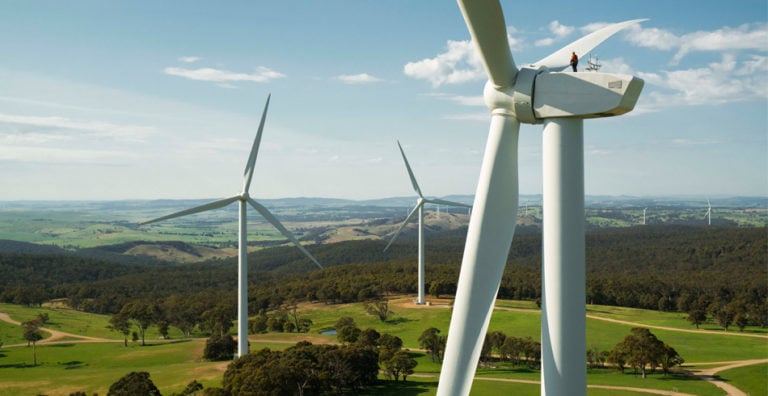
Goldwind Capital has submitted the Milpulling Wind Farm, a 600MW wind project with a co-located 250MW/1,000MWh battery energy storage system (BESS), for federal environmental assessment under Australia’s Environment Protection and Biodiversity Conservation (EPBC) Act.
The project is proposed approximately 17km southwest of Gilgandra in New South Wales (NSW), within the Gilgandra Shire Council area. It is located within the Central-West Orana Renewable Energy Zone (REZ).
According to the EPBC Act referral, the project will comprise up to 76 wind turbine generators, each with a rated capacity of up to 10MW, with a maximum ground-to-blade-tip height of 300 metres and a rotor diameter of up to 220 metres.
The 4-hour duration BESS, sized at 250MW/1,000MWh, is designed to be DC-coupled and located within the hardstand and laydown areas of the wind farm’s turbine infrastructure.
Try Premium for just $1
- Full premium access for the first month at only $1
- Converts to an annual rate after 30 days unless cancelled
- Cancel anytime during the trial period
Premium Benefits
- Expert industry analysis and interviews
- Digital access to PV Tech Power journal
- Exclusive event discounts
Or get the full Premium subscription right away
Or continue reading this article for free
In an interview with ESN Premium, last year, Neha Sinha, product manager for energy storage systems at Wärtsilä Energy Storage, discussed how DC-coupled hybrid systems address emerging market challenges and maximise system potential by improving operational flexibility and reducing capital costs through shared inverter infrastructure.
The project covers approximately 11,670 hectares across nine landholdings, primarily used for sheep and cattle grazing with some cropping.
Supporting infrastructure will include up to two substations, approximately 90km of underground cabling, an internal 66kV overhead transmission line, and connection to the National Electricity Market (NEM) via a 132kV transmission line and switchyard.
The wind farm’s primary site access will be via Milpulling Road from the Newell Highway, with wind turbine generator (WTG) components transported from the Port of Newcastle. The project is expected to operate for approximately 35 years.
An Environmental Impact Statement is currently being developed and will be submitted to the NSW Department of Planning, Housing and Infrastructure. The project is classified as State Significant Development under NSW planning legislation.
Co-located storage in a zone with growing grid obligations
The Milpulling referral comes as the queue of large-scale energy storage projects seeking federal environmental clearance in NSW continues to build.
Eku Energy recently submitted two 300MW/1,200MWh BESS projects to the EPBC Act: the Tramway Road BESS in Victoria’s Gippsland REZ and the Wongalea BESS near Armidale in northern NSW, both deploying an identical 4-hour configuration.
Ausgrid, meanwhile, has submitted its 150MW/300MWh Berkeley Vale BESS in NSW for the same federal process, adding to a pipeline of network-connected storage projects advancing through approvals across the state.
In May, Iberdrola Australia submitted its 1,000MW Burrenbring BESS in Queensland to the EPBC Act, a standalone project being developed independently from a wind farm the company is also investigating at the same Queensland site.
NSW now requires 56GWh of energy storage by 2030, up from 40GWh projected in mid-2025, driven by higher-than-expected solar penetration that is shifting the generation mix away from wind.
Of that 56GWh, only 12.5GWh had reached financial investment decision as of the Energy Storage Summit Australia 2026 in March, according to Paul Peters, CEO of the NSW Energy Security Corporation.
AEMO’s 2026 Integrated System Plan, released in final form this week, confirmed that Australia is running short of the large-scale wind capacity needed to meet its 82% renewable energy target by 2030, making hybrid wind-plus-storage projects of the kind Goldwind Capital is proposing increasingly relevant to the grid’s transition pathway.
Interested in Australia? Read Energy-Storage.news’ Energy Storage Summit Australia coverage and related content.