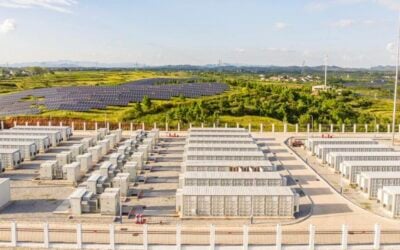
Massachusetts’s Department of Energy Resources (DOER) has issued a request for proposals (RFP) for 1,000MW of energy storage in the US state.
Issued 31 July by the DOER and the Massachusetts electric distribution companies (EDCs), the RFP includes a 250MW-300MW procurement target for distribution projects in addition to the 1,000MW of mid-duration battery energy storage systems (BESS).
The EDCs, which are also the investor-owned utilities (IOUs), in the state involved in the RFP are Eversource, National Grid and Unitil.
In August 2025, the EDCs and DOER launched an RFP for approximately 1,500MW of BESS. In December of that year, DOER announced it had completed evaluating the bids received in response to the RFP, selecting projects totalling 1,268MW of energy storage capacity.
Try Premium for just $1
- Full premium access for the first month at only $1
- Converts to an annual rate after 30 days unless cancelled
- Cancel anytime during the trial period
Premium Benefits
- Expert industry analysis and interviews
- Digital access to PV Tech Power journal
- Exclusive event discounts
Or get the full Premium subscription right away
Or continue reading this article for free
Projects were selected from developer FlatIron Energy, River Mill Storage, Rhynland Energy, and Jupiter Power.
In November 2024, Massachusetts Governor Maura Healey signed comprehensive energy legislation mandating the procurement of 5,000MW of energy storage systems by 31 July 2030.
According to the RFP, “The Distribution Companies will be responsible for negotiation and execution of any final LongTerm Contracts. For Distribution Projects, the Distribution Companies will provide selected projects with a standard, non-negotiable contract. DOER will have the opportunity to monitor contract negotiations between the Distribution Companies and selected bidders.”
Additionally, the procurement process has three evaluation stages. Stage One verifies that proposals meet eligibility and threshold requirements. Stage Two evaluates proposals against specified quantitative and qualitative criteria.
In Stage Three, the evaluation team conducts deeper analysis using the Stage Two criteria and additional discretionary factors to select viable projects that “provide cost-effective, reliable Energy Storage Systems charging and discharging with limited risk.”
Confidential and public proposals must be submitted by 9 September, projects will be selected, and negotiations will begin on 27 January, long-term contracts and memoranda of understanding will be executed 28 April and long-term contracts will be submitted for DPU approval on 26 May.
In July of this year, Eversource and National Grid announced that they are integrating vehicle-to-grid (V2G) technology into their ConnectedSolutions virtual power plant (VPP) through partnerships with distributed energy resource management system (DERMS) platform provider EnergyHub, Sunrun’s grid services division, and V2G platform provider The Mobility House. ConnectedSolutions runs in northeastern US states, including Massachusetts, where the V2G integration will take place.
The programme leverages flexible capacity from thermostats, BESS, and commercial and industrial resources to reduce grid strain across five states, orchestrating more than 280,000 distributed energy resources (DERs) and over 800MW of flexible capacity.