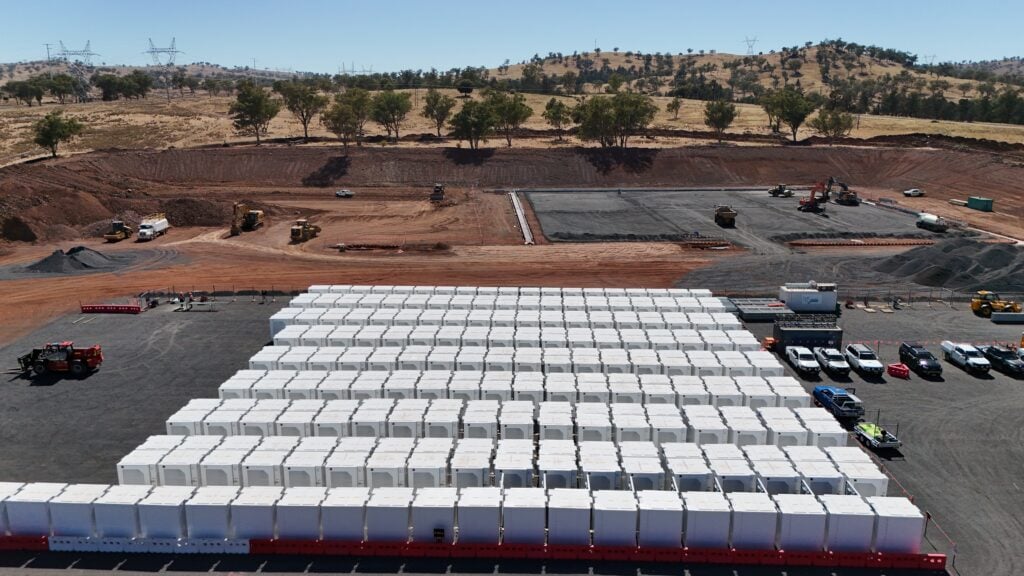
Ausgrid has submitted its 150MW/300MWh Berkeley Vale Battery Energy Storage System (BESS) to the Australian government’s Environment Protection and Biodiversity Conservation (EPBC) Act for federal environmental assessment.
The project involves installing a BESS adjacent to Ausgrid’s existing Berkeley Vale Zone Substation. It is classified as a New South Wales State Significant Development (SSD).
The facility will have a maximum power output of 150MW with a 2-hour duration, equating to 300MWh of storage capacity, and will connect to the substation via a 33kV underground cable.
Supporting infrastructure will include containerised battery units, inverters, medium-voltage transformers, a combined switch room and control room, an on-site workshop, a backup diesel generator, fire suppression, stormwater management systems, security fencing and CCTV.
Try Premium for just $1
- Full premium access for the first month at only $1
- Converts to an annual rate after 30 days unless cancelled
- Cancel anytime during the trial period
Premium Benefits
- Expert industry analysis and interviews
- Digital access to PV Tech Power journal
- Exclusive event discounts
Or get the full Premium subscription right away
Or continue reading this article for free
The total site spans 2.25 hectares and will require the clearing of 1.55 hectares of native vegetation. Once operational, the facility will store electricity from the grid, release it during periods of high demand, and provide ancillary services to the National Electricity Market (NEM).
As with Ausgrid’s other network BESS proposals, the project is intended to be built and operated by a third party on the network operator’s behalf.
New South Wales’ battery storage pipeline grows
The Berkeley Vale BESS submission is the latest in a series of network-connected battery storage projects Ausgrid has been advancing across New South Wales.
In March 2026, the NSW Independent Planning Commission (IPC) approved the 200MW/400MWh Steel River East BESS, located within an existing 132kV substation in Mayfield West in the Hunter and Central Coast Renewable Energy Zone (REZ).
The approval came despite 61 public objections, with the IPC finding the AU$208 million (US$149 million) project would contribute positively to the New South Wales energy transition.
Ausgrid is also pursuing a second 200MW/400MWh system at Homebush in western Sydney, currently in the planning process.
The Berkeley Vale facility would sit on the New South Wales Central Coast region, outside but proximate to the Hunter and Central Coast REZ.
The EPBC Act referral places the Berkeley Vale BESS in a growing queue of battery storage developments in new South Wales seeking federal environmental clearance.
BW ESS recently submitted its 700MW Bannaby BESS in New South Wales’ Upper Lachlan Shire to the EPBC Act.
The accumulation of EPBC Act referrals across New South Wales coincides with an increasing shortfall between the state’s storage targets and the contracted capacity to date.
New South Wales now requires 56GWh of energy storage by 2030, representing a 40% increase from the 40GWh projected in mid-2025, according to Paul Peters, CEO of the Energy Security Corporation, speaking at the Energy Storage Summit Australia 2026 in March.
Interested in Australia? Read Energy-Storage.news’ Energy Storage Summit Australia coverage and related content.