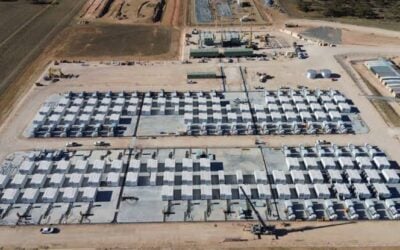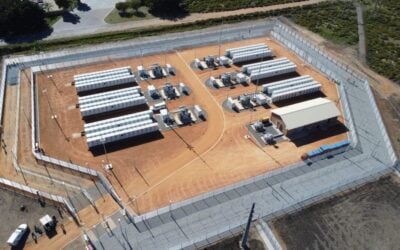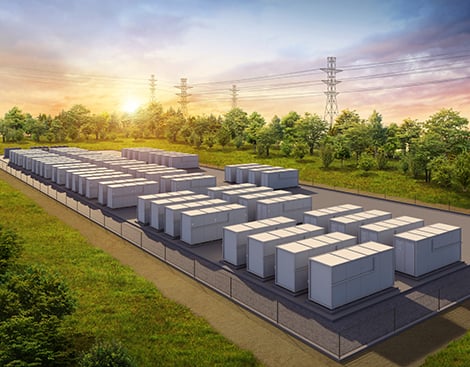
A joint venture (JV) in Japan between financial services group Orix and regional utility company Kansai Electric (KEPCO) will build and operate a large-scale battery storage system.
Orix said last week that the JV is preparing to begin construction this August of the 48MW/113MWh battery energy storage system (BESS) project, to be in operation by 2024.
The announcement comes ahead of rule changes in the Electricity Business Act which governs Japan’s electricity sector, through which grid-connected BESS assets of 10MW or higher output will be eligible from next year to register as generation resources for participation in trading opportunities like day-ahead markets.
In January, Japanese news outlet Nikkei reported that numerous large corporate entities are preparing a play for market share in the battery storage space as it emerges.
Try Premium for just $1
- Full premium access for the first month at only $1
- Converts to an annual rate after 30 days unless cancelled
- Cancel anytime during the trial period
Premium Benefits
- Expert industry analysis and interviews
- Digital access to PV Tech Power journal
- Exclusive event discounts
Or get the full Premium subscription right away
Or continue reading this article for free
To date, the country has one of the largest residential battery markets for backup power and solar self-consumption in the world, and commercial and industrial (C&I) systems for peak shaving are increasingly popular too.
However, interest in large-scale batteries has not really progressed beyond the pilot stage, except in the northern island region of Hokkaido, where an excess of renewable energy installations means solar PV and wind project developers must add storage to their projects under the rules of that region’s monopoly utility Hokkaido Electric Power.
Reforms to the market via the Electricity Business Act could change this landscape considerably. Japan has also raised its target for adding renewables to its energy mix to be 36%-38% of power supply by 2030. This still lags behind many other countries’ targets but is a significant increase from a previous target of 22%-24%, while longer term, Japan has committed to net zero emissions by 2050.
Nikkei noted in its January article that Orix owns a 20% stake in US geothermal power producer Ormat Technologies. Ormat has recently diversified into other energy technologies including energy storage. There was no mention of the US company in Orix’s statement last week including whether it would provide equipment or services to the JV’s project.
The Orix-KEPCO 50:50 JV is called Kinokawa Energy Storage. KEPCO is one of Japan’s 10 major utility companies. Historically, these utilities have been responsible for everything from generation and supply to transmission and distribution of electricity.
As part of ongoing reforms to liberalise the energy market, these regional monopolies have been broken up, or unbundled – KEPCO for example is now separate from Kansai Transmission & Distribution, which took over the T&D part of its business in 2020.
Kinokawa Energy Storage’s 48MW BESS will be deployed at a Kansai Transmission & Distribution substation Wakayama, the southern prefecture of the Kansai region which also includes the major cities of Osaka and Kobe.
The BESS will absorb power from the grid when there is a surplus, such as at times of abundant solar or wind generation. It will store the electricity and then output to the grid at peak times when it is most needed.
KEPCO will operate the facility while Orix will be in charge of maintenance and asset management.
The pair said that they hoped their JV would be able to contribute to solving issues such as the shortage of electricity supply for use on the grid and the ongoing curtailment of variable renewable energy assets.
Orix has plenty of experience in the renewables sector, having invested in, owned or operated assets in countries including the US, China and Latin America. It is also an investor in Greenko, the Indian renewable energy developer which is marketing dispatchable wind and solar coupled with pumped hydro, and Orix also set up a UK office in 2018.