US nickel-hydrogen battery startup EnerVenue has secured its first commercial order at multi-megawatt-hour scale and opened the factory in China that will fulfil it.
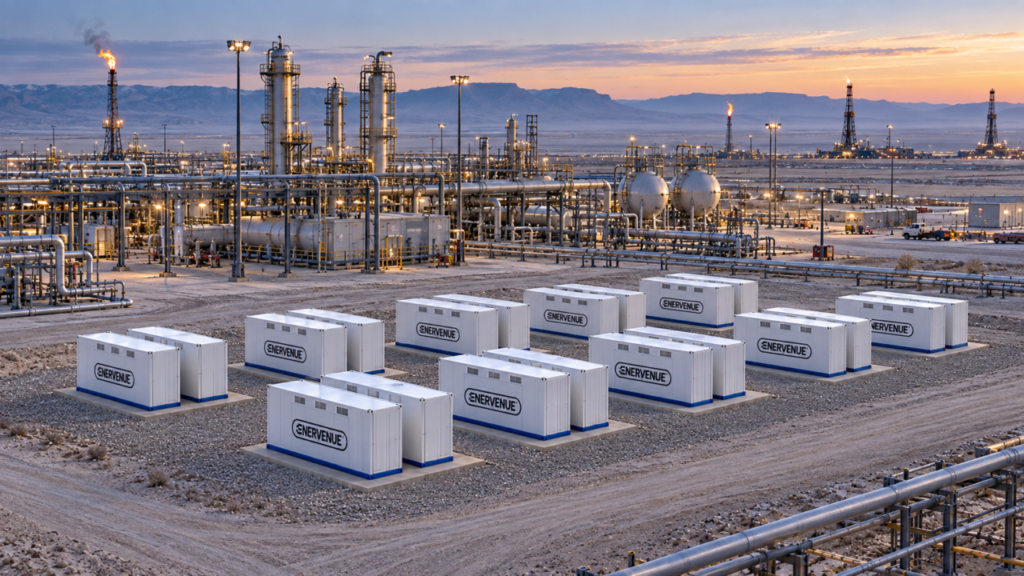
Announced 23 September, EnerVenue is supplying 26 containerised battery energy storage systems (BESS) with a combined capacity of 11MWh to an oilfield in northern China.
The installation will store electricity generated by an onsite solar array at an oil and gas production site operated by a major Chinese producer. The first three BESS units are scheduled for delivery in December 2026, with the remaining 23 units following in March 2027.
Try Premium for just $1
- Full premium access for the first month at only $1
- Converts to an annual rate after 30 days unless cancelled
- Cancel anytime during the trial period
Premium Benefits
- Expert industry analysis and interviews
- Digital access to PV Tech Power journal
- Exclusive event discounts
Or get the full Premium subscription right away
Or continue reading this article for free
The company’s first installation was a 150kWh system integrating renewable generation with electric bus charging at Jintan in Changzhou, which has been operating since November 2025.
According to EnerVenue, the unnamed Chinese gas customer selected its aqueous metal cell (AMC) technology primarily based on fire safety considerations—a critical requirement for oil and gas facilities where fire risk cannot be tolerated.
The company’s battery chemistry uses a water-based, non-flammable electrolyte and contains no lithium. It also has a UL 9540A certification, the industry standard test for battery fire propagation, with no fire propagation at cell level.
The nickel-hydrogen chemistry is derived from technology that powered the Hubble Space Telescope and International Space Station for decades. EnerVenue has re-engineered the chemistry using lower-cost materials for terrestrial applications.
EnerVenue has claimed its AMC is designed for 30,000 charge cycles—equivalent to up to three cycles per day for 30 years— roughly 4 to 6 times higher throughput compared to standard lithium-ion (Li-ion) batteries.
The company stated the cells require no scheduled augmentation across their operational life, whereas Li-ion installations typically require replacement or augmentation every seven to ten years.
The technology also reportedly requires no active cooling and, where local codes permit, no fire suppression system, potentially reducing auxiliary equipment costs. However, these performance claims remain largely unproven at commercial scale.
EnerVenue has undergone notable strategic changes over the past two years as it has worked to commercialise its technology and establish manufacturing capabilities.
The company’s energy storage vessels (ESVs) were purchased for a US storage pilot project by RWE in 2024. The company remained fairly silent after that point, before closing a US$300 million extension of its Series B preferred stock financing round and announcing the appointment of its new CEO, Henning Rath in the first half of 2026.
The cells for the Chinese oilfield project will be produced at EnerVenue’s new manufacturing facility in Changzhou, Jiangsu, which opened on 24 September.
EnerVenue claimed the factory is designed to produce 250MWh of AMC annually in its first phase—approximately 300 cells per day at full automation—with production planned to ramp to 1GWh in 2027 and multi-GWh scale by 2028 as capacity expands.
The company has unveiled four product lines built on the same chemistry: Energy Core (30kWh) for distributed and remote sites; Energy Cube (108kWh) for in-building and data centre applications; Energy Rack (150kWh) for commercial, industrial and grid-connected projects; and Energy Prism for utility and heavy industrial sites.
EnerVenue stated that details of the northern China oilfield project, including the identity of the end user, will be disclosed as the installation progresses.
While unconfirmed, the customer could be The Hong Kong and China Gas Company Limited (Towngas), Hong Kong’s first public utility and one of China’s largest energy suppliers, which owns and operates the electric bus charging-focused project in Changzhou. Towngas also signed a distribution agreement with EnerVenue in 2021, wherein the utility would deploy the AMC technology in its own projects.