
Energy-storage.news Premium speaks with the new CEO of nickel-hydrogen battery company EnerVenue, Henning Rath, about the company’s goals for 2026 and beyond.
The California-based company, which recently closed a US$300 million funding extension, is positioning its Gen 4 battery technology as infrastructure rather than a consumable asset, targeting utility-scale projects, commercial and industrial applications, and increasingly, data centre.
“We rethink batteries not as assets anymore, but more like infrastructure,” Rath told ESN. “We designed a battery that has three times longer lifetime (than lithium-ion cells), roughly 30,000 cycles, 30 years. It is inherently safer, as we do not have any risk of fire or thermal runaway.”
From the Hubble telescope to the grid
EnerVenue’s technology traces its roots to NASA, which developed nickel-hydrogen batteries in the 1980s for use in the International Space Station and the Hubble telescope.
Try Premium for just $1
- Full premium access for the first month at only $1
- Converts to an annual rate after 30 days unless cancelled
- Cancel anytime during the trial period
Premium Benefits
- Expert industry analysis and interviews
- Digital access to PV Tech Power journal
- Exclusive event discounts
Or get the full Premium subscription right away
Or continue reading this article for free
“This technology was chosen because of its temperature stability, safety, and life cycle,” Rath explains. “The Hubble telescope is still flying through space and still cycling.”
However, NASA’s batteries were prohibitively expensive. Rath explains that EnerVenue took the electrochemistry and rebuilt it for commercial viability, adjusting electrodes, introducing a new form factor, and developing manufacturing processes suited to scale production.
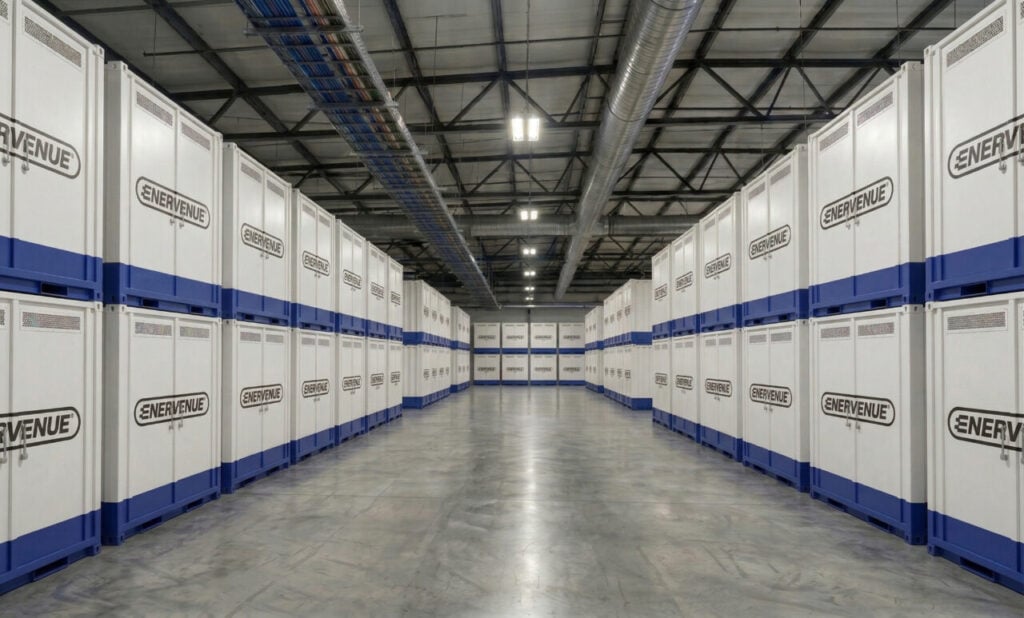
The result is the company’s energy storage vessel (ESV), a roughly two-meter-long steel tank wrapped in composite material, assembled into energy racks and containerised for deployment. The battery operates from minus 20 to plus 60 degrees Celsius.
Addressing fire safety
Rath points to a persistent safety challenge in the industry: “(Lithium-based cells) need to be managed with extreme caution, high effort needs to be placed into thermal management and fire protection.”
That caution, he argues, limits deployment in critical or challenging environments, such as petrochemical plants, data centres, and other applications where fire risk is unacceptable.
“This mixture is something the world needs—that we think of this as infrastructure, as a bridge that lives with us. It doesn’t need attention, but it performs durably and reliably.”
The company’s battery chemistry, made of nickel, steel, and glass fiber composite, also sidesteps lithium and rare earth supply chains, making it “geopolitically independent and manufacturable basically everywhere on the globe,” according to Rath. Though EnerVenue’s first mass manufacturing is going to be in China, as is the case with most of the lithium-ion industry.
Prior to its recent funding announcement, ESN last reported on EnerVenue in 2024, when energy firm RWE purchased the company’s ESVs for a storage pilot project in the US, which was announced to take place at the US arm of RWE’s Milwaukee-area testing facility.
In November of the same year, EnerVenue vacated a manufacturing plant in Shelby County, Kentucky, subsequently bought and occupied by Canadian Solar. A spokesperson for the company said of the decision, at the time, “EnerVenue made the decision to accelerate the development of a fourth generation of its Energy Storage Vessel, rather than bring a prior version to scale.”
In July of 2024, EnerVenue raised US$308 million in venture capital, placing it in research firm Mercom Capital’s top five VC deals for H1 2024. Prior to this, in 2023, the company’s ESV obtained UL1973 certification and completed UL9540A tests.
These events took place under EnerVenue’s previous CEO Jorg Heinemann, who joined in 2020 and stepped down in late 2024, with no replacement officially announced until Rath on 1 April this year (alongside the US$300 million extension). Rath most recently worked as managing director/chief supply chain officer and board member, at German renewable energy equipment company Enpal.
According to Rath, echoing the company’s previous statement, EnerVenue’s relative silence in 2025 wasn’t due to funding challenges or market hesitation, it was a deliberate retreat into R&D.
The company had attempted to commercialise its Generation 2 technology, but it became clear the technology wasn’t ready for scale.
“We put the project on hold and went back to the drawing board,” Rath explains. “We spent two years developing what we now call our Gen 4 technology, improved performance, improved cost curves, and flexibility.”
The RWE pilot, using Gen 2 technology, is still operational. But EnerVenue is now deploying Gen 4 pilots across China, Australia, the US, Europe, and the Middle East, with installations expected online by mid-2026.
Manufacturing strategy
EnerVenue is building its first high-volume manufacturing line in China, where it expects 250MWh of capacity online by the end of Q3 2026, scaling to 1GWh in 2027.
The decision to manufacture in China, despite being an American company headquartered in Fremont, California, is an interesting approach, considering the current geopolitics and supply chain realities of the two countries.
“America, especially Silicon Valley, is still an amazing place for driving innovation. In the same way, China is a very competitive place when it comes to infrastructure, manufacturing, and supply chain capabilities,” Rath notes.
EnerVenue plans to replicate its manufacturing lines in other markets, potentially the US, Europe, and the Middle East, under a “local for local” strategy enabled by the claimed simplicity of its production process.
“Never fight the universe,” Rath says, adding, “The geopolitics is what it is, and companies that adapt most flexibly to the situations will be the companies that thrive in the future.”
By 2028, the company aims to scale into multi-GWh production capacity across multiple geographies, using its local for local approach.
Data centres
While EnerVenue is pursuing utility-scale and commercial and industrial (C&I) markets, the company is particularly focused on data centres, a segment experiencing explosive growth in power demand driven by artificial intelligence and cloud computing.
Industry leaders argue that economic fundamentals favor energy storage deployment as the fastest and most cost-effective solution to meet surging electricity demand, regardless of climate policy changes.
“We see the real necessity for reliable power supply to run the algorithms in the data centres, in combination with the safety aspects of the products. We’re seeing amazing market response and feedback. That’s an area where we want to double-click right now and focus our efforts in the near future,” Rath says.
Data centres represent a use case where EnerVenue’s value proposition, long cycle life, temperature tolerance, and fire safety, aligns closely with operator priorities.
In a 2025 guest blog for Energy-Storage.news, William Derasmo, partner at US law firm Troutman Pepper Locke noted that “Energy storage systems co-located with data centres need to be able to function effectively in more confined surroundings. Innovation is a must, and one solution that developers are exploring with optimism is the vertical stacking of storage containers to make the most of limited floor space.”
As the company emerges from this latest R&D phase with what should be a refined product and a global manufacturing strategy, the question now is whether its chemistry can carve out a meaningful niche in a market still dominated by lithium-ion economics. EnerVenue is betting that in applications where safety and durability outweigh upfront cost, the answer is yes.
