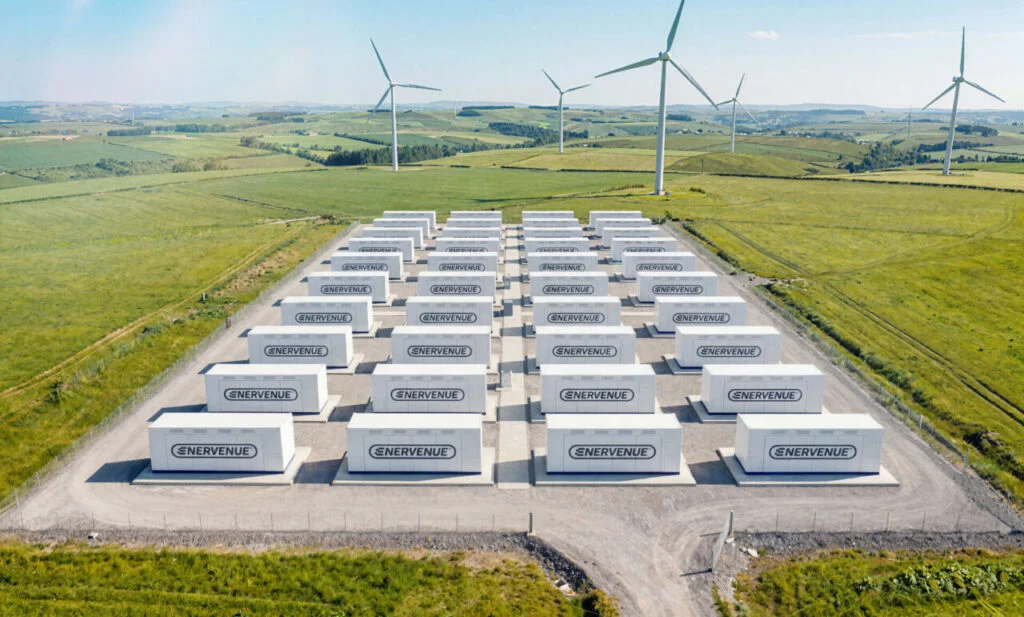
EnerVenue, the US company commercialising technology adapted from nickel-hydrogen batteries, has closed a US$300 million extension of its Series B preferred stock financing round.
The extension round was led by Full Vision Capital and included a new investor. EnerVenue stated that the funding will aid in the rapid expansion of its high-volume manufacturing facilities in Changzhou, China.
EnerVenue claimed that this shift will enable the company to optimise costs, utilise the region’s battery expertise, and serve a growing international customer base more effectively. Additionally, the funding will help speed up supply chain development and expand the company’s commercial reach.
Meanwhile, R&D based in Silicon Valley, California, will concentrate on improving the company’s aqueous metal cells.
Try Premium for just $1
- Full premium access for the first month at only $1
- Converts to an annual rate after 30 days unless cancelled
- Cancel anytime during the trial period
Premium Benefits
- Expert industry analysis and interviews
- Digital access to PV Tech Power journal
- Exclusive event discounts
Or get the full Premium subscription right away
Or continue reading this article for free
EnerVenue’s energy storage vessels (ESVs) employ nickel-hydrogen technology initially developed and utilised by NASA in the 1980s. The company has adapted a more affordable, modified version of this technology, created by Stanford professor Yi Cui in 2017.
EnerVenue asserts that its ESVs can surpass a 30,000-cycle lifespan and operate up to three cycles daily without interruption. This suggests that the technology offers roughly 4 to 6 times higher throughput compared to standard lithium-ion (Li-ion) batteries.
In May 2023, EnerVenue’s metal-hydrogen battery received UL1973 certification and passed UL9540A testing.
The UL1973 standard ensures safety for batteries used in stationary setups, light electric rail (LER), and vehicle auxiliary power. It covers construction requirements and assesses fire resistance, mechanical design, thermal management, and electrical safety.
The UL9540A certification examines the risk of fire from thermal runaway in battery systems. If thermal runaway is possible, the system undergoes testing at increasing intervals to evaluate the risks.
In 2024, the company secured US$308 million in venture capital, ranking among Mercom Capital’s top five VC deals for H1 2024.
Later that same year, energy company RWE purchased EnerVenue’s metal-hydrogen ESVs for a US energy storage pilot project. Announced on 3 December, the project was announced to take place at RWE’s Milwaukee testing facility in the US, where the ESVs would be cycled to assess their performance.
The pilot aimed to validate the ESVs’ cycling flexibility, charge and discharge behaviour, operational duration, temperature performance, and efficiency. The insights gained could lead RWE to adopt the technology for future uses.
EnerVenue also announced the appointment of its new CEO, Henning Rath, alongside the US$300 million extension. Rath most recently worked as Managing Director/Chief Supply Chain Officer, and Board Member, at German renewable energy equipment company Enpal.