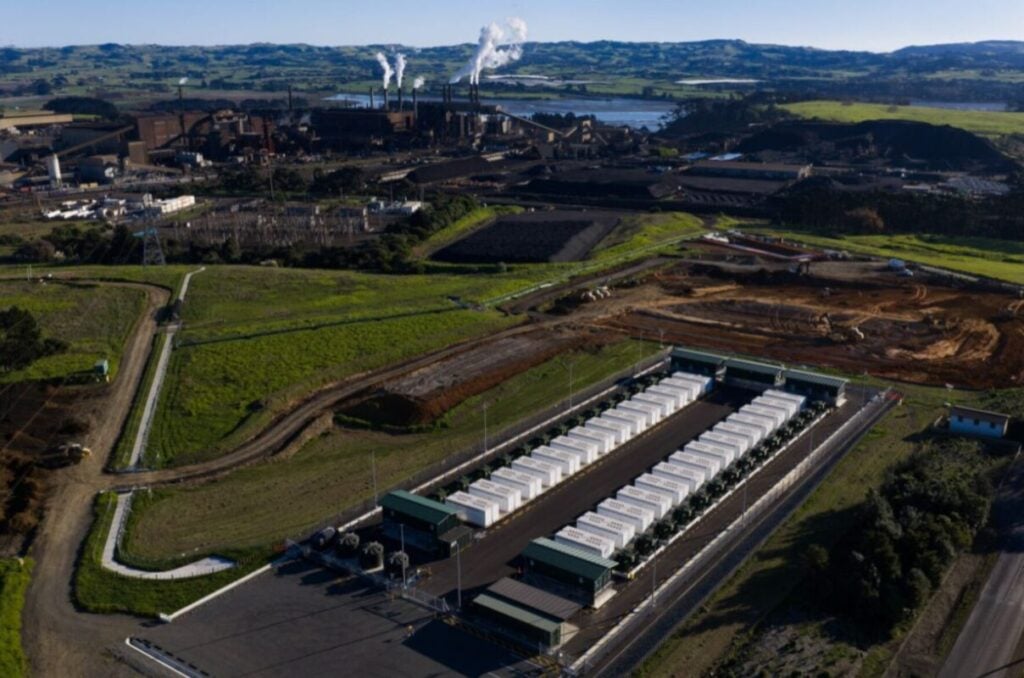
New Zealand gentailer Contact Energy has brought online its first grid-scale battery energy storage system (BESS), a 100MW/200MWh installation at New Zealand Steel’s Glenbrook site in South Auckland.
The Glenbrook Ohurua Battery 1, features 56 Tesla Megapack 2XL units, has a duration of up to 2-hours and can respond to grid signals in 0.2 seconds.
Contact Energy CEO Mike Fuge described the battery storage system as “a bit like the Swiss Army Knife of the electricity system,” capable of storing excess renewable energy generated during off-peak periods and discharging it rapidly when demand spikes.
The system will store electricity from New Zealand’s hydro, geothermal and wind power stations that would otherwise be curtailed, then release it during periods of high demand or unexpected outages.
Try Premium for just $1
- Full premium access for the first month at only $1
- Converts to an annual rate after 30 days unless cancelled
- Cancel anytime during the trial period
Premium Benefits
- Expert industry analysis and interviews
- Digital access to PV Tech Power journal
- Exclusive event discounts
Or get the full Premium subscription right away
Or continue reading this article for free
The project was delivered on time and under budget alongside partners including New Zealand Steel, Tesla, Transpower, Omexom, ABB, Entec, Obertech Group, Worley and ElectroNet Group.
Construction began in July 2024, creating around 50 jobs during the build phase. Tesla is responsible for supply, commissioning and long-term maintenance services for the system, which is the company’s first Megapack 2XL deployment in New Zealand.
Contact Energy has already secured the option to expand the Glenbrook site to 130MW, making it, the company claims, New Zealand’s largest battery storage system.
The company is also advancing Glenbrook Ohurua Battery 2, a separate 200MW/400MWh BESS at the same location, which is expected to be operational by the first quarter of 2028.
That project forms part of Contact’s broader NZ$525 million (US$316 million) equity raise, announced earlier this year, to fast-track its renewable energy and storage pipeline.
The equity raise will also fund the 150MWac Glorit solar PV plant, which is being developed through a 50/50 joint venture with Lightsource bp, and pre-final investment decision drilling for the Tauhara 2 geothermal expansion.
Contact is already progressing the Kōwhai Park solar plant, another 150MWac project with Lightsource bp, which is on track for completion by the second quarter of 2026.
The switch-on comes as New Zealand faces a looming energy security gap. Transpower, the country’s grid operator, has warned that despite a record project pipeline, the country could face supply shortfalls by 2031 without accelerated deployment of generation and storage capacity.
New Zealand’s battery storage market is also gaining momentum, with several developers advancing utility-scale projects.
Genesis Energy recently greenlit what it described as the “lowest-cost grid-scale BESS in the country”, while international developers are also entering the market.