New Zealand’s electricity system is expected to fall below minimum security standards by 2031 despite a record pipeline of new generation and battery energy storage projects, according to Transpower’s draft 2026 Security of Supply Assessment (SOSA).
The assessment, released for industry consultation this week, shows that even if all committed and consented projects likely to proceed are delivered on schedule, the National Winter Energy Margin (NZ-WEM) will drop below the lower security standard by 2031, representing a 698GWh shortfall.
Under Transpower’s “Expected Future” case, which incorporates a lower gas supply forecast reflecting ongoing trends, this breach occurs even earlier by 2030, with shortfalls reaching 734GWh in 2030 and 1,903GWh by 2031.
“Delivery risk is a key issue to manage over the medium-term with security of supply concerns reappearing in the early 2030s even if the existing pipeline of projects that are expected to proceed are delivered on schedule,” said Transpower chief executive James Kilty.
Try Premium for just $1
- Full premium access for the first month at only $1
- Converts to an annual rate after 30 days unless cancelled
- Cancel anytime during the trial period
Premium Benefits
- Expert industry analysis and interviews
- Digital access to PV Tech Power journal
- Exclusive event discounts
Or get the full Premium subscription right away
Or continue reading this article for free
“This means the sector needs to lift the pace of new investment coming online over the medium-term, including committing earlier to new projects, to support increased demand growth and reduce our exposure to risks like lower gas supplies or ageing plant failure.”
The sector is on track to commission more than 1,100MW of generation, battery storage and capacity upgrades this year.
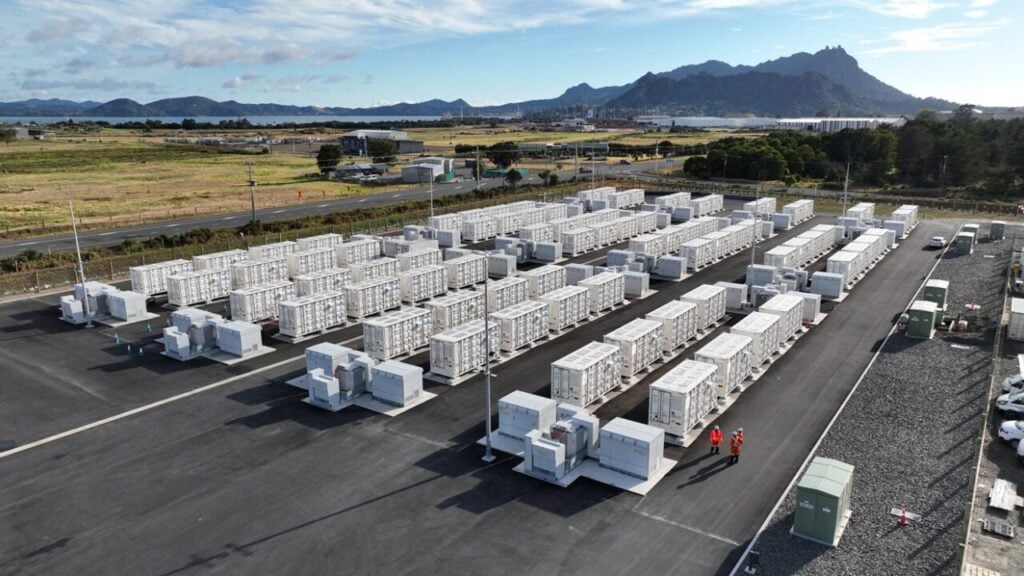
Battery energy storage systems (BESS) are playing an increasingly important role, with Genesis Energy recently greenlighting the lowest-cost grid-scale battery storage project in New Zealand, while Contact Energy is eyeing a US$316 million raise for renewables and energy storage expansion.
Beyond utility-scale projects, a New Zealand port has demonstrated battery storage potential amid the country’s complex tariff landscape, highlighting diverse applications of storage technology.
In the immediate term (2026-2028), the assessment shows that the electricity system is positioned above minimum security standards, but this outlook remains fragile. The NZ-WEM sits below the upper security standard but above the lower threshold of 14%.
Project delays, reduced thermal generation support, faster demand growth, lower gas supply, or weaker wind and solar output could all push margins below acceptable levels.
New Zealand is entering winter 2026 with above-average storage levels in hydro lakes, providing some buffer against immediate risks.
However, challenges persist around potential further reductions in gas supply, reliability concerns with ageing thermal generation infrastructure, and the possibility of prolonged dry conditions similar to those experienced in 2024 and early 2025.
Gas supply decline emerges as a critical challenge
The decline in natural gas availability emerges as a critical thread throughout the assessment.
While the sector has secured additional gas for power generation, partly through reductions in industrial gas consumption due to demand flexibility arrangements, facility exits, and electrification investments, the trajectory remains concerning.
Transpower has introduced a “very low gas supply” sensitivity in this year’s assessment to test system resilience against steeper declines. The government is progressing an initiative to develop LNG import capability, which the assessment models as a sensitivity that would improve gas availability.
However, LNG is assumed to be available only toward the end of the short-term horizon by winter 2028, limiting its near-term impact.
Under the Expected Future scenario with lower gas availability, the South Island Winter Energy Margin (SI-WEM) could fall below the lower security standard of 25.5% by 2031, representing a 942 GWh shortfall.
The North Island Winter Capacity Margin (NI-WCM) remains between the upper and lower standards in the mid-term under the reference case, but faces increasing pressure from higher demand growth and reduced thermal generation availability.
Looking to the long term (2032-2035), the assessment shows margins can remain above upper security standards, but only if the entire pipeline of existing, committed, consented, and planned-to-be-consented projects is delivered without significant delays.
Strong demand growth over the next decade, potentially driven by industrial electrification and data centre development, could cause shortfalls by 2035 even if all planned projects are completed.
The assessment notes that fewer potential new projects appear in the SOSA 2026 supply pipeline than last year, partly reflecting the introduction of a likelihood assessment that excludes projects assessed as having a likelihood of proceeding of less than 75%.
In the short term (2026-2028), the industry must maintain focus on delivering new supply-side projects on time and ensuring thermal fuel supplies and flexible generation assets, including the three Rankine units at Huntly, remain available.
For the mid-term (2029-2031), the sector needs to bring forward additional consent-ready projects and maintain a well-balanced, diverse pipeline of ready-to-build generation that is less vulnerable to weather-dependent risks.
“Last year’s assessment identified emerging risks for electricity supply this winter due largely to the faster-than-expected decline in natural gas availability in recent years,” said Kilty.
“The draft assessment we are now consulting on indicates that the sector has taken a meaningful step toward mitigating these risks with new generation and battery storage systems coming online and efforts to secure additional gas supply.”
Transpower is now seeking feedback on the draft SOSA 2026 report, with the final assessment to be published by 30 June 2026.