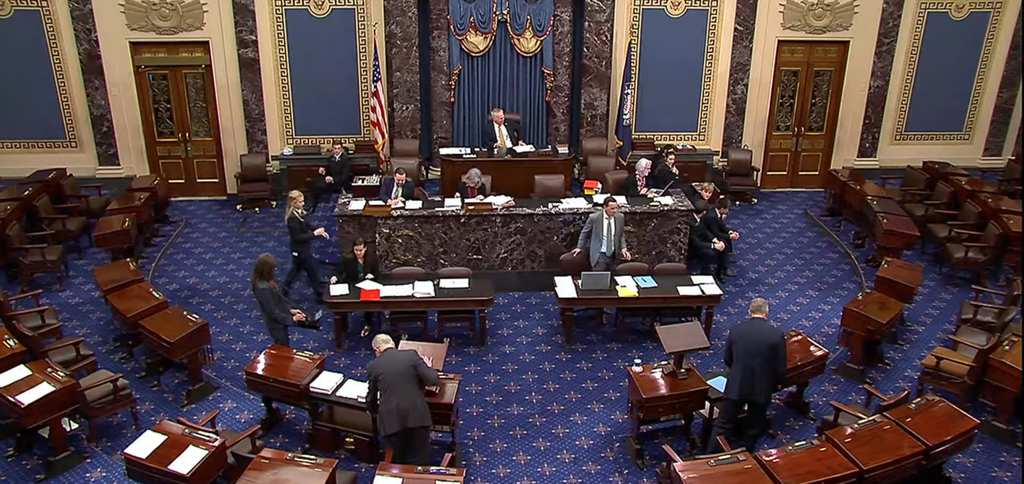
The US Senate has passed the Bipartisan American Affordability and Jobs Act of 2026 (BAAJA), the permitting reform bill that has been a major source of clean energy industry discussion.
The Senate voted on BAAAJA late on 19 November, passing the bill 62-33. 15 Democrats, including the embattled John Fetterman of Pennsylvania and New York’s Chuck Schumer, joined all but two Republicans in voting Yea for the bill’s passage.
The bill now faces a vote in the House, where, if passed, it would go to President Donald Trump to either sign or veto, though the White House has backed BAAJA.
Introduced on 30 September by leaders of the Senate Environment and Public Works and Energy and Natural Resources Committees, the bill aims to accelerate approval of US energy, transmission, and infrastructure projects.
Try Premium for just $1
- Full premium access for the first month at only $1
- Converts to an annual rate after 30 days unless cancelled
- Cancel anytime during the trial period
Premium Benefits
- Expert industry analysis and interviews
- Digital access to PV Tech Power journal
- Exclusive event discounts
Or get the full Premium subscription right away
Or continue reading this article for free
It would amend the National Environmental Policy Act (NEPA), the Clean Water Act, the Endangered Species Act, and the National Historic Preservation Act (NHPA) to shorten reviews and reduce federal delays.
It would also give the Federal Energy Regulatory Commission (FERC) federal backstop authority over major interstate transmission lines, require 20-year transmission plans, and require high-energy data centres to pay the full cost of power delivery and grid upgrades.
Tim Pawlenty, CEO of the Solar Energy Industries Association (SEIA), who also spoke on the bill at RE+ in Las Vegas, Nevada, last week, credited senators Lee, Capito, Heinrich, and Whitehouse for advancing the BAAJA, calling the Senate’s passage a step toward “lower energy costs, more clean energy and a more reliable electric grid.”
SEIA analysis suggests BAAJA could unlock 167GW of additional solar capacity between 2028 and 2035, pushing solar past 18% of US electricity generation by 2035, while cutting cumulative power sector CO2 emissions by roughly 20% and avoiding an estimated US$54 billion in public health damages.
Oil and gas lobbying group Independent Petroleum Association of America (IPAA) welcomed the Senate vote as well, urging the House to take up and pass the bill “upon returning from Thanksgiving recess,” arguing it would deliver “needed certainty for independent producers across the country.”
Opposition has sharpened following passage. Environmental advocacy non-profit Delaware Riverkeeper Network criticised the timing of the vote, calling attention to the bill’s advancement during a lame-duck session, and argued that while BAAJA is framed as a vehicle to streamline fossil fuel development, data centres, and grid reforms, it “takes a hammer to bedrock environmental protection laws” including NEPA, the Clean Water Act, NHPA, and the Endangered Species Act.
The group also warned that the bill would curb the authority of courts, agencies, states, and Tribes to enforce regulations or to challenge construction projects, with many projects potentially exempt from consideration of impacts on wildlife, climate change, or flooding.
The bill’s path through the House remains uncertain. Some senior Democrats have expressed interest in rewriting it from scratch—a move industry figures warn could delay or derail the reforms developers are counting on to ease interconnection bottlenecks.
Currently, no date has been set for a vote in the House, but it is expected to be scheduled after the week of Thanksgiving (26 November).