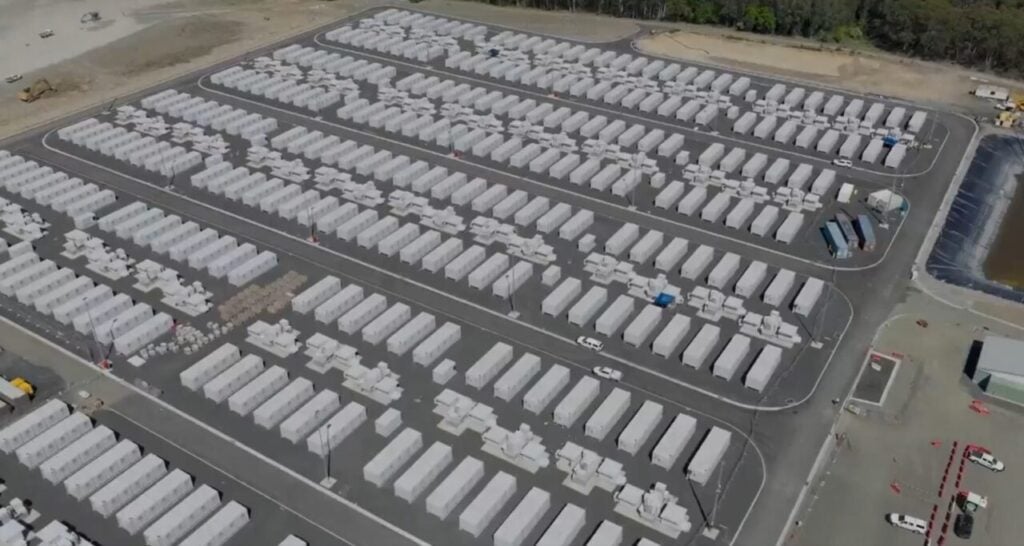
Australia’s 58 grid-scale battery storage systems in the National Electricity Market (NEM) generated a combined AU$28.79 million (US$19.02 million) in estimated gross energy and Frequency Control Ancillary Services (FCAS) revenue in August 2026.
This is according to NEMPulse, a platform that tracks battery storage dispatch and revenue across the NEM using publicly available Australian Energy Market Operator (AEMO) data.
Total revenue rose 6% from July’s AU$27.22 million, though earnings normalised for fleet growth and time, at AU$103/MW/day, fell 4% over the same period.
NEMPulse attributed the divergence to continued additions to the fleet’s active capacity, which reached 8,983MW and 21,539MWh by the end of August.
Try Premium for just $1
- Full premium access for the first month at only $1
- Converts to an annual rate after 30 days unless cancelled
- Cancel anytime during the trial period
Premium Benefits
- Expert industry analysis and interviews
- Digital access to PV Tech Power journal
- Exclusive event discounts
Or get the full Premium subscription right away
Or continue reading this article for free
Energy arbitrage supplied 97% of total revenue, with FCAS contributing 2% and estimated Frequency Performance Payments the remaining 1%. Within FCAS, regulation services accounted for 81% of that segment’s revenue, with raise regulation the single largest market at AU$327,000.
The fleet’s overall capture rate, the share of revenue actually earned compared with what a perfect-foresight trading strategy would have achieved, improved from 48% in July to 54% in August, though this still left an estimated AU$23.35 million on the table across the month.
NEMPulse’s data shows performance varied sharply across individual assets: Limondale Battery led on energy capture at 81%, followed by Woolooga BESS at 77% and Supernode BESS at 76%, while Bulgana Green Power Hub, Phillip Island BESS and Pine Lodge BESS recorded capture rates of 5%, 0% and -10% respectively.
NEMPulse noted that low capture figures reflect contracting structures and operational constraints as much as trading performance, a nuance consistent with findings that Australia’s battery storage contracts have shifted away from rigid physical tolling arrangements toward more commoditised, interchangeable products that can constrain how freely an asset trades on the open market.
Trading conditions tighten as spreads narrow across the NEM
The average daily price spread across the NEM’s five regions, calculated as the top two hours minus the bottom two hours, fell 27% from the previous period to AU$110/MWh in August, with the highest spot price of the month reaching AU$450/MWh.
That compression reflects a broader pattern flagged across the sector this year: panellists at the Battery Asset Management Summit Australia 2026 in Sydney last month said battery storage investors are feeling the pinch as arbitrage spreads narrow across the NEM, with some attributing the squeeze to coal closures being delayed beyond original business case timelines.
Revenue per MW varied by battery storage duration class, with 4-hour-plus systems earning AU$6,141/MW, more than double the AU$2,822/MW recorded by 2-hour systems and well ahead of 1-hour and 3-hour assets at AU$1,225/MW and AU$1,035/MW respectively, underlining the premium longer-duration battery storage systems continue to command in energy arbitrage.
Queensland led all regions on total revenue at AU$11.30 million across 15 battery storage systems, followed by New South Wales at AU$9.45 million across 16 battery storage systems, Victoria at AU$5.66 million across 14 battery storage systems, and South Australia at AU$2.38 million across 13 BESS.
The top three individual earners for the month were Eraring BESS at AU$3.03 million, Orana BESS at AU$2.36 million and Supernode BESS at AU$2.33 million, with Eraring BESS 2 recording its first month of market revenue after adding 240MW of earning capacity to the fleet.
Revenue generation remained concentrated around a small number of high-value trading days, with five of August’s 31 days accounting for 29% of total fleet earnings.
The strongest single day was 5 August, when the fleet earned AU$1.98 million, with Orana BESS recording the best individual battery-day performance at AU$272,000.
The only significant price event NEMPulse recorded during the period was a negative pricing episode in South Australia, which reached -AU$497/MWh.
Growing pipeline builds on a global deployment surge, with regulatory scrutiny sharpening
August’s revenue data follows a period of rapid fleet expansion both in Australia and globally.
Global large-scale battery storage deployment reached 18GWh in July 2026 alone, taking the year-to-date total to 154GWh, up 27% year-on-year according to Benchmark Mineral Intelligence, with Oceania’s contribution driven largely by the 1GWh second stage of Quinbrook’s Supernode BESS, one of August’s top three revenue earners.
That expansion mirrors dynamics described by Wärtsilä senior strategy lead Kashish Shah, who told ESN Premium that Australia’s energy-only market structure and price volatility make it “a market made for batteries” relative to other markets in the Asia-Pacific region.
That growth has coincided with closer regulatory scrutiny of how battery storage assets bid into the market.
In Western Australia, energy company Synergy was fined AU$1.2 million after a software error caused its Kwinana battery energy storage system to submit inflated price offers into the state’s Wholesale Electricity Market, an episode the state’s Economic Regulation Authority said increased wholesale energy costs by an estimated AU$9.5 million over an eight-month period.
Alongside separate June 2026 figures showing Australia’s grid-scale battery fleet generated AU$17.98 million with revenue capture reaching 32% that month, the improvement to 54% capture recorded in August points to a fleet whose collective trading performance continues to shift month to month, shaped as much by contracting structures, new capacity additions and market volatility as by any single technology upgrade.
Never miss an Australian energy storage story. Sign up for our Australia newsletter and get the latest project announcements, policy updates and market analysis delivered directly to you.