The Clean Energy Finance Corporation (CEFC), the Australian federal government’s green bank, committed a record AU$9.1 billion (US$6 billion) in the financial year to 30 June 2026.
In doing so, this has helped drive AU$19.6 billion in total transaction value and lifted its lifetime tally of catalysed clean energy project value to AU$105 billion since inception.
The CEFC made 45 new transactions during the year, with every dollar committed attracting an additional AU$3.40 from co-investors. Lifetime capital leverage since the CEFC’s establishment stands at AU$3.54 for every dollar committed.
Outgoing CEFC chief executive Ian Learmonth, who will step down in September 2026 after nearly a decade in the role, said the year had demonstrated that Australia’s clean energy transition had moved from ambition to execution.
Try Premium for just $1
- Full premium access for the first month at only $1
- Converts to an annual rate after 30 days unless cancelled
- Cancel anytime during the trial period
Premium Benefits
- Expert industry analysis and interviews
- Digital access to PV Tech Power journal
- Exclusive event discounts
Or get the full Premium subscription right away
Or continue reading this article for free
“The past year has been a defining one for Australia’s transition to net zero. Global energy markets have again highlighted the importance of reducing our reliance on fossil fuels and accelerating the shift to clean, renewable energy and electrified transport,” he said.
“While emissions reduction remains at the heart of the CEFC mission, recent events have reinforced that the clean energy transition is also about reducing costs, building a stronger, more resilient economy, improving energy security and creating long-term economic opportunity.”
Learmonth’s successor, Paul McCartney, takes over as chief executive on 18 September 2026.
The FY26 result follows a prior record set in FY25. In the 12 months to 30 June 2025, the CEFC committed AU$4.7 billion (US$3.1 billion) to large-scale renewables, energy storage and transmission projects, a figure 2.5 times higher than FY24, driven by the HumeLink transmission commitment and an AU$1.4 billion finance package supporting Neoen’s Australian portfolio.
The FY26 figure of AU$9.1 billion represents a further doubling of that record within a single year.
The Rewiring the Nation (RTN) Fund, the CEFC’s dedicated programme for grid modernisation, accounted for AU$7.2 billion of FY26 commitments, reflecting the scale of transmission infrastructure required to connect Australia’s renewable energy generation resources to demand centres as coal-fired power stations retire.
The fund’s largest FY26 commitment was AU$3.8 billion to Stage 1 of the Marinus Link interconnector, a 750MW high-voltage direct current undersea cable between north-west Tasmania and Victoria’s Latrobe Valley.
As Energy-Storage.news reported when the commitment was made, the Marinus Link financing was the CEFC’s largest single investment commitment at that time, expected to deliver AU$900 million in consumer benefits during the first five years of operation and reduce transmission-related consumer costs by around 45% in that period.
The RTN Fund also committed AU$1.2 billion to Stage 1 of North West Transmission Developments, which consists of complementary infrastructure within Tasmania that will increase transfer capacity and connect with Marinus Link. This is forecast to reduce project-related network charges by around 55% over the life of the project and deliver an estimated AU$315 million in benefits to Tasmanian electricity consumers in the first five years.
Storage and renewables within the general portfolio
Outside the RTN Fund, the CEFC’s general portfolio committed AU$1.7 billion across 23 new and six follow-on transactions in FY26.
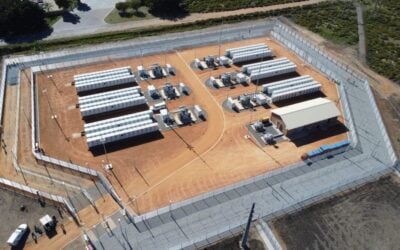
Within that, the CEFC financed more than AU$340 million of large-scale renewables and storage projects representing 1.2GW of renewable energy capacity added to the grid.
The storage financing sits within a market that is evolving rapidly. Lenders to Australian battery storage projects have noted that the merchant risk environment has required new approaches to underwriting, with arbitrage revenue spreads compressing as installed capacity has scaled.
The CEFC’s role as a concessional lender gives it a different risk tolerance from commercial banks and allows it to support projects at earlier stages of the financing process or in configurations where merchant risk exposure would otherwise deter conventional capital.
The CEFC’s own analysis of the Capacity Investment Scheme (CIS) has identified structural gaps in how long-duration storage is supported.
As Energy-Storage.news has reported, the CEFC argued that the CIS as structured needs changes to adequately support long-duration storage, noting that the current framework’s contract design and revenue certainty provisions are better suited to 2-to-4-hour lithium-ion systems than to projects with 8-hour or longer durations, where capital costs are higher and the revenue case is more complex.
The general portfolio also covered a wide range of sectors beyond storage and generation.
The Household Energy Upgrades Fund reached AU$535 million in commitments since inception, supporting more than AU$1 billion in discounted lending programmes for Australian households, with CEFC-cited modelling suggesting HEUF customers are saving up to 85% on energy bills.
Electric vehicle (EV) financing since inception has covered more than 23,000 vehicles exceeding AU$1.4 billion in total value. Some 22,000 smaller-scale clean energy projects received support through more than AU$800 million in CEFC and third-party capital.
The CEFC also launched a capital recycling initiative during FY26, cornerstoning a new Australian Ethical investment fund through the transfer of selected CEFC assets, a structure designed to free up capital for new commitments while maintaining exposure to the underlying clean energy assets.