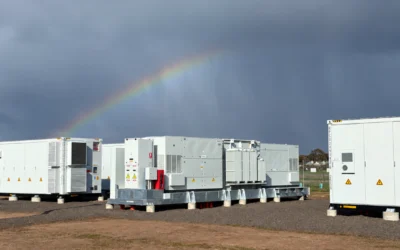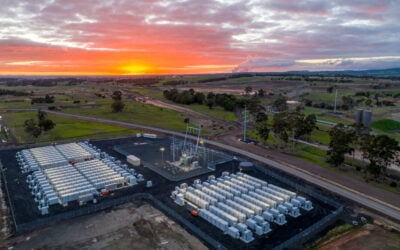
Australia’s biggest utility AGL, which has committed to phasing out coal by 2050, has said it is likely to replace the capacity provided by one ageing power station with batteries, peaking plants, demand response and pumped hydro.
The utility made the announcement at the same time as saying it will spend US$2 billion across networks to “build new energy supply” and is doing its best to create tariffs and customer offers that are simple and offer long-term value.
In a recent blog, AGL CEO Andy Vesey outlined that in his view, with 75% of Australia’s thermal generation plants already being in use “past their use-by-date”, investors in the energy sector were clear that the cheapest sources of electricity in Australia will be renewables backed with energy storage.
This morning, AGL and Vesey put out a release outlining that following meetings with the country’s government including the Prime Minister Malcom Turnbull, AGL remains intent on shutting down Liddell, a coal-fired power station in its service area, by 2022. The utility will produce a plan for Liddell’s closure within 90 days.
Try Premium for just $1
- Full premium access for the first month at only $1
- Converts to an annual rate after 30 days unless cancelled
- Cancel anytime during the trial period
Premium Benefits
- Expert industry analysis and interviews
- Digital access to PV Tech Power journal
- Exclusive event discounts
Or get the full Premium subscription right away
Or continue reading this article for free
Originally, the government had asked AGL to consider continuing to operate Liddell for five years beyond that date, or to consider selling the power station off. However in a statement to the Australian Stock Exchange (ASX) last week, AGL said neither option had been adopted by its board.
“AGL will continue to engage with governments, regulators and other stakeholders to deliver appropriate outcomes but notes that the company has made no commitment to sell the Liddell Power Station nor to extend its life beyond 2022,” the statement to ASX said.
Long-term planning to give market some certainty over carbon risk
Vesey made the point that AGL has done its best to not make any sudden moves on shuttering its fossil fuel plants. The company actually gave advance notice of Liddell’s closure in 2015 and Vesey said the “long notice period given reflects our commitment to managing carbon risk for shareholders and avoiding the volatility created by recent sudden withdrawal of capacity.”
AGL has actually only owned the Liddell plant since 2015 itself, but the power station has proved problematic. Having bought the plant from the government of New South Wales that year, AGL has had to lay out some AU$123 million investment in improving its reliability. The plant was then responsible for some of South Australia’s blackouts in February this year, when some boiler tubes leaked and the plant had to go offline.
‘Rehabilitating’ the four units that make up 1,680MW of generation capacity at Liddell and Bayswater, another coal plant, would cost AGL AU$898 million, the company said. The power station was built and commissioned between 1971 and 1973 and produces about 8,000GWh of energy annually. AGL CEO Andy Vesey said coal was now simply too expensive, even before environmental costs had been factored in. While natural gas might pick up the slack in the short term, he put forward the view that renewables and batteries will be doing the bulk of the heavy lifting before long.
“Short term, new development will continue to favour renewables supported by gas peaking. Longer term, we see this trend continuing with large scale battery deployment enhancing the value of renewable technology. In this environment, we just don’t see new development of coal as economically rational, even before factoring in a carbon cost.”
A May 2017 report by the Australian government’s scientific R&D agency CSIRO and Energy Networks Australia (ENA) said distributed energy technologies such as solar and battery-based storage could save Australia AU$101 billion (US$75 billion) by 2050 and eliminate greenhouse gas emissions
While much has been made of recent large-scale energy storage project announcements such as Tesla-Neoen’s South Australia contract, AGL was the first utility in Australia to trial the use of aggregated residential energy storage systems for balancing the grid as a virtual power plant at scale. US maker Sunverge supplied those units.
In a recent presentation, AGL CFO Brett Redman said that all the signs are pointing towards a low carbon future for Australia, in which “growth in renewables long-term depends on growth in storage”, where long duration load-shifting will overtake capacity firming as a key application for energy storage. Redman also said “new market rules [will be] needed once electricity is storable”.