Distributed energy technologies such as solar and battery-based storage could save Australia AU$101 billion (US$75 billion) by 2050 and completely eliminate greenhouse gas emissions, according to a new report from the government’s scientific R&D agency CSIRO and Energy Networks Australia (ENA).
The release named ‘Electricity Network transformation Roadmap: Final Report’ also details how individual households could save AU$414 every year on average by combining solar and batteries. If a clear roadmap is followed, then network charges could also be 30% lower.
ENA aims to guide Australia’s energy transition for the next 10 years up to 2027, with an expectation of a step change in renewable energy uptake as costs fall. The nation is already in the midst of a major large-scale solar surge with multiple projects under construction. It has also been a global frontrunner in terms of rooftop solar penetration for many years, despite some slowdowns.
The report stated: “The agility with which networks connect, integrate and incentivise new, lower carbon energy choices will directly influence the cost, fairness, security and reliability of the electricity system for customers.”
Try Premium for just $1
- Full premium access for the first month at only $1
- Converts to an annual rate after 30 days unless cancelled
- Cancel anytime during the trial period
Premium Benefits
- Expert industry analysis and interviews
- Digital access to PV Tech Power journal
- Exclusive event discounts
Or get the full Premium subscription right away
Or continue reading this article for free
It went on to call for technical standards as well as urgent regulatory and policy changes to help the integration of distributed energy resources, standalone systems and micro-grids.
The expectations are for more than 40% of customers to use onsite energy resources by 2027, totalling 29GW solar and 34GWh of batteries. By this stage, networks will provide incentives for standalone systems and micro-grids that stay connected to the grid. Networks will also pay for the organisation of distributed generation systems to be able to provide grid support when needed. The coutry has already paved the way for aggregation of stroage systems. For example, in March, Australian firm AGL commissioned the first phase of what it claimed to be the world’s largest virtual power plant (VPP).
The report then forecast that by 2050 nearly two thirds of customers could have distributed generation systems.
The roadmap also noted that each individual state has a unique market. It therefore forecast how each state may perform in terms of deployment in the run up to 2050.
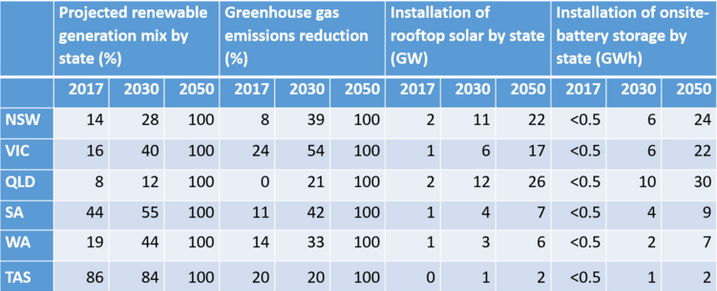
Purely in terms of capacity, Queensland looks set to have the highest solar and storage deployment, but GHG emissions are still potentially brought down to zero in each state by 2050.
Energy Networks Australia also recently released a database of projects involving integration of renewable energy into the grid in order to help collaboration between the renewables industry and grid operators in Australia.
The Clean Energy Regulator also revealed today that investment in Australian renewables was at a record high in 2016. The Clean Energy Council has also reported further record investments in the last three months.