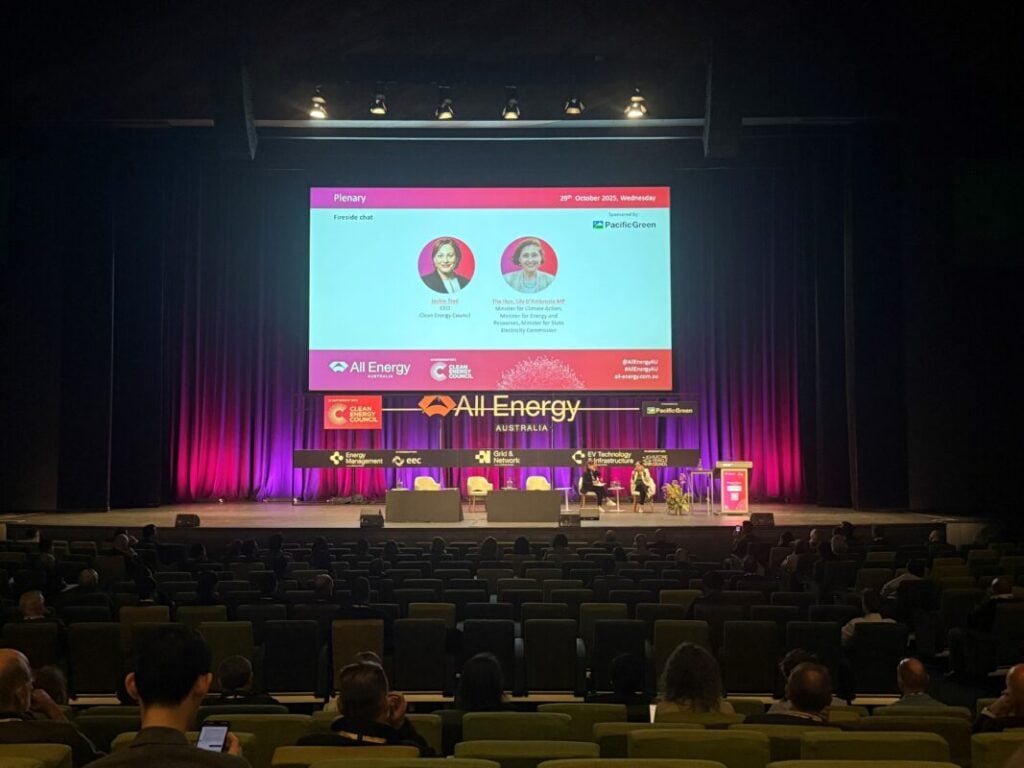
Victoria’s home battery energy storage programme has supported the installation of approximately 20,000 residential energy storage systems, doubling its original target of 10,000 units, according to the state’s climate action minister, Lily D’Ambrosio.
Addressing the audience at All-Energy Australia 2025, D’Ambrosio said the state programme has now been replaced by the federal government’s Cheaper Home Batteries Program, which has received more than 100,000 (2GWh) applications since its launch.
D’Ambrosio, Australia’s longest-serving climate change and energy minister, outlined Victoria’s approach to residential energy storage during a fireside chat at the conference.
“I really do commend the Commonwealth government for this initiative, because you can see that people are hungry for it, and that’s reflected in the uptake figure,” she said, referring to the federal programme’s strong application numbers.
Try Premium for just $1
- Full premium access for the first month at only $1
- Converts to an annual rate after 30 days unless cancelled
- Cancel anytime during the trial period
Premium Benefits
- Expert industry analysis and interviews
- Digital access to PV Tech Power journal
- Exclusive event discounts
Or get the full Premium subscription right away
Or continue reading this article for free
The minister emphasised the sequential nature of residential energy technology adoption, explaining that solar PV systems had to establish the market foundation before battery storage could flourish.
“The role of solar PV has been really important for people, and the uptake of solar PV in the home has had to be the forerunner. Now people want to go to that next step of being able to have even greater control of the energy,” D’Ambrosio stated.
Victoria’s experience with residential battery energy storage deployment revealed multiple drivers for consumer adoption beyond simple cost savings. The minister identified energy security as a significant factor, explaining that climate change has increased the frequency of disruptive weather events.
“We’re seeing with climate change, there are so many more storm events, so many more massive wind events, so many bushfires. That can actually lead to significant and long disruptions to the energy supply, and people are looking to battery systems as a way to give them that extra security,” she said.
According to D’Ambrosio, the technology addresses multiple consumer concerns simultaneously. For instance, battery storage systems provide “even greater control of the energy, not just in terms of the production of it, but the flexibility around how to use it, how to store it, how to use it at the time that minimises your energy costs.”
She described home battery technology as “the next technology piece that addresses so many different consumer concerns.”
Victoria’s broader renewable energy transformation provides context for the battery storage programme’s success. In the most recent financial year, the state achieved 42.4% of electricity generation from renewable energy sources, a dramatic increase from the baseline when the current government took office.
“When we were elected, less than 11% of electricity came from renewable energy sources. It’s been a massive, massive jump,” D’Ambrosio noted.
The minister outlined Victoria’s approach to the energy transition, describing it as requiring both speed and endurance. “This transition is a long transition, but it’s a sprint every day, and will be for years to come,” she explained.
The state’s renewable energy strategy includes legislative targets that D’Ambrosio believes Victoria was “the first jurisdiction to do that” before describing them as “ambitious but doable”.
Regarding the transition from state to federal home battery storage system support, D’Ambrosio indicated that Victoria achieved its programme objectives before transferring responsibility.
“Regarding Victoria, when we did roll out the home batteries programme, we aimed for 10,000. We ended up supporting the installation of about 20,000 of those. And we’re really pleased now that the Commonwealth government scheme has now been able to replace our scheme,” she said.
The Victorian government continues to explore optimisation opportunities for battery support even after transitioning primary responsibility to the federal scheme.
“We continue to look for ways to optimise further the support around that for Victorians,” D’Ambrosio stated, suggesting ongoing state-level initiatives may complement federal programmes.