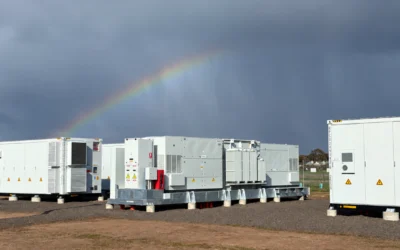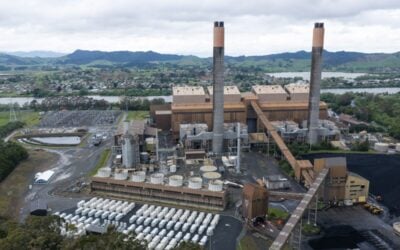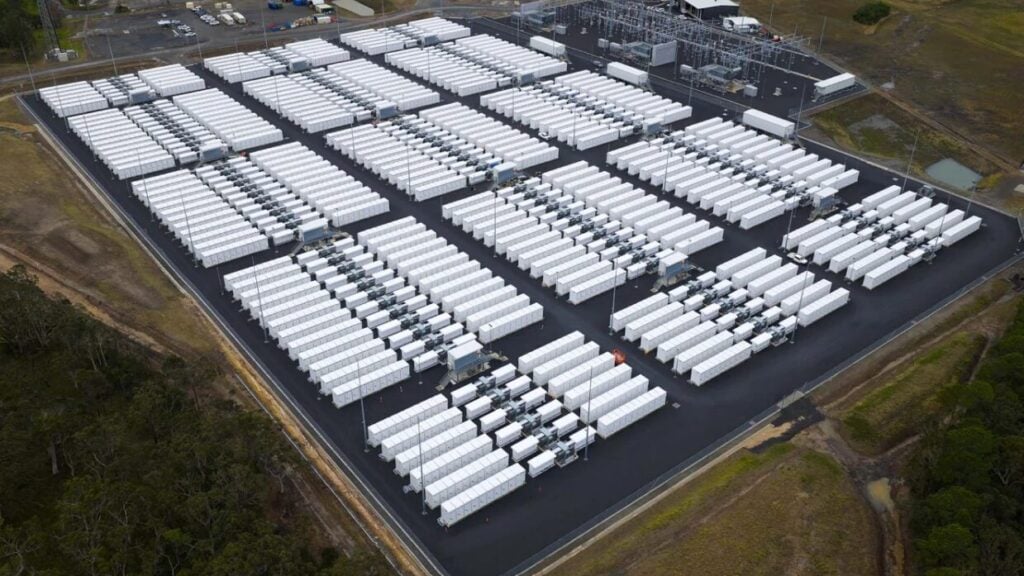
Akaysha Energy’s Waratah Super Battery in Australia briefly reached its full rated output of 850MW on 7 September for the first time since the “catastrophic failure” of its High Voltage Transformer 3 (HVT3), according to data from Open Electricity (formerly OpenNEM).
Two days later, on 9 September, the facility discharged 701MW at 10:15am, a figure consistent with a test of its System Integrity Protection Scheme (SIPS) service to Transgrid at its full contracted level.
Waratah Super Battery is located at the site of the former Munmorah coal-fired power station near Budgewoi, New South Wales, and is owned and operated by Akaysha Energy, a battery storage developer backed by global investment firm BlackRock.
The facility was designed as a SIPS asset under contract to transmission operator Transgrid, functioning as what Akaysha has described as a “giant shock-absorber” for the grid.
Try Premium for just $1
- Full premium access for the first month at only $1
- Converts to an annual rate after 30 days unless cancelled
- Cancel anytime during the trial period
Premium Benefits
- Expert industry analysis and interviews
- Digital access to PV Tech Power journal
- Exclusive event discounts
Or get the full Premium subscription right away
Or continue reading this article for free
Through the SIPS arrangement, Transgrid can signal the battery storage system to inject energy while simultaneously instructing paired generators to adjust output, with the SIPS Control System monitoring 36 transmission lines in real time and responding instantaneously to system events.
The arrangement allows existing transmission infrastructure serving the Hunter, Sydney and Illawarra regions to operate at higher capacity than would otherwise be possible, providing a stopgap until the Hunter Transmission Project, which connects inland Renewable Energy Zones (REZs), comes online.
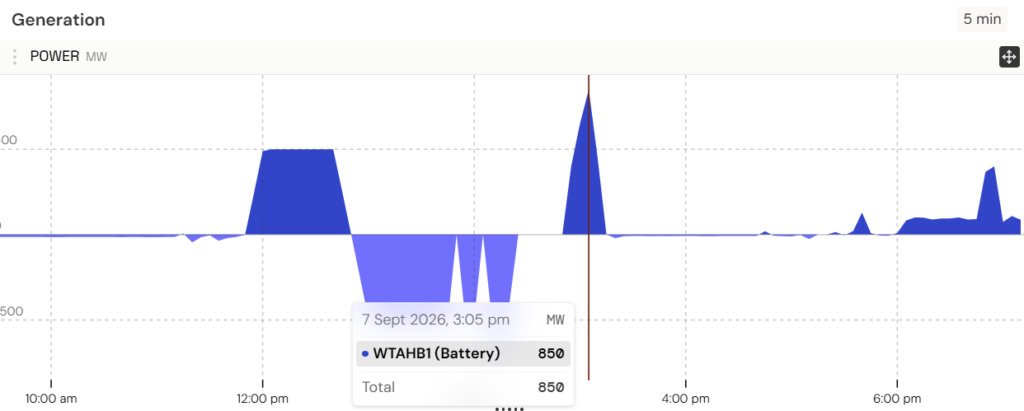
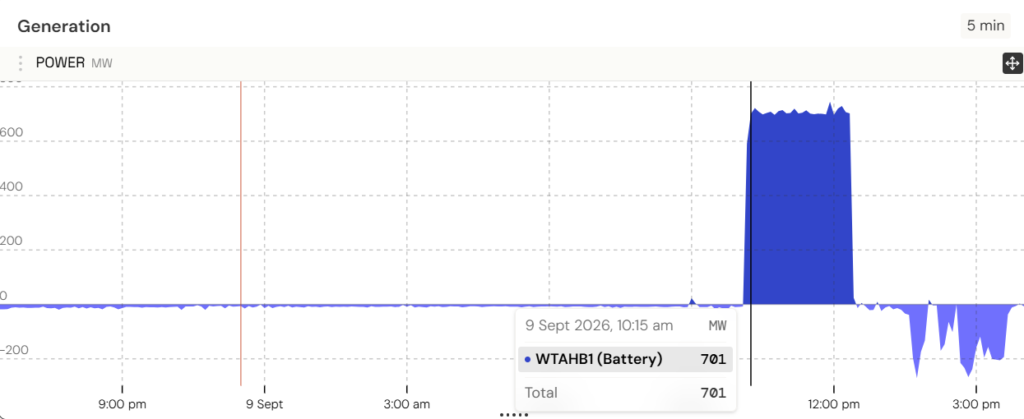
As seen in the images above, Open Electricity data shows the facility’s WTAHB1 unit recorded 850MW of output at a five-minute interval logged at 15:05 on 7 September, matching Waratah’s full 850MW/1,680MWh rated capacity.
The 701MW discharge recorded at 10:15am on 9 September aligns with the facility’s contracted 700MW SIPS obligation to Transgrid, the guaranteed service level the project has been building toward since a transformer failure constrained its output for most of the past year.
Read together, the two events point to a facility now testing, and in the case of 7 September, briefly exceeding its full contracted and rated capacity, ahead of the timeline Akaysha had previously outlined publicly.
A transformer failure that has shaped more than a year of commissioning
The current uncertainty over Waratah’s exact operating capacity traces back to October 2025, when the facility suffered what Akaysha described as a “catastrophic failure” of High Voltage Transformer 3 (HVT3), just months after it had achieved its first full discharge to the NEM at full 850MW output in October 2025, a discharge that broke the record for a single BESS injection into the NEM from New South Wales at the time.
The HVT3 fault caused extensive winding damage and an overpressure event that ruptured the transformer’s tank wall, forcing the unit to self-drain into its surrounding bunded area, while a second transformer, HVT2, was taken offline as a precaution, leaving the facility running at 350MW for months and meeting only an interim SIPS obligation at that reduced level.
Dr Tom Harries, partner at specialist energy insurance broker NARDAC, told Energy-Storage.news that the estimated total losses from the failure could range between AU$50-80 million (US$32-51 million), depending on how quickly replacement transformers could be secured.
In February 2026, Akaysha confirmed a Q3 2026 delivery timeline for the HVT3 replacement, manufactured domestically by Wilson Transformer Company following a design review involving contractor Consolidated Power Projects Australia and independent transformer consultants.
The use of an Australian manufacturer allowed diagnostic, rectification, and re-commissioning work to be carried out locally, avoiding the 12-18 month lead times typical of specialised transformer manufacturing sourced internationally, with full 850MW capacity targeted for delivery by the end of 2026.
HVT2 was returned to service first. In June 2026, Akaysha confirmed the facility had returned to 700MW and its full 1,680MWh energy capacity following HVT2’s successful recommissioning, representing 82% of the facility’s total power rating.
At that point, 350MW remained committed to the SIPS contract with Transgrid, with the remaining 350MW available for merchant participation in the NEM’s wholesale energy and ancillary services markets, pending HVT3’s return before the full 700MW SIPS obligation was reached, and the facility’s full 850MW rated capacity could be reached.
The project’s equipment supply chain has also shifted materially since construction began.
Original BESS provider Powin Energy, which delivered the project alongside Spanish power conversion and controls specialist Eks Energy, filed for Chapter 11 bankruptcy after struggling to compete with integrated offerings from Chinese OEMs.
Hitachi Energy subsequently acquired full ownership of Eks Energy, while US system integrator FlexGen acquired the bulk of Powin’s remaining assets, including its intellectual property, and took over long-term servicing responsibilities for Powin’s global project portfolio, including Waratah.
That recovery lands within a battery storage fleet generating increasing revenue at scale.
Australia’s grid-scale battery storage fleet storage earned a combined AU$28.79 million in estimated gross energy and FCAS revenue in August 2026, with the overall capture rate climbing to 54%, according to NEMPulse data.
Never miss an Australian energy storage story. Sign up for our Australia newsletter and get the latest project announcements, policy updates and market analysis delivered directly to you.