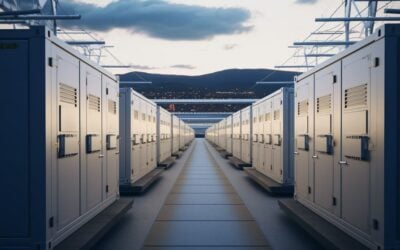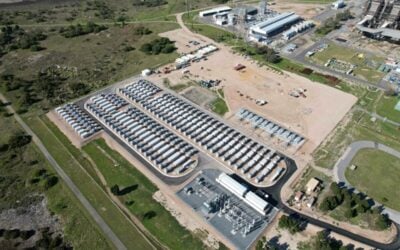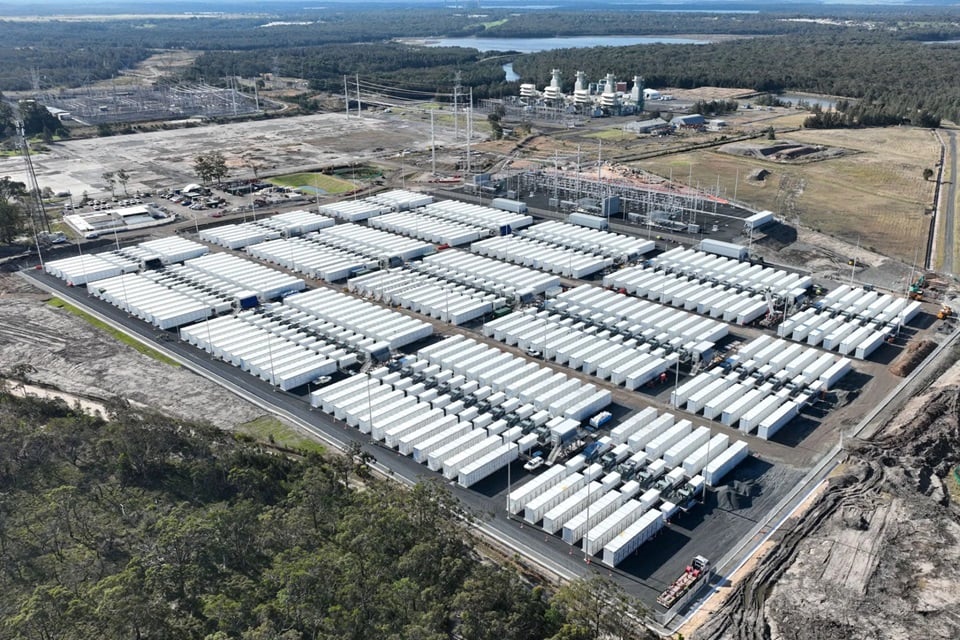
Australia’s most powerful battery energy storage system (BESS), the 850MW Waratah Super Battery, achieved its first full discharge to the National Electricity Market (NEM) last week.
Owned by its developer, Akaysha Energy, the Waratah Super Battery, sized at 850MW/1,680MWh, achieved its first full output to the NEM on Friday (10 October) at 08:30. This is the first full discharge for the BESS since it was initially energised at 350MW/700MWh in August.
This simultaneously has broken the record for a single BESS discharge to the NEM from New South Wales, according to Open Electricity (formerly OpenNEM), an online platform that aims to make NEM and Wholesale Electricity Market (WEM) data more accessible to a broader audience.
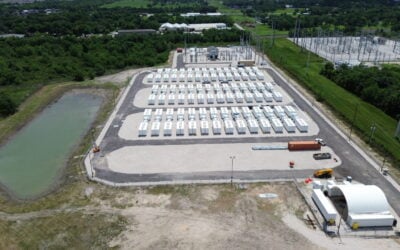
The Waratah Super Battery, previously described as a “giant shock-absorber for the grid,” is the largest operational BESS in Australia, surpassing the 300MW/450MWh Victorian Big Battery and the first stage of the 270MW/540MWh Western Downs BESS in Queensland.
Try Premium for just $1
- Full premium access for the first month at only $1
- Converts to an annual rate after 30 days unless cancelled
- Cancel anytime during the trial period
Premium Benefits
- Expert industry analysis and interviews
- Digital access to PV Tech Power journal
- Exclusive event discounts
Or get the full Premium subscription right away
Or continue reading this article for free
However, despite its capacity set to be overtaken by Neoen Australia’s 560MW/2,240MWh Collie BESS in Western Australia, the Waratah Super Battery will remain the most powerful battery storage site thanks to its power output.
In a recent interview with ESN Premium, Nick Carter, CEO of Akaysha Energy, reiterated that the Waratah Super Battery is the “world’s most powerful battery storage system” in terms of power output.
How does the Waratah Super Battery function as a ‘giant shock-absorber’?
Akaysha Energy, acquired by global investment powerhouse BlackRock in 2022, won the contract to deliver Waratah later that year through state-owned corporation EnergyCo.
Akaysha, in turn, appointed US-headquartered Powin Energy as the project’s BESS provider. Though it stayed the course to deliver the project, Powin recently filed for Chapter 11 bankruptcy after admitting it struggled to compete with Chinese OEMs’ integrated BESS offerings.
Through the partnership with Powin Energy, Spanish power conversion system (PCS) and power plant controller (PPC) specialist Eks Energy was also employed to support the development of the BESS. During the project delivery cycle, Powin acquired Eks Energy, only to then sell a majority stake in the Spanish company to Hitachi Energy.
Following Powin’s recent struggles, Hitachi Energy bought the remaining 20%. Meanwhile, US system integrator FlexGen acquired ‘nearly all’ Powin’s remaining assets, including IP and took over long-term servicing for its multi-gigawatt-hour portfolio of deployed projects worldwide.
At its core, the Waratah Super Battery Project is designed to optimise the capacity of transmission lines supplying electricity to the Hunter, Sydney and Illawarra regions of New South Wales.
This is achieved via the largest System Integrity Protection Scheme (SIPS) in Australia, which enables transmission operator Transgrid to send signals to the BESS to inject energy into the grid while simultaneously instructing paired generators to adjust their output.
Specifically, the SIPS Control System can monitor 36 transmission lines in real time and respond instantaneously to system events.
This dynamic balancing act prevents disruptions and allows existing transmission infrastructure to operate at higher capacities, effectively “running harder” without compromising reliability.
Through the SIPS, the Waratah Super Battery will also serve as a stopgap measure until the Hunter Transmission Project – a major infrastructure initiative to connect inland Renewable Energy Zones (REZ) to the rest of New South Wales – comes online.