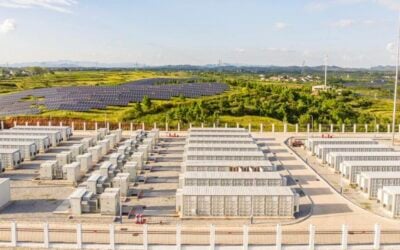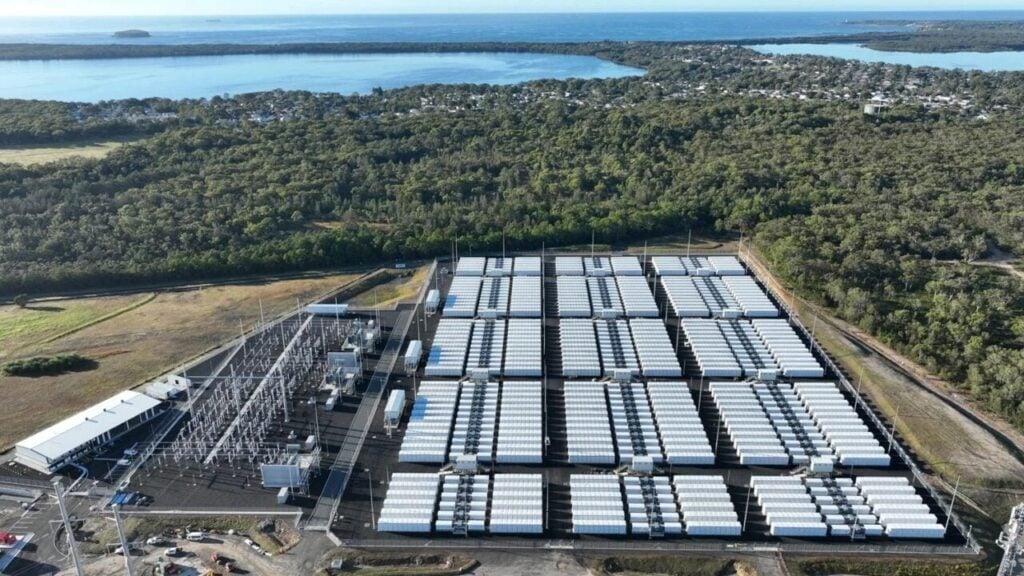
Akaysha Energy’s Waratah Super Battery is now operating at 700MW and 1,680MWh following the successful return to service of High Voltage Transformer 2 (HVT2), the BlackRock-backed developer confirmed in a market update today (4 June).
The 700MW figure represents 82% of the facility’s total 850MW power output and its full rated energy capacity of 1,680MWh.
Of the 700MW now available, 350MW will continue to be committed to the System Integrity Protection Scheme (SIPS) service contracted with transmission operator Transgrid, with the remaining 350MW to be deployed on a merchant basis into the National Electricity Market (NEM).
This agreement enables the battery storage system to participate in wholesale energy and ancillary services markets as commissioning continues.
Try Premium for just $1
- Full premium access for the first month at only $1
- Converts to an annual rate after 30 days unless cancelled
- Cancel anytime during the trial period
Premium Benefits
- Expert industry analysis and interviews
- Digital access to PV Tech Power journal
- Exclusive event discounts
Or get the full Premium subscription right away
Or continue reading this article for free
Akaysha confirmed that the full 700MW SIPS service requirement will only be deliverable once HVT3, the transformer that suffered a catastrophic failure in October 2025, is replaced and operational.
That replacement, being manufactured by Wilson Transformer Company, remains on track for delivery to the site in the third quarter of 2026, with full 850MW capacity targeted by the end of the year.
The return of HVT2 closes out the longest phase of the project’s troubled commissioning sequence. As Energy-Storage.news reported in November 2025, HVT3 suffered a catastrophic internal fault that caused winding damage and an overpressure event, rendering it beyond repair just hours before it was due to complete its next commissioning milestone.
At the same time, HVT2 was taken offline as a precautionary measure, leaving the facility running on a single transformer at 350MW and meeting only its interim SIPS obligation.
In February 2026, Akaysha confirmed that Consolidated Power Projects Australia had been instructed to proceed with the HVT3 replacement following a design review process involving Wilson Transformer Company and independent consultants.
The use of an Australian-based manufacturer was credited with enabling rapid engineering engagement, a strong on-site presence, and fast mobilisation of manufacturing resources.
The remediation of HVT2, incorporated into a separate defined programme of work, has now been completed ahead of the HVT3 delivery.
Commercial implications
The return to 700MW has direct revenue implications for Akaysha. The Waratah Super Battery was contracted to deliver a guaranteed capacity of 700MW and 1,400MWh to Transgrid under the SIPS arrangement, with the contract including mechanisms to adjust payments to reflect the actual SIPS service provided, subject to annual adjustment processes with the Australian Energy Regulator (AER).
Operating at 350MW for the majority of the commissioning period meant Akaysha was receiving approximately half of its expected contracted revenues.
The additional 350MW now being deployed into the NEM on a merchant basis enables the battery to participate in the wholesale price spreads and ancillary services markets that have been reshaping NEM economics over the past twelve months.
Wholesale battery storage revenues across the NEM have grown substantially as the fleet has expanded. CleanCo Queensland’s 250MW Swanbank BESS earned AU$743,000 in a single month of dispatch revenue, while average two-hour intraday spreads across all NEM states fell below AU$106/MWh in May 2026 as the installed battery fleet absorbed midday solar surplus at increasing scale.
The Waratah milestone arrives as Akaysha’s broader portfolio continues to expand. BlackRock is rumoured to be considering raising several hundred million dollars for Akaysha based on a valuation of over US$1 billion, with potential investors being sounded out in what was described as early-stage discussions.
The final step toward Waratah’s full 850MW capacity remains the delivery and installation of the replacement HVT3. Once operational, the full 700MW SIPS service will be available to Transgrid, with the additional 150MW of power capacity above that threshold also available for merchant market participation.
Akaysha said it will provide further updates as commissioning progresses.