New market rules will encourage investment in energy storage as a key component of Thailand’s national energy vision, according to the country’s energy ministry.
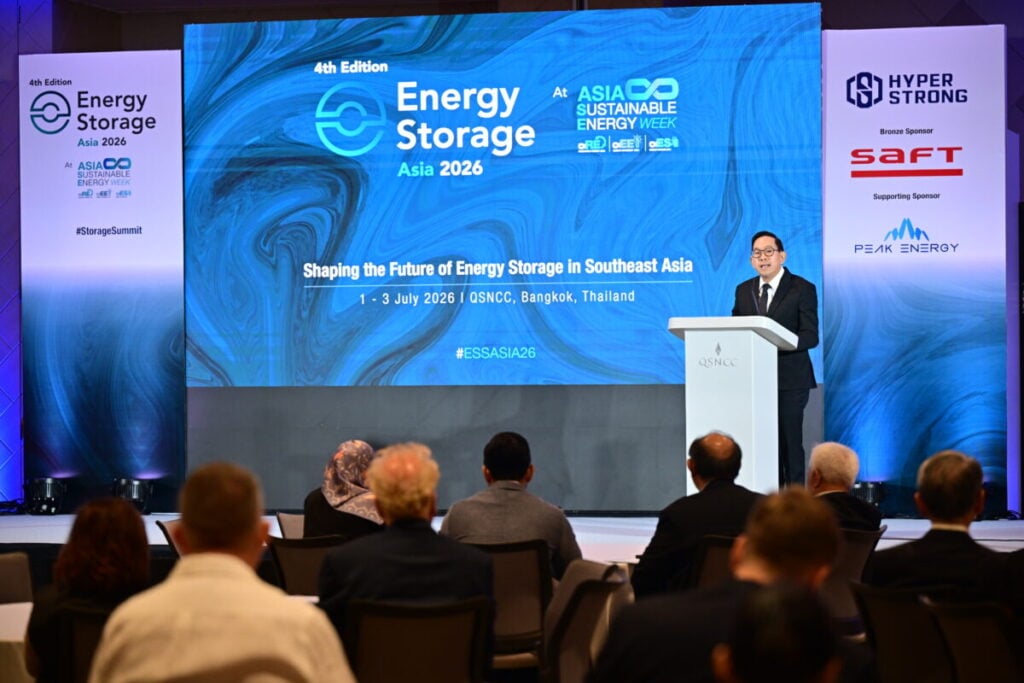
A keynote address from Wattanapong Kurovat, Director-General of the Energy Policy and Planning Office (EPPO) at the Ministry of Energy Thailand, opened Day One of Energy Storage Summit Asia 2026 at the beginning of this month (2 July).
“Energy storage plays a vital role as the backbone of the modern power system. It enables flexibility. Flexibility, reliability, and resilience, bridging intermittent renewable energy with stable resistive supply,” Kurovat said.
The secretary called energy storage a “pillar” of Thailand’s national energy vision, underpinning the commitment to net-zero emissions by 2050 and enabling the adoption of larger shares of renewable energy, “while ensuring affordability and security for our people,” he said.
Try Premium for just $1
- Full premium access for the first month at only $1
- Converts to an annual rate after 30 days unless cancelled
- Cancel anytime during the trial period
Premium Benefits
- Expert industry analysis and interviews
- Digital access to PV Tech Power journal
- Exclusive event discounts
Or get the full Premium subscription right away
Or continue reading this article for free
Energy storage development in the country has been limited, at least for large-scale battery energy storage system (BESS) projects. The Asia Sustainable Energy Week (ASEW) expo in the Thai capital, Bangkok, was the host event for this year’s summit.
The ASEW expo floor had no shortage of battery storage suppliers catering for the local market. However, nearly all offerings were aimed at the residential, commercial and industrial (C&I) market segments.
According to figures cited by the Asian Development Bank (ADB), as of the end of 2024, Thailand had just three utility-scale solar-plus-storage projects pairing 184MW of solar PV generation with 345MWh of BESS capacity, and no standalone BESS projects. These were deployed through a 2022 programme aimed at supporting a gigawatt of co-located projects.
Thailand’s energy demand is growing rapidly, and its renewable energy market is relatively mature compared to other ASEAN countries, but the development of policies to support energy storage participation has lagged, Solar Media Market Research analyst Charlotte Gisbourne wrote in a March Guest Blog for Energy-Storage.news.
The Philippines and Vietnam are further ahead in accelerating the adoption of battery storage through new revenue frameworks that could allow for value stacking and tender programmes, for example.
However, the government is implementing a four-pillar strategy to “incorporate energy storage into the national evolving power landscape,” the ministry secretary said, including smart grid integration of storage, developing domestic manufacturing and supply chains, market mechanisms and market access reforms, alongside cross-border power trading in the ASEAN region and broader international partnerships.
“As [the] Thai electricity sector continues to evolve, we are creating a more flexible and competitive market environment,” Kurovat said.
One example of important policy developments, which is “creating a more open and competitive electricity market”, is the introduction of direct power purchase agreements (PPAs), which grant third-party access to the grid for large energy users and producers, such as data centres, renewable energy developers, and open investment pathways.
“At the same time, energy storage is becoming an integral part of this evolving market framework by making renewable energy more accessible, enhancing system flexibility, and supporting demand side management,” Kurovat said.
“Solar is unlocking a new business opportunity and strengthening investors’ confidence.”
Investor confidence was a theme consistently returned to by speakers at Energy Storage Summit Asia 2026 during the two days of conference programming that followed Kurovat’s speech.
Southeast Asian countries so far lack either the depth of merchant opportunities that BESS can participate in or the government support schemes that have driven the uptake of renewable energy in the region.
The Philippines’ power trading markets are an exception to the first, and the country has become an early leader in storage deployment among ASEAN nations. Multilateral industry group Future Energy Storage & System Integration Alliance (FESSIA) recently advocated for ASEAN countries to follow the Philippines and Vietnam’s lead and implement regulatory frameworks that reflect the value of energy storage, in a new report, ‘Unlocking the role of battery energy storage systems (BESS) in ASEAN electricity markets.’
Thailand has a clear mission to integrate energy storage into every level of its power system, Kuorvat said, and to promote “industry and innovation, enable market access and digital operations.”
The role of state-owned power player EGAT
Thailand’s electricity market operates under an enhanced single buyer model, with the Electricity Generating Authority of Thailand (EGAT), the state-owned power generation, transmission and distribution (T&D) enterprise as the primary offtaker for large-scale energy storage.
EGAT deputy governor for strategy, Warit Rattanachuen, gave a keynote presentation after Wattanapong Kurovat. Rattanachuen said that solar is the most viable technology today for Thailand to increase its renewable energy share to the 70% by 2050 target that will be included in the country’s long-awaited national Power Development Plan (PDP).
The PDP sets a net-zero emissions target by the mid-Century point, but, officially titled the 2024 PDP, its publication has been delayed, first from a 2025 release date to this summer. It is now expected to be launched this autumn.
In 2025, Thailand’s mix was 54% natural gas, 19% coal/lignite, 25% renewable energy, and 2% other sources. Thailand aims to transition to 70% renewables, with the vast bulk of the remainder based on natural gas, by 2050.
Rattanachuen said that, in light of grid integration challenges including curtailment of solar PV generation, Thailand needs energy storage, and this should be a combination of BESS and pumped hydro energy storage (PHES).
The tropical, hot and humid climate of Thailand reduces the efficiency gap between batteries and pumped storage, the EGAT representative said, because BESS assets would require cooling.
PHES will be better suited for applications that require 4-hour to 12-hour discharge durations, but it requires specific site topography and conditions to build.
Conversely, EGAT believes that batteries and their faster response times will be better for performing system regulation applications such as frequency and voltage control over 0.5-hour to 4-hour durations, as well as smoothing the impact of large loads such as data centres.
Long-awaited national Power Development Plan likely includes 26GWh by 2037 BESS target
In addition to three operational PHES projects with a cumulative capacity of about 8GWh, EGAT is planning to deploy three more, to create a total fleet of 4GW/27.84GWh, under the draft 2024 PDP.
From just two operational BESS pilot projects today, a 16MW/16MWh system in Chaiyaphum, and a 21MW/21MWh system in Lopburi, the 2024 draft PDP targets the deployment of 10,485MW/26,010MWh of battery storage by 2037.
The morning’s final keynote speaker, Dr Pimpa Limthongkul, is both a director at the National Energy Technology Center (ENTEC) research institute and president of the Thailand Energy Storage Technology Association (TESTA).
Dr Limthongkul briefly discussed the science underpinning the proposed PDP climate and energy transition targets, noting that, alongside renewable energy and energy storage development, Thailand must continue adopting electrification technologies, such as electric vehicles (EVs). She also said that according to recent reports, the 70% clean energy by 2050 target could comprise 60% variable renewable energy (VRE) and 10% small modular nuclear reactors (SMRs).
TESTA has convened three Working Groups for specific issues that present barriers to energy storage adoption: policy and promoting usage of energy storage, end-of-life management and safety and standards.
“We hope it will come out very soon,” Dr Limthongkul said of the PDP in response to an audience question on its importance, given that much of her presentation had to focus on values given in the previous 2018 PDP and reports of what is likely in the new version.
The TESTA president said that the plan is now expected to “pass through the parliament and come out in October,” after going through government approval steps in August.