Electricity sector regulations in Thailand require significant reforms to support the use of energy storage as a critical tool for renewable energy integration.
While the national government has recognised the strategic importance of energy storage in enabling 2050 targets for 70% low-carbon energy and net-zero emissions, Thailand’s electricity markets are not designed with the modelling and transparency required to stimulate investment.
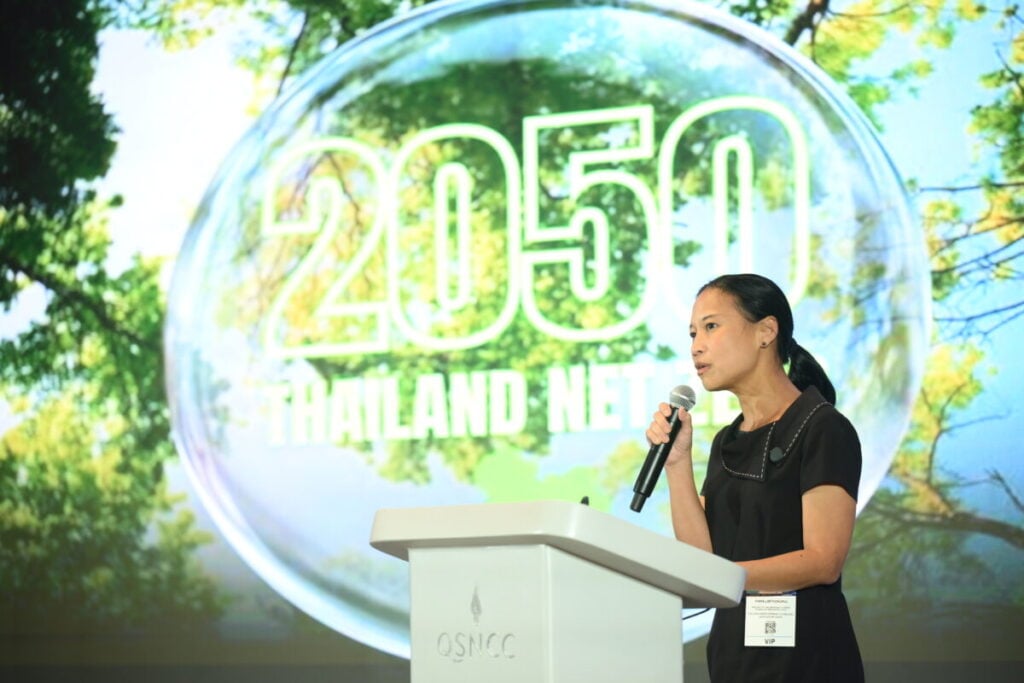
That was the take of Dr Pimpa Limthongkul, director at Thailand’s National Energy Technology Center (ENTEC) and president of the Thailand Energy Storage Technology Association (TESTA), speaking at the recent Energy Storage Summit Asia 2026 event in the nation’s capital, Bangkok.
Limthongkul participated in a panel discussion on the ASEAN Renewable Energy Long-Term Roadmap, a framework for scaling up solar and wind capacity and accelerating electrification in alignment with plans for an ASEAN Power Grid to interconnect and trade power between the 11 Member States.
Try Premium for just $1
- Full premium access for the first month at only $1
- Converts to an annual rate after 30 days unless cancelled
- Cancel anytime during the trial period
Premium Benefits
- Expert industry analysis and interviews
- Digital access to PV Tech Power journal
- Exclusive event discounts
Or get the full Premium subscription right away
Or continue reading this article for free
Thailand has lagged behind other ASEAN countries in its deployment of utility-scale battery energy storage systems (BESS). The Philippines for example allows revenue stacking from electricity trading and ancillary services. Malaysia just completed a first tender for 400MW/1,600MWh across four projects. Vietnam meanwhile has recently developed a two-part electricity tariff structure for BESS.
There are “so many regulatory reforms that are needed,” Limthongkul said, when asked what should be done to improve the bankability of energy storage projects.
Thailand has a single-buyer model electricity sector, with the state-owned Electricity Generating Authority of Thailand (EGAT) responsible for bulk power generation and transmission.
The country has been very successful so far in bringing electricity to the whole country and selling it at a single unified price, irrespective of system or generation costs. Now that the task of delivering electricity at an “affordable price” has been achieved, Thailand can push into a new transition, towards higher shares of renewable energy, lessened environmental impact and increased sustainability of the energy sector and better energy security, Limthongkul said.
“We have to transform the market pricing scenario,” Limthongkul said, adding that while this does not have to mean abolishing the single-buyer model or deregulating the whole market, the Thai electricity sector should move away from its current model of just having two tariffs: on-peak (which on weekdays is 9am to 10pm) and off-peak (10pm to 9am).
Speaking in the morning of the first day of the conference, a representative of the Thai Ministry of Energy said the government is committed to creating a more “flexible and competitive” market environment for energy storage, enabling its strategic role at the heart of the country’s energy transition.
“Energy storage plays a vital role as the backbone of the modern power system,” Wattanapong Kurovat, Director-General of the Ministry of Energy’s Energy Policy and Planning Office (EPPO), said, adding that Thailand will “incorporate energy storage into the national evolving power landscape,” through a four-pillar strategy that includes grid, market and market access reforms, domestic supply chain development and cross-border energy trading in the ASEAN region.
Philippines: nodal prices increase complexity but offer signals to investors
For instance, the Wholesale Electricity Spot Market (WESM) in the Philippines is a nodal market that registers different prices across regions. Recent analysis by Aurora Energy Research highlighted that the grid connection location has a material impact on project returns.
This can increase the complexity of energy project investment decisions, but it also gives battery storage developers and investors a clear signal into the relative value of their project to the network.
“In the Philippines’ nodal market, the value of a battery will depend heavily on location,” Aurora Energy Research’s wider Asia APAC head Patrick Tan told Energy-Storage.news.
“As more renewables connect, a storage project’s economics will be shaped by the part of the network it sits in, the level of congestion around it, local price signals in terms of spreads, and the level of renewable penetration or load development in the area.”
“That makes system-wide price assumptions alone a weak basis for investment decisions. Developers need to understand the conditions at the node where a project will connect, because two batteries with similar technical specifications can exhibit very different revenue stacking profiles across energy arbitrate and ancillary services,” Tan said.
“As the Philippines builds out its renewable pipeline, this level of analysis will matter for storage as much as it does for generation. It will influence where batteries are developed, how revenue cases are assessed and whether storage projects can secure financing.”
In addition to a reform of electricity pricing that better reflects demand patterns and the sources of power, Dr Pimpa Limthongkul said that Thailand also needs greater cost transparency.
“Cost has to be more transparent in the transformation. In Thailand, the costs of local production across provinces are not yet transparent to the public,” Limthongkul said.
Speaking on the same conference panel, Somesh Shah, manager for international solar business at consultancy AFRY, said that ASEAN countries need to keep in mind the end goal of utilising all the capabilities of energy storage systems.
“Battery storage in most of the countries in our region has been taken as only for one single use case; unless we utilise it more, we would not be able to get more benefit out of it,” Shah said.
Policy mechanisms can be reformed in “three sequential phases,” to achieve this, he said: beginning with government-backed auctions and pilot programmes, such as those seen in the Philippines and Malaysia, then the introduction of capacity payments as part of the overall revenue mechanism for storage, followed by an opening of markets to give the ability to stack revenue streams.
“I think these are not choices, these are the sequential steps through which we can improve the policy mechanism,” Shah said.
Utility-scale market likely to focus on 2-hour duration BESS
Energy Storage Summit Asia 2026 was hosted as part of Asia Sustainable Energy Week (ASEW) expo at Queen Sirikit National Convention Centre (QNCC) at the beginning of July.
It was clear from walking the expo floor that in fact, Thailand does have a maturing energy storage market, just not yet in the utility-scale market segment. There were plenty of products and solutions providers targeting the residential and commercial and industrial (C&I) battery storage market.
Charles Gao, head of APAC ESS business for Chinese BESS integrator and manufacturer CLOU, said that there is a lot of demand for C&I systems coming from commercial buildings and small factories.
These customers typically have solar PV installed already and want to be able to store the power generated to save on electricity costs. Others will want to increase their productivity without needing to draw more power from the grid. The relatively high uptake of electric vehicles (EVs) in Thailand also means there is demand for BESS-integrated EV charging, Gao said.
CLOU’s main C&I product in the Thai market is a 233kWh system based on 280Ah cells, with the next generation an upgrade to 261kWh systems using 314Ah cells, which is pretty standard for C&I installations worldwide, he said.
Charles Gao said that the Thai market is gradually opening up. Having visited the country “many, many times” in the past, but not finding it to be the right time to engage, “this year we have seen that there’s some pipeline in local markets,” he said.
Yet while the C&I market is materialising, with standardised products and distributor networks, the utility-scale market is developing more gradually and “demand is not so big.”
Gao notes that the few, mostly pilot, standalone BESS projects that are being built in Thailand are delivering frequency regulation and other ancillary services and are most commonly 2-hour duration systems.
“Everybody in the US, in Europe, they are moving to long-duration utility-scale requirements, but now in Thailand, it looks like they are more focusing on the power, not energy, not capacity,” Gao said.
“The most typical case I have seen is they require 2-hour systems, 0.5 C-rate, and this is quite different from other markets.”
The market will most likely favour 5MWh, 20-foot containerised systems rather than the more advanced 6MWh+ solutions seen in more mature markets, according to Gao.
CLOU expects the average duration to remain relatively short, at 2-hour, because the Thai BESS market will be Capex-sensitive.
“For now, because the commercial model is not so very clear, they care more about keeping capex under control. This is a very big commercial reason why they choose 2-hour. In the future, when they see that BESS will generate revenue, they will start to consider moving to long-duration, because this is what happens in other markets and what other markets have experienced before.”
Finally, it has often been said that the very warm temperatures and high humidity of the ASEAN climates impact project design and equipment selection considerations.
The heat will mean that auxiliary power loads to cool the system are higher during BESS operation than in other regions, while the humidity and proximity to the sea in much of Southeast Asia result in more demanding anti-corrosion protection, Charles Gao said.
“That will increase your material costs and also your R&D costs because you need to design a higher-level protection system for your container,” Gao said.
However, in such a Capex-sensitive market, solution providers need to compete on costs and Gao said it will therefore be the equipment supplier that swallows the extra cost, rather than the customer.
CLOU expects the impact to be such that “gross margin in Southeast Asia will be lower than in other markets.”
Read more Energy-Storage.news coverage of, and related to, Energy Storage Summit Asia 2026.