Utah-based solar and battery pack supplier Lion Energy has announced a strategic partnership with gigafactory startup American Battery Factory (ABF) to enable ABF’s recently announced 4.5GWh offtake agreements.
The partnership is “strategically aligned” with the initial production offtake agreements for ABF’s planned 1.1GWh annual production capacity from new production lines, according to a Lion Energy release. Last month, ABF announced it had secured the offtake agreements with “A Rated” energy storage solution (ESS) companies, which it claimed paved the way to finalise plant financing in the coming months.
As a strategic partner with an equity position in ABF, Lion Energy claims it is closely aligned with the long-term growth and commercialisation of US-produced lithium iron phosphate (LFP) battery cell technology.
Lion Energy said the alignment takes on an increased significance with its acquisition by Aqua Metals, a company with a novel lithium-ion battery recycling technology.
Try Premium for just $1
- Full premium access for the first month at only $1
- Converts to an annual rate after 30 days unless cancelled
- Cancel anytime during the trial period
Premium Benefits
- Expert industry analysis and interviews
- Digital access to PV Tech Power journal
- Exclusive event discounts
Or get the full Premium subscription right away
Or continue reading this article for free
The two companies have an intertwined history. ABF was originally incubated within Lion Energy and launched in 2022 in Utah by then-ABF CEO and president Paul Charles, together with Lion Energy’s co-founders.
The companies claim that the transaction is expected to accelerate the development of a vertically integrated, US-based battery ecosystem. It would cover critical stages of the energy storage system (ESS) lifecycle, from cell manufacturing and deployment to energy management and end‑of‑life recycling.
Lion also said it is expanding its US battery assembly abilities, expecting production lines to come online in June. It claims the ESS are anticipated to be both foreign entity of concern (FEOC) and domestic content compliant. It will integrate cells from ABF as they become available.
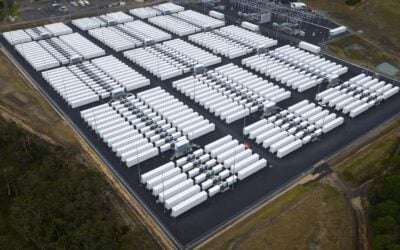
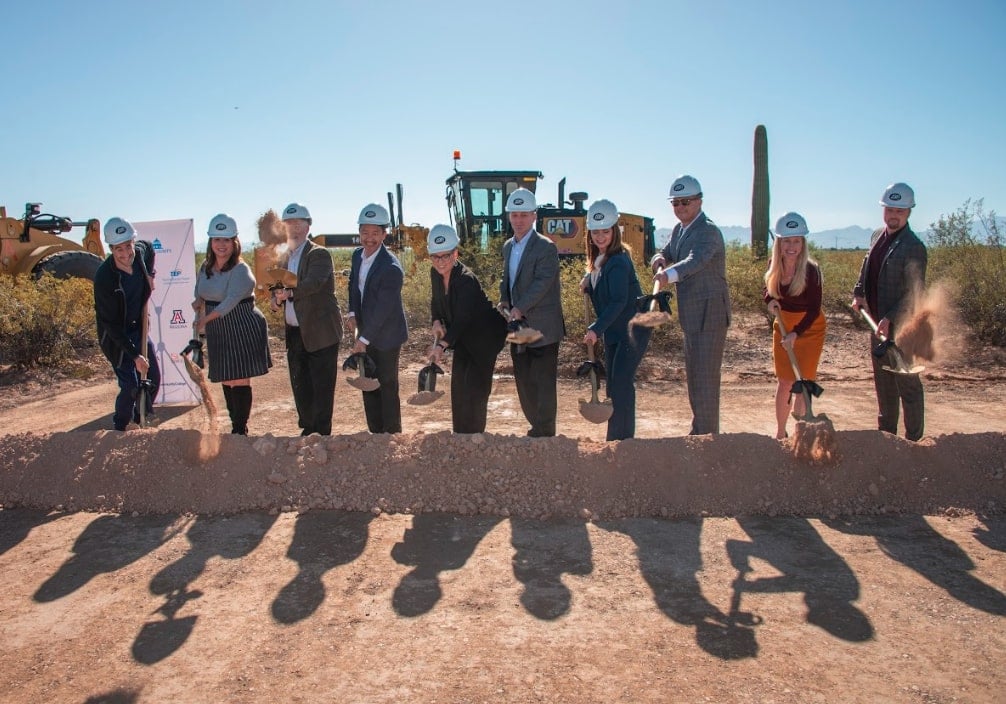
ABF’s US facility in Pima County, Arizona, will have 5.5GWh output for the first five years of production. The company plans to continue scaling up the facility, which will also house its R&D centre and headquarters, to 15GWh. The company broke ground on the US$1.2 billion plant in 2023, as seen in the picture above.
It will produce prismatic LFP battery cells, which Lion Energy claims its proprietary systems, including hardware, firmware, and the LionESS energy management system (EMS), are well-positioned to integrate with.
Interviewed by Energy-Storage.news in 2022, former CEO Charles, since replaced by co-founder Zhenfang ‘Jim’ Ge, discussed the link with Lion Energy, noting at the time that ABF could call on the assistance of around 130 Lion Energy workers to help its own much smaller team. Charles also said ABF would build a network of replicable factories that could be brought online quickly and would be smaller than those of some existing market players, requiring fewer staff and allowing them to be built in proximity to customers.
In 2024, ABF partnered with KAN Battery to pilot a line of LFP battery cells. By launching its subsidiary, ABF China, with KAN, the company said it would utilise a 1GWh factory for high-capacity prismatic cells as part of its preparation for the design and construction of the Arizona facility.
Additional reporting by Andy Colthorpe.