
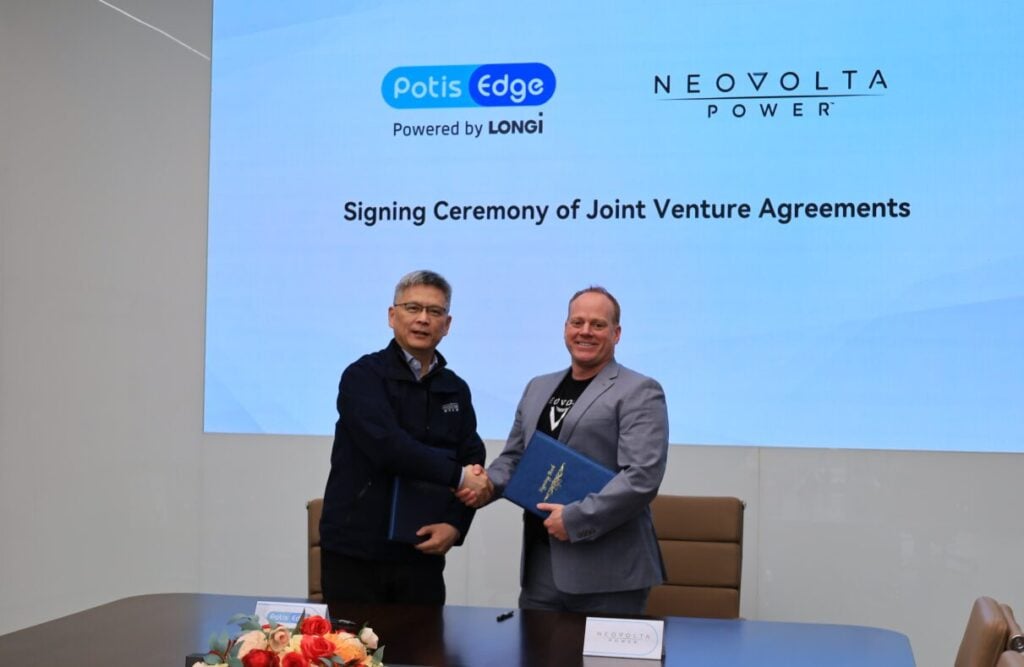
We caught up with NeoVolta CEO Ardes Johnson about its US domestic BESS manufacturing partnership with Chinese firms Potis Edge and Longi, and how it has been structured to be FEOC compliant.
The companies announced the joint venture (JV) in January this year for a battery pack and battery energy storage system (BESS) assembly facility in Georgia, US, that NeoVolta has been developing for a few years. It will start with a 4GWh production line with space to add a second, doubling capacity to 8GWh.
That came just a few weeks after new Foreign Entity of Concern (FEOC) restrictions were brought in on clean energy tax credits in the US. The crucial aspect of it is that projects are ineligible for tax credits if they are owned by a company with 75%+ Chinese ownership. They are also ineligible if they use technologies accounting for 55% of project cost from a 75%+ Chinese controlled company (rising gradually to 75% by 2030).
It therefore might seem strange to some that NeoVolta brought in Chinese partners just as these rules came in. Johnson explained to Energy-Storage.news in detail how the company has structured the partnership to avoid FEOC penalties.
Try Premium for just $1
- Full premium access for the first month at only $1
- Converts to an annual rate after 30 days unless cancelled
- Cancel anytime during the trial period
Premium Benefits
- Expert industry analysis and interviews
- Digital access to PV Tech Power journal
- Exclusive event discounts
Or get the full Premium subscription right away
Or continue reading this article for free
NeoVolta bringing in PotisEdge/Longi’s experience
The company had already been in discussion with system integrator PotisEdge about a partnership before it was acquired by solar PV giant Longi in November, Johnson explained.
The structure the companies have settled on for the JV is 80:20% ownership split between NeoVolta and PotisEdge, while Longi holds a 2% stake in NeoVolta Inc.
Johnson said that keeps the JV company FEOC compliant while giving Longi a vested interest in NeoVolta’s success. NeoVolta’s share was initially 60%, with 20% held by PotisEdge and another 20% from an unnamed ‘group of strategic investors providing additional technical and operational support’. That group appears to have sold up, when in April NeoVolta announced an increase in its stake to 80%.
Longi has done a similar deal in solar PV manufacturing in the US, with IPP Invenergy for a module plant in Ohio, so it had experience in doing this kind of structuring, Johnson added.
FEOC restrictions also apply to technology partnerships and licensing. While the rules have still not been finalised by the Internal Revenue Service (IRS), they do currently say that you have to do a technology transfer, so NeoVolta is acquiring ownership of some of PotisEdge’s intellectual property (IP).
It needs the partnership with PotisEdge particularly because the Chinese company has deep experience in battery management in BESS applications, whereas NeoVolta has until recently been primarily a domestic battery storage company.
“Their special sauce is battery management, lifecycle knowledge, ensuring batteries’ health is where it needs to be when in a storage plant,” Johnson said. “Assembly of product is not rocket science, but where it matters is obviously in quality.”
“The final product will be similar to PotisEdge’s, a 5MWh capacity in a 20-foot unit, as we wanted something that was not totally new to the market.”
The firm expects to be able to ship products from the facility as early as the middle of 2026.
NeoVolta to phase out Chinese batteries
It is, for now, still able to procure batteries from Chinese FEOC entities and still offer a product that will allow developers to capture the investment tax credit (ITC). This is because of the Safe Harbor threshold of 55% (for 2026) of project costs, and battery cells will typically comprise less than that.
However, that threshold is increasing over the next four years to 75% by 2030, so all manufacturers need to start planning how to adapt.
“We will be using Chinese while we still can. The next step would be using non-Chinese, Southeast Asia cells or then eventually US-made ones,” Johnson explained.
“The latest guidelines also allow for a mixing of cells to hit the Safe Harbor figures. So you could theoretically use a mix of FEOC and non-FEOC entity products.”
However, there is still not enough US-made cell capacity for everyone who needs it and they are not as competitive as Chinese ones for now. In fact, some developers are opting to forego the tax credits entirely to continue buying from China.
“Procuring US cells is more of a 2028 strategy. The big players like Fluence and Tesla are gobbling up the capacity available, for now,” Johnson said.
NeoVolta signed a first grid-scale BESS offtake deal recently with Infinite Grid Capital (IGC), via a letter of intent (LOI) to procure products from its Georgia site.
All Chinese firms with US manufacturing assets are having to restructure ownership of those if they want to comply with FEOC and continue to receive tax credits. We recently discussed this trend with Mona Dajani, a lawyer from Cooley, who described these deals as part of a wider restructuring of the whole US clean energy manufacturing industry.
