“The word tsunami describes very well the hype that was in Germany,” said Cristina Yandiola on a panel discussion at this week’s Energy Storage Summit, reflecting a shift in developers’ perspectives in the last year: from optimism for generating revenue in the German BESS market to a realisation of the challenges and complexities involved in working in the market.
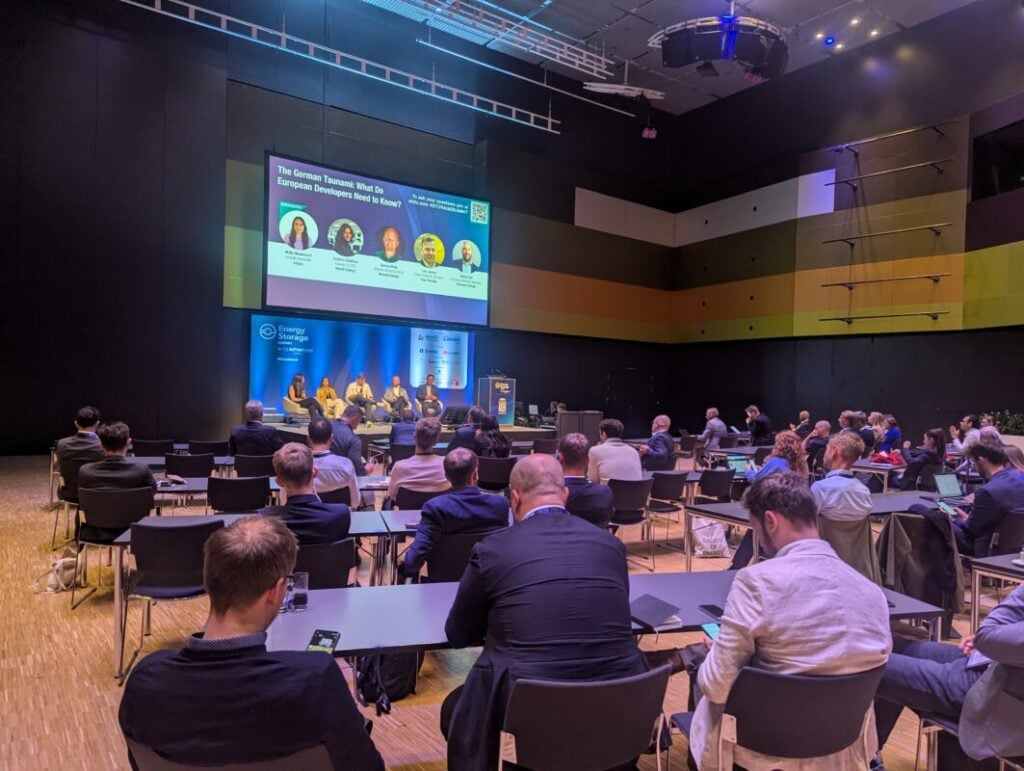
Yandiola, founder and CEO of Revolt Energy, was speaking on a panel titled ‘the German tsunami’ at the Energy Storage Summit at the Battery Show Europe, hosted by Energy-Storage.news publisher Solar Media and co-located with parent company Informa’s The Battery Show Europe. The panellists were first asked to describe the accuracy of referring to the last year in German battery energy storage system (BESS) market as a ‘tsunami’, and Yandiola said it was apt.
“If you compare it to last year, we were in the same conference and there was a lot of investment coming from abroad,” she continued, noting that this optimism has turned to frustration with the realities of working in the German market. “[There were] a lot of UK investors coming to Germany … and I feel like it was not a realistic enough conversation about the complexities that Germany has. The wave of the tsunami has already reached the top of its hype and this year has shown the reality.”
Some of these realities pertain to the policy and legislative uncertainty in the German market, which was a topic of conversation on an earlier panel discussion, and was picked up on by Stefan Tait, executive director for Germany at Harmony Energy.
Try Premium for just $1
- Full premium access for the first month at only $1
- Converts to an annual rate after 30 days unless cancelled
- Cancel anytime during the trial period
Premium Benefits
- Expert industry analysis and interviews
- Digital access to PV Tech Power journal
- Exclusive event discounts
Or get the full Premium subscription right away
Or continue reading this article for free
“There has really been not any focus at all on once projects are reserved, what’s happening then?” he asked. “One of the TSOs we’re currently negotiating a contract with, a 380kV BESS connection, told us they have not signed any grid construction agreements for BESS; so they also don’t know how it works!
“We’re really far away from standardising that process,” he continued. “It’s rally interesting to see how little defined this process actually is.”
Challenges for TSOs and DSOs
Perhaps most strikingly, this ‘tsunami’ of interest in the German BESS market put pressure on both TSOs and DSOs.
“The tsunami was not good for all of us,” explained Lars Josten, project director of Germany at Giga Storage. “It created a horror scenario on the TSO and DSO side.”
“It was all driven by a lot of promising revenue curves from developers, who didn’t understand quite how the German market is working; there’s this shocking number of over 800 TSOs and DSOs, so you want to fit your revenue model to an operating system and this turned out [to be] not good for a lot of them,” he continued.
Dennis Klink, director of grid and policy at developer Noveria Energy, meanwhile, said that broader uncertainties around aspects of the German market, like BKZ fees, created the conditions where more speculative grid applications could be made, adding to the backlog that has long been a feature of the German market.
“If you look back a couple of years, you have the situation where sub-TSOs didn’t ask for a BKZ payment; there were no criteria to hand in a grid application—at least at the TSO level—and we know of early projects where you didn’t even have to bring, let’s say, a land reservation, so it was really easy to hand in the papers saying ‘I want grid access here’,” he said.
“We also know that some people have done that very systemically, flooding the TSOs with these applications, and I think this has gone down now and it needs to go down,” he continued. “The big question is what happens in the next one to two years.”