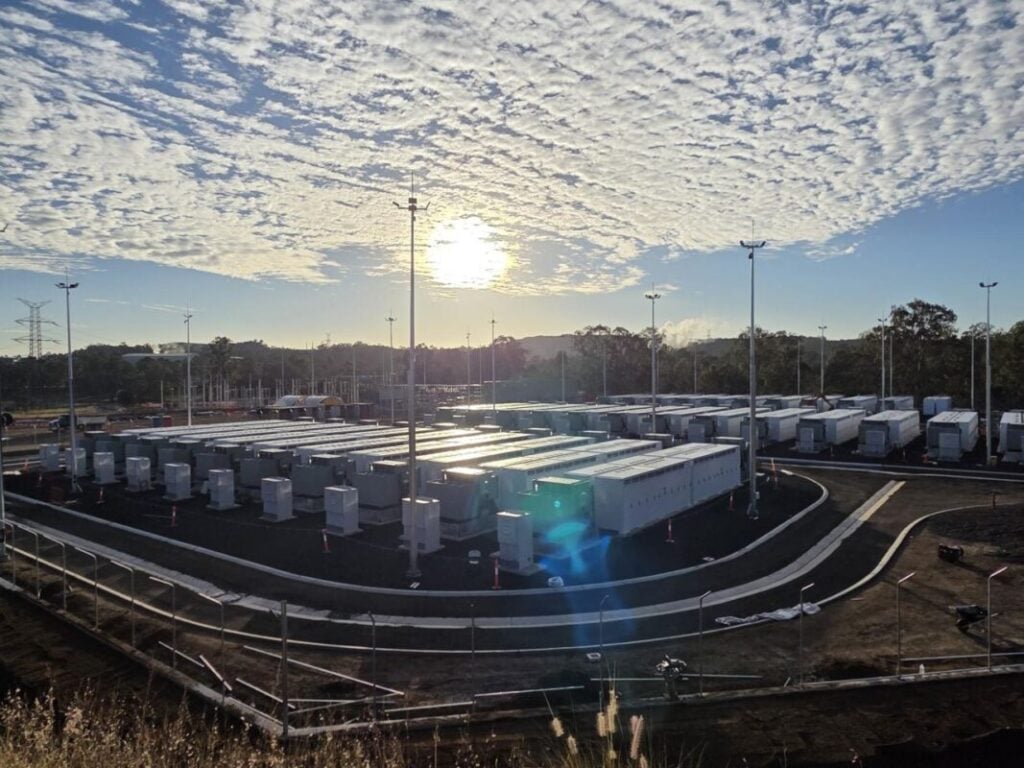
Queensland’s Swanbank battery energy storage system (BESS) earned AU$743,000 (US$532,608) in dispatch revenue last month, more than double the AU$306,000 generated by the Victorian Big Battery over the same period in Australia.
This is according to data shared by EnergyAustralia senior analytics specialist Franz David Schaefer on LinkedIn, who noted that the battery storage systems have similar capacities and cycle counts.
The revenue disparity highlights differences in bidding strategies between the two merchant battery storage systems.
The 250MW/500MWh Swanbank employs a passive approach, setting its price and waiting for the market to come to it. At the same time, the 300MW/450MWh Victorian Big Battery rebids constantly, shifting its stack interval-by-interval, withdrawing and restoring capacity and waiting for optimal conditions.
Try Premium for just $1
- Full premium access for the first month at only $1
- Converts to an annual rate after 30 days unless cancelled
- Cancel anytime during the trial period
Premium Benefits
- Expert industry analysis and interviews
- Digital access to PV Tech Power journal
- Exclusive event discounts
Or get the full Premium subscription right away
Or continue reading this article for free
Last month, the passive approach delivered substantially higher returns. However, this could be down to several factors, including different optimisation software or decision-making behind the bids.
Energy capture figures reinforce the performance gap. Swanbank achieved 49.1% of its linear-programming optimal, while the Victorian Big Battery achieved just 22.4%.
Part of this difference stems from regional market conditions. Queensland has experienced stronger price spreads than Victoria over the past 30 days, but the Victorian Big Battery also carries contracted System Integrity Protection Scheme (SIPS) obligations that constrain its available capacity for merchant dispatch.
The Victorian Big Battery, a lithium-ion system located next to Moorabool Terminal Station in Geelong, was officially opened in December 2021 as Australia’s largest battery storage system at the time.
Developed by Neoen using Tesla Megapack technology, the facility operates under a 250MW contract with the Australian Energy Market Operator (AEMO) to provide automatic instant response under Victoria’s SIPS framework, while also participating in the National Electricity Market (NEM) for grid services such as frequency response.
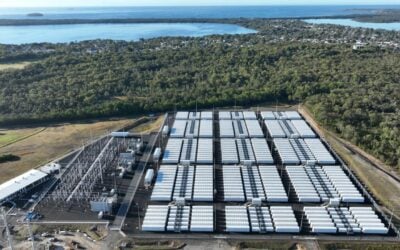
Swanbank BESS, owned by publicly-owned CleanCo Queensland, commenced operations in February 2026 at the site of the former Swanbank coal power station in Ipswich, approximately 45km south-west of Brisbane.
The AU$330 million project, also using Tesla Megapack technology, reuses existing transmission infrastructure from the decommissioned coal plant, which was originally commissioned in 1971 and shut down in 2012.
By leveraging established transmission connections, Swanbank was able to integrate into the NEM more quickly and cost-effectively than greenfield developments, CleanCo claimed.
Schaefer’s analysis, tracked through NEMPulse, a platform that monitors bid behaviour, dispatch, and revenue for every NEM grid-scale battery, raises questions about whether the Victorian Big Battery’s active rebidding strategy is optimised for current market conditions or is leaving revenue on the table.
However, he noted that operators possess information not visible in public bid stacks, meaning the full rationale behind bidding decisions cannot be determined solely from dispatch data.
Neoen, which developed the Victorian Big Battery, sold its Victoria portfolio for AU$950 million in late 2025 amid a takeover by Brookfield Asset Management. The transaction included the Victorian Big Battery alongside wind and solar assets.
Interested in Australia? Read Energy-Storage.news’ Energy Storage Summit Australia coverage and related content.