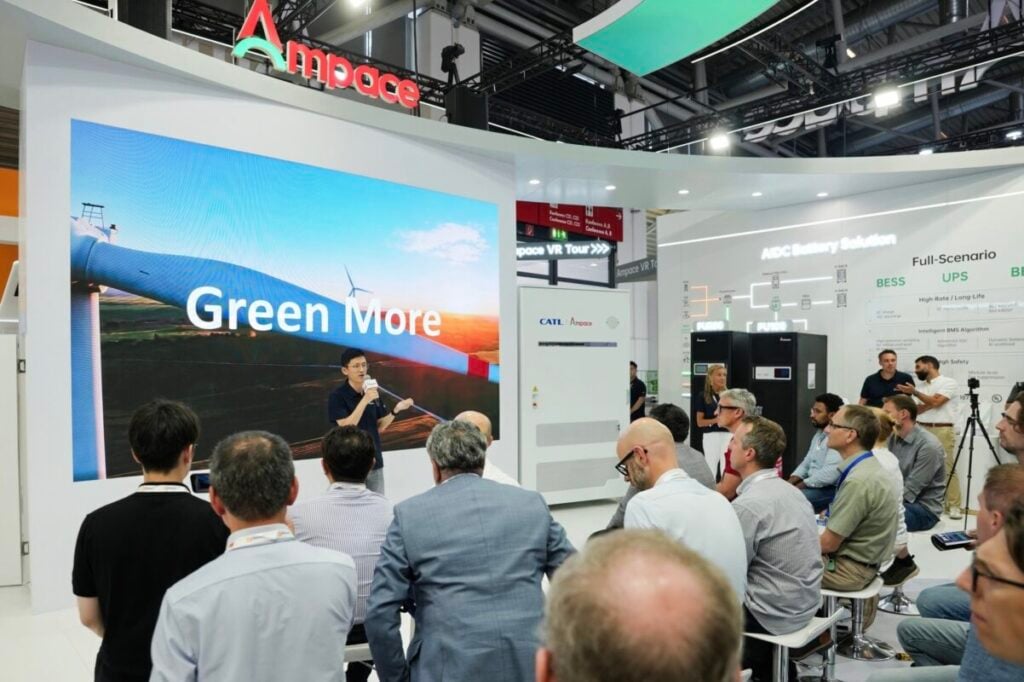
Dr. Qingfeng Yuan, CTO of Ampace, explains how semi-solid state cell chemistry and high-frequency cycling validation are addressing the artificial intelligence infrastructure sector’s zero-tolerance requirements for safety and reliability.
Artificial intelligence data centres require backup power systems capable of bridging grid interruptions without a microsecond of downtime – computing workloads worth millions per hour cannot tolerate even momentary power quality degradation. Yet these same facilities are deploying ever-larger battery systems in high-density configurations, often within or adjacent to buildings housing irreplaceable computing infrastructure.
The result is a risk calculus that keeps facility managers awake at night: conventional systems, whilst proven for grid-scale applications, carry inherent thermal runaway risks that become unacceptable when deployed at scale near critical AI hardware. Auxiliary safety systems can mitigate but not eliminate these risks, and mitigation failures have already resulted in catastrophic data centre fires in other markets.
Ampace, the CATL-ATL joint venture, believes the solution requires rethinking battery safety at the cell chemistry level rather than relying solely on system-level suppression. Dr. Yuan, chief technology officer at Ampace, spoke with Energy-storage.news about how the company’s semi-solid state technology addresses AI data centres’ unique combination of safety, power quality and high-frequency cycling requirements – and why conventional battery integrators struggle to meet these demands.
Try Premium for just $1
- Full premium access for the first month at only $1
- Converts to an annual rate after 30 days unless cancelled
- Cancel anytime during the trial period
Premium Benefits
- Expert industry analysis and interviews
- Digital access to PV Tech Power journal
- Exclusive event discounts
Or get the full Premium subscription right away
Or continue reading this article for free
The perfect storm of demanding requirements
According to Dr. Yuan, “Ai data centres (AIDC’s) demands—zero-tolerance safety, grid-grade power quality and mission-critical reliability—map almost exactly to the core technology bets we have been placing for years.”
AI workloads create a perfect storm of difficult requirements. High-density battery deployments near irreplaceable computing infrastructure mean thermal runaway risks are absolutely unacceptable. Power quality requirements exceed what most grid-scale systems are designed for, and cycling patterns are fundamentally different from traditional applications.
Most battery suppliers are trying to adapt grid-scale products to meet these requirements. Ampace has taken the opposite approach: engineering to address each challenge at its root cause.
Intrinsic safety through semi-solid state chemistry
The safety challenge represents the most critical concern for AI data centre operators. Ampace’s approach differs fundamentally from conventional thermal runaway mitigation strategies by addressing the problem at the cell chemistry level.
Dr. Yuan explains that “safety is Ampace’s non-negotiable baseline and our strongest commitment to the AIDC industry. We deliver intrinsic safety at the cell chemistry level: our semi-solid state cells contain no free liquid electrolyte, preventing leakage; gas generation during thermal runaway is reduced by 58% compared to the industry average; and under extreme conditions such as nail penetration, overcharge and high-temperature ageing, no cascading thermal propagation occurs.”
This represents a different approach from adding more sensors, fire suppression systems, or thermal barriers to conventional liquid-electrolyte cells. Those approaches mitigate consequences – Ampace claims it is eliminating the root cause. When there’s no free liquid electrolyte, the mechanism for thermal runaway propagation simply doesn’t exist.
“At the system level, PU-100 and PU-200 have passed UL 9540A, UL 1973, IEC 62619 and other system-level thermal runaway tests, with verified fire-resistance that ensures no burning and no propagation under extreme conditions—providing proven protection for high-density deployments.”
For data centre operators, this translates to a different risk profile. They’re not depending on suppression systems working perfectly under emergency conditions, the chemistry itself is inherently stable.
Validating performance under AI workload patterns
The second major challenge involves AI workloads creating unusual cycling patterns that standard battery testing doesn’t adequately address. Most suppliers struggle here because standard cycle-life testing doesn’t replicate AI workload patterns.
Ampace has built proprietary validation capabilities specifically for this application. “To address AI workloads characterised by high frequency, shallow depth of discharge and high-current pulses, we built a proprietary simulation platform. We import real customer load profiles and replicate them 1:1 on our test benches, having already completed matching tests with several leading data centres.”
The validation rigour is critical to providing genuine assurance. “Measured cell temperature rise deviates from simulation by no more than ±3°C. For life validation, we employ a 1.5C/1.5C charge-discharge protocol at frequencies of 100–1000 Hz, with SOC maintained close to 100%. After tens of millions of micro-cycles, capacity fade and internal resistance increase remain well within controllable limits—a result of the synergy amongst low-impedance electrode design, semi-solid state technology suppressing interfacial side reactions, and precise BMS balancing.”
Rather than extrapolating from standard testing protocols, Ampace replicates actual AI data centre load profiles and validates performance under those specific conditions—the only way to provide genuine assurance for this demanding application.
Understanding semi-solid state technology
The semi-solid state cell technology that underpins Ampace’s AI data centre solutions represents a significant departure from conventional lithium-ion design. Dr. Yuan explains that the company’s “semi-solid LFP cells use an electrolyte-lean design without free liquid electrolyte, fundamentally preventing leakage and suppressing thermal runaway.”
The safety impact is dramatic: “gas generation during thermal runaway is reduced by 58% compared to the industry average; and under extreme conditions such as nail penetration, overcharge and high-temperature ageing, no cascading thermal propagation occurs.”
For AI data centres where battery systems may be deployed in high-density configurations within or adjacent to computing facilities, this intrinsic safety provides a fundamentally different risk profile than conventional systems that rely entirely on external suppression mechanisms.
Flexible solutions across backup duration requirements
Beyond safety and cycling validation, AI data centre operators require flexibility and scalability across different backup duration requirements. Ampace has developed a comprehensive portfolio to address this need.
According to Dr. Yuan, the company has “built a one-stop product matrix and turnkey solution for AIDC, spanning ‘from grid-side to chip-side’, capable of flexibly supporting scenarios from seconds-level backup power to hours-level bridging. In an era of surging computing power, safety remains Ampace’s constant answer—semi-solid state technology will continue to safeguard every watt of computing power.”
Thermal management expertise from extreme-climate applications
Ampace’s work on extreme-climate residential applications has generated thermal management expertise that translates directly to AI data centre requirements. Dr. Yuan explains that “delivering reliable operation at -25°C without auxiliary heating whilst staying safe in high heat is not the result of a single component—it is a system-level co-engineering achievement spanning cell electrochemistry, intelligent thermal management and robust mechanical design.”
For AI data centres, the challenge isn’t sub-zero operation, but maintaining stable performance under high-frequency cycling whilst preventing thermal accumulation in high-density deployments. The company has “designed a proprietary thermal management strategy that captures and redistributes the internal heat generated during controlled charge-discharge pulses at cold start. Combined with advanced insulation and passive cooling pathways, the system keeps the cell core within its optimal temperature window without external heating devices, whilst also preventing hot-spot accumulation in high-temperature ambient conditions.”
“On the high-temperature side, multi-layer physical shielding, active airflow design and intelligent derating algorithms work together to ensure the system never enters a dangerous thermal regime. This simultaneously protects safety, preserves cycle life, and maintains performance even when ambient temperatures soar.”
The vertical integration imperative
Vertical integration from cell to system proves essential for meeting AI data centre requirements. Dr. Yuan emphasises that the company is “not just a pack assembler. We inherit over 20 years of lithium-ion experience from CATL and ATL, meaning deep battery expertise is in our DNA from day one. Ampace therefore covers the full chain from cell to module to system R&D and manufacturing. This vertical control allows us to break trade-offs that normally force customers to choose between, say, low-temperature performance and long cycle life. We deliver both in the same product without prohibitive cost premiums.”
For AI applications specifically, vertical integration means Ampace can co-optimise cell chemistry, electrode design, and thermal management to deliver intrinsic safety, high-frequency cycling capability, and long service life. Integrators buying cells on the open market have to work within whatever specifications are available—they can’t fundamentally redesign the cell to meet application-specific requirements.
“Because Ampace and CATL share a common DNA under the joint-venture structure, there is no technology wall between cell development and system integration. We move from joint cell specification to system deployment far faster than typical integrators, allowing us to combine, for example, -25°C cold start with 10,000-cycle longevity in a single product generation.”
Long-term supplier reliability through CATL partnership
For mission-critical infrastructure, supplier stability and long-term support are as important as technical specifications. Ampace’s CATL partnership provides tangible assurance in this dimension.
“CATL’s R&D depth and manufacturing quality control at gigawatt scale mean the cells inside the AG440 are engineered with the same rigour that powers millions of EVs. This translates into outstanding consistency, intrinsic safety, and a performance baseline that is extremely difficult for less-integrated competitors to replicate.”
The supply chain implications are equally significant. “CATL’s material security and financial strength provide a robust, predictable supply chain. For customers, this means confidence that their assets will be supported over a 15-year horizon, directly enhancing project bankability, insurability and long-term return on investment.”
AI data centres are making infrastructure investments with 15-20 year horizons. They need suppliers who will still be here—and still be innovating—decades from now.