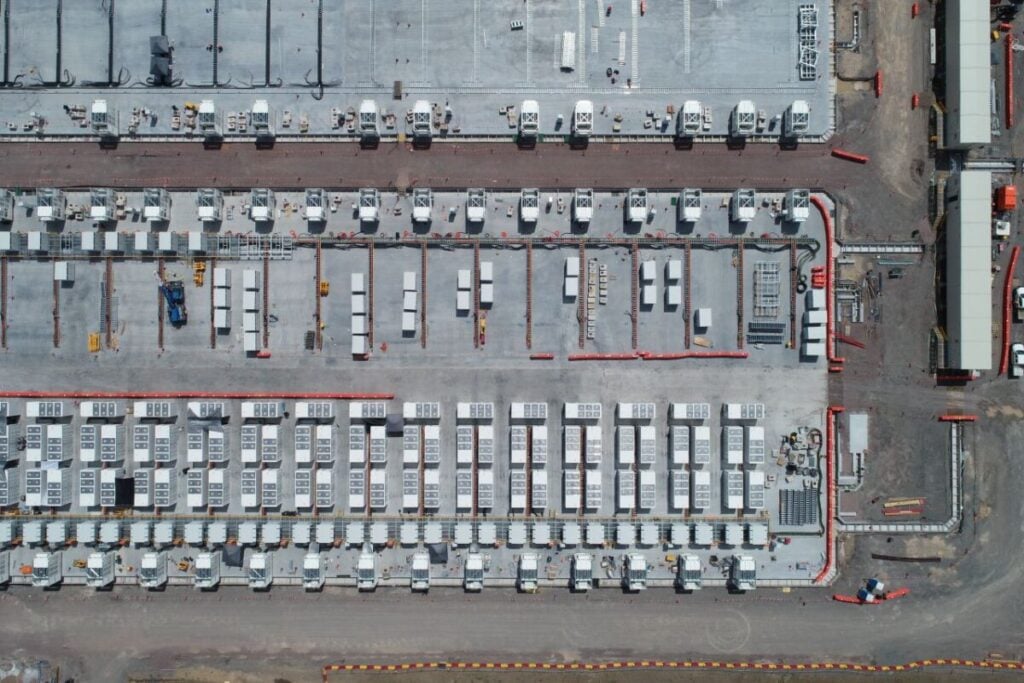
Australian energy company AGL has installed the first 100 units at its 500MW Tomago battery energy storage system (BESS) in the Hunter region of New South Wales (NSW).
The AU$800 million (US$538 million) project has a 4-hour duration and is being built in the Tomago Industrial Estate, north-west of Newcastle. It will connect to the National Electricity Market (NEM), Australia’s main grid across its eastern and southern states.
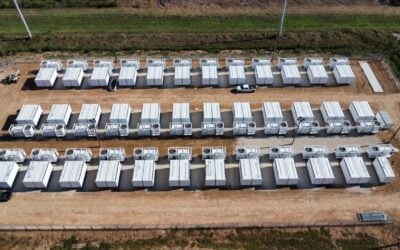
Concrete foundations have been laid, and the first 100 of more than 400 units that will make up the BESS are now in place, AGL said on Wednesday (18 November).
Work on the project’s substation is well advanced, with the first of two main transformers arriving last week, while teams continue laying electrical cabling and installing inverters.
Try Premium for just $1
- Full premium access for the first month at only $1
- Converts to an annual rate after 30 days unless cancelled
- Cancel anytime during the trial period
Premium Benefits
- Expert industry analysis and interviews
- Digital access to PV Tech Power journal
- Exclusive event discounts
Or get the full Premium subscription right away
Or continue reading this article for free
More than 200 workers are involved in construction, which began in December 2025, and AGL said the project remains on track for completion in late 2027.
AGL held a groundbreaking ceremony to start construction of the 2,000MWh Tomago Battery that month, attended by AGL managing director and CEO Damien Nicks and Chris Bowen, federal minister for climate change and energy.
Johan Myburgh, general manager, construction at AGL, said the installation was “an important milestone as we work to deliver” the project “on schedule in late 2027”.
“Australia’s energy transition needs a mix of new projects to help power homes and businesses, and AGL’s Tomago Battery will play an important role by storing electricity ready to be discharged later,” Myburgh added.
Fluence is supplying its Gridstack Pro system, in what it described as its biggest deal globally when AGL reached final investment decision (FID) on Tomago in July 2025. Fluence is also building the project and will provide ongoing service and maintenance.
Gridstack Pro, launched in 2023, succeeded the original Gridstack product Fluence introduced in 2020. Tomago will use grid-forming inverters, part of its power conversion system (PCS), which can provide system strength without the synchronous machines found in coal and gas plants.
Jason Beer, general manager, Australia at Fluence, said: “Following the recent completion of the Liddell Battery, our teams are proud to be on the ground in the Hunter once again, delivering advanced grid-forming technology to help secure New South Wales’ energy future.”
Beer added that Tomago would “provide critical system strength and firming power right in the state’s industrial heartland”.
In May 2026, the NSW government awarded Tomago underwriting support through its Long-Term Energy Service Agreement (LTESA) scheme. The state government granted planning approval for the project in November 2024, when AGL estimated its cost at around AU$1 billion.
Units for Tomago have been received and stored at the Port of Newcastle’s Mayfield Multipurpose Terminal, after the port became the first in NSW cleared to stage grid-scale lithium-ion BESS. Units for Origin Energy’s Eraring BESS and Vena Energy’s 510MWh Bellambi Heights BESS have also been stored there.
Liddell completion and AGL’s wider BESS fleet
The Tomago milestone came two months after AGL’s nearby 500MW Liddell Battery, beside the former Liddell coal power station, reached practical completion, the company said.
The 1,000MWh, 2-hour Liddell BESS, also built by Fluence as engineering, procurement and construction (EPC) contractor, registered with the Australian Energy Market Operator (AEMO) in September 2025. It received AU$35 million from the Australian Renewable Energy Agency (ARENA) and an LTESA.
In May, Nicks said adding the Liddell and Tomago BESS to AGL’s 2.6GW Bayswater coal plant could lift returns by 10%, citing modelling of a realised price of AU$93/MWh, against AU$84/MWh for Bayswater alone.
AGL also operates the 250MW Torrens Island BESS in South Australia and the 50MW Broken Hill BESS in NSW. It aims to add 12GW of renewable and firming capacity across its portfolio by the end of 2035.
In Queensland, AGL’s 125MW/500MWh Abermain BESS near Ipswich has been cleared under Australia’s EPBC Act, after the federal government ruled it was not a controlled action needing further assessment. The 500MW/2,000MWh Tuckeroo BESS in the Western Downs received the same ruling.
Australia became the world’s third-largest utility-scale battery storage market in 2026, with 4.3GW of large-scale BESS reaching financial close, according to the Clean Energy Council’s most recent industry report.
Nearby, the first 460MW/1,770MWh stage of Origin Energy’s Eraring BESS began earning revenue in January 2026, and its second stage, expected in early 2027, will take the system to 700MW/3,160MWh.
Never miss an Australian energy storage story. Sign up for our Australia newsletter and get the latest project announcements, policy updates and market analysis delivered directly to you.