Australian utility AGL has revealed that adding its Liddell and Tomago battery energy storage systems (BESS) to its existing coal-fired generation could boost portfolio returns by 10%.
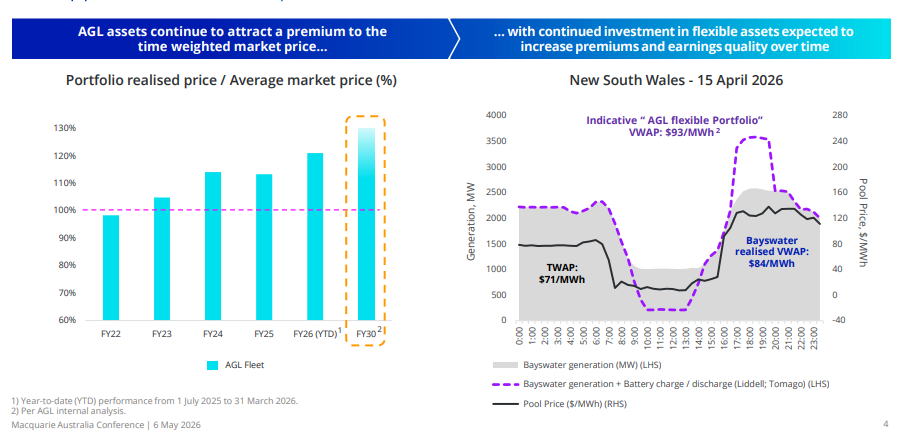
Speaking at the Macquarie Australia Conference earlier this week (6 May), AGL managing director and CEO Damien Nicks presented modelling showing that the addition of the two BESS projects to its portfolio: the 500MW/1,000MWh Liddell battery storage system and the 500MW/2,000MWh Tomago BESS, alongside the company’s 2.6GW Bayswater coal plant, would achieve a realised volume weighted average price of AU$93/MWh (US$67/MWh), compared to AU$84/MWh achieved by just the Bayswater coal plant on a typical trading day. Liddell and Tomago are both nearing their start of commercial operations.
The analysis, based on 15 April market conditions, showcased how battery systems charge during mid-day periods when solar generation drives spot prices near zero and discharge during evening peaks.
The Bayswater coal plant flexed down by 70% during the solar generation period, recording a realised price materially higher than the time-weighted average price of AU$71/MWh. The battery systems, operating at full capacity, would improve on this performance by charging at near zero prices and discharging when demand and prices peak.
Try Premium for just $1
- Full premium access for the first month at only $1
- Converts to an annual rate after 30 days unless cancelled
- Cancel anytime during the trial period
Premium Benefits
- Expert industry analysis and interviews
- Digital access to PV Tech Power journal
- Exclusive event discounts
Or get the full Premium subscription right away
Or continue reading this article for free
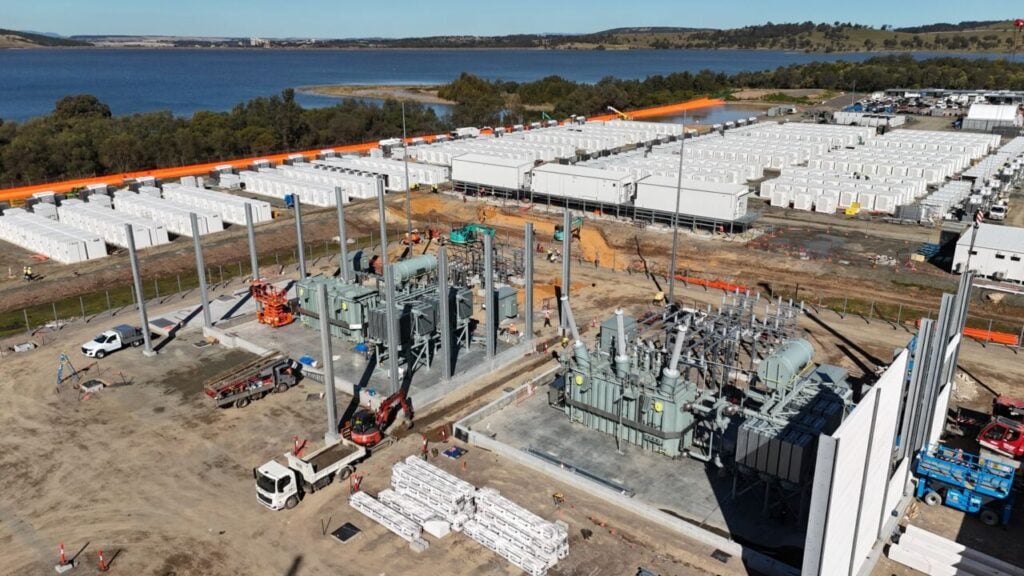
AGL has commenced commissioning the first 250MW tranche of the Liddell BESS, with the full 500MW expected to be operational by June 2026. The project, located at the former Liddell coal-fired power station in New South Wales, was completed in March 2026.
As readers of Energy-Storage.news will be aware, the Liddell BESS utilises grid-forming inverter technology that can provide system strength services without relying on traditional synchronous machines.
Meanwhile, AGL said that construction of the Tomago BESS is progressing, with operations targeted for the second half of 2027. The project, also located in New South Wales, forms part of AU$2 billion in flexible asset developments currently underway at AGL.
Transition economics and portfolio reshaping
Nicks emphasised that the company’s progressive shift away from thermal generation toward lower-carbon energy supply is expected to reduce operating and asset risks over time.
Operationally intensive thermal assets with higher fuel costs, labour intensity and sustaining capital requirements will be replaced with firming assets and renewables.
The company’s analysis showed that realised pricing premiums for its generation fleet have steadily increased since FY22, with a notable uptick in FY26 year-to-date. AGL expects continued investment in flexible assets to further increase these premiums and earnings by FY30 and beyond.
Market conditions remain finely balanced, particularly during peak demand periods. Evening winter peaks continue to rise, with super peak mainland operational average demand reaching 26GW in recent months.
The retirement of coal-fired generation has created gaps in dispatchable capacity, leaving the market susceptible to volatility during periods of extreme weather, low solar irradiation, thermal generator outages, or a lack of wind generation.
AGL’s expanding portfolio of grid-scale battery storage systems includes the 500MW Liddell BESS, the 250MW Torrens Island Battery, the 50MW Broken Hill Battery, and the under-construction 500MW Tomago Battery.
Data centre demand driving storage deployment
The economic case for battery storage in Australia’s National Electricity Market (NEM) continues to rise. Initially driven by increasing renewable energy generation and decarbonisation, it is now also being driven by data centre expansion and increased electrification.
AEMO forecasts data centre electricity demand could reach 34TWh based on projects currently in development, compared to approximately 5TWh from operational facilities today.
AGL highlighted that operational data centres are expected to double their energy consumption once projects under construction reach full capacity, with a further 25TWh of forecast demand if all projects currently in development come to fruition.
The company noted that data centre demand accounts for a portion of forecast growth across all AEMO scenarios, with the potential to exceed AEMO’s Step Change forecast of 23TWh by FY36.
Origin Energy, another Australian utility company, recently declared that electricity sales grew, driven by data centres, in its recent quarterly results.
The company’s strategy to capture data centre demand includes deploying battery storage systems that can serve multiple functions for these facilities. Origin began generating revenue in January 2026 from the first stage of its Eraring battery storage project, a 460MW/1,770MWh system located at the site of Australia’s largest coal-fired power station.
A second stage is expected online in early 2027, bringing total capacity to 700MW/3,160MWh.
Battery storage is increasingly recognised as essential infrastructure for data centre operations, addressing three primary use cases according to Fluence chief growth officer Jeff Monday, who spoke exclusively to ESN Premium at the Energy Storage Summit Australia 2026 in March.
Origin extended the operational life of its Eraring coal-fired power station to April 2029 in January 2026, citing the need to support a secure power supply as renewable energy, storage, and transmission projects are delivered.
The company is targeting up to 5GW of renewables and energy storage by 2030, including 1.7GW of owned and tolled battery storage capacity.
Interested in Australia? Read Energy-Storage.news’ Energy Storage Summit Australia coverage and related content.