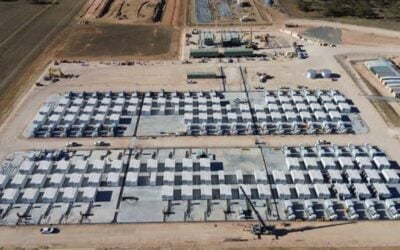
The World Bank will invest in a huge 4GW, 5.12GWh solar-plus-storage complex in Malaysia, part of a pan-Southeast Asian power grid initiative.
The Southern Johor Renewable Energy Corridor (SJREC) will be a roughly 2,000-square-kilometre area dedicated to solar PV and energy storage capacity. The US$6 billion project is backed by the World Bank’s private investment arm, the Iternational Finance Corporation (IFC), alongside the state investment firm of Johor, Permodalan Darul Ta’zim (PDT), and Ditrolic Energy, a Malaysian integrated energy company.
The project is part of a number of larger schemes, chiefly the ASEAN Power Grid Initiative, a plan to integrate power grids and energy supply across Southeast Asian nations. In this vein, the SJREC will be part of the Johor–Singapore Special Economic Zone (JS-SEZ) “masterplan”, able to transmit clean energy to Singapore, which sits on Johor’s southern border.
As a densely populated city state, Singapore relies heavily on energy imports and has made significant plans for cross-border renewables transmission, perhaps most notably the mammoth AA PowerLink project in Northern Australia, which aims to deploy almost 20GW of solar capacity when fully operational and supply power to Singapore via undersea cables.
Try Premium for just $1
- Full premium access for the first month at only $1
- Converts to an annual rate after 30 days unless cancelled
- Cancel anytime during the trial period
Premium Benefits
- Expert industry analysis and interviews
- Digital access to PV Tech Power journal
- Exclusive event discounts
Or get the full Premium subscription right away
Or continue reading this article for free
The site is also part of the Johor Green Development Policy 2030, which the state government introduced to expand its green industries and renewable energy developments.
In an announcement, the IFC said the project would supply renewable energy to “local and multinational corporations, including hyperscale data centre operators, manufacturers, and other businesses in Johor”.
To read the full version of this story, visit PV Tech.