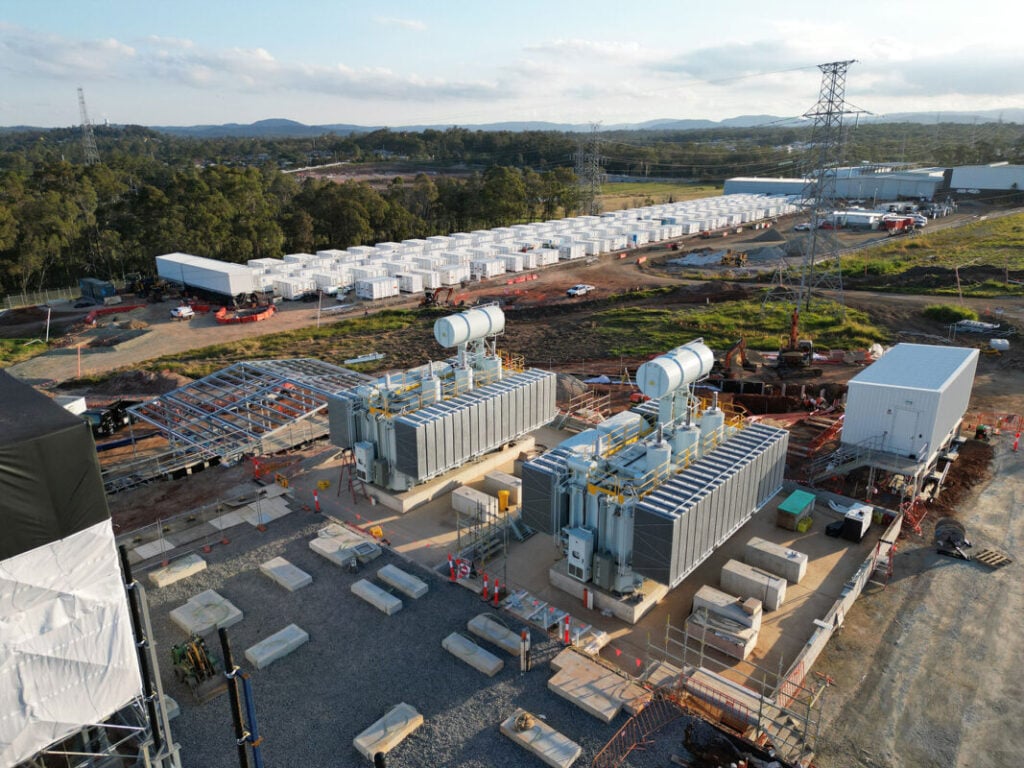
Queensland’s growing battery energy storage system (BESS) fleet set new instantaneous records for both the renewables-plus-storage (RES) share of consumption and the battery storage share of consumption on 31 May 2026.
According to analysis published by Geoff Eldridge of energy consultancy Global Power Energy on LinkedIn, the state reached a new maximum instantaneous RES share of consumption of 79.5% at 11:20, surpassing the previous Queensland high of 78.4% set at 11:40 on 13 April 2026.
One year prior, the record stood at 76.6%, meaning the state has added nearly 3% to its peak RES share in 12 months.
In the same morning window, the Queensland BESS fleet also set a new record for battery storage. The state’s maximum instantaneous battery share of consumption reached 16.9% at 10:50, fractionally exceeding the previous record set just eight days earlier on 23 May.
Try Premium for just $1
- Full premium access for the first month at only $1
- Converts to an annual rate after 30 days unless cancelled
- Cancel anytime during the trial period
Premium Benefits
- Expert industry analysis and interviews
- Digital access to PV Tech Power journal
- Exclusive event discounts
Or get the full Premium subscription right away
Or continue reading this article for free
A year earlier, the comparable figure stood at just 6.4%, a near-tripling in 12 months that Eldridge described as highlighting “how quickly storage is becoming material in National Electricity Market (NEM) operations.”
Eldridge characterised the result as a record of flexibility as much as a renewables record. More than 4GW of rooftop PV, strong grid-scale solar output, over 1.2GW of battery storage charging, net exports, and some curtailment all interacted during the late-autumn midday interval, with utility-scale battery storage, exports and curtailment collectively managing the midday generation surplus.
The timing of the record is what distinguishes it from previous highs. Across the NEM, peak renewable energy share events are typically associated with spring conditions, with mild temperatures, strong solar irradiance and low demand.
Queensland reaching a near 80% RES share on the final day of autumn, close to the winter minimum-demand trough, signals that its operating envelope is no longer confined to seasonal windows.
As Eldridge noted: “high solar output, rapidly growing battery charging, exports and curtailment are now combining to push RES share of consumption close to 80%, even on the final day of autumn.”
Queensland BESS records in context
Eldridge’s analysis also flags what the headline figure does not show. The 79.5% result was concentrated in the late-morning solar window rather than sustained across the full day.
Queensland’s full-day average RES share of consumption on 31 May was 40.5%, ranking 60th since March 2018, compared with the daily-average record of 45.5% set on 30 March 2026 and the third-highest day of 44.9% on 8 May 2026.
The record is an instantaneous five-minute marker rather than a measure of whole-day performance. But as Eldridge noted, it is a meaningful indicator of how quickly Queensland’s grid flexibility is expanding.
The records arrive in the wake of a string of Queensland BESS milestones. As Energy-Storage.news reported last month, Queensland became the first NEM state to discharge over 100GWh from utility-scale battery storage in a single month in April 2026, with NEM intraday spreads collapsing as installed battery storage systems ramped up.
The average 2-hour intraday spread fell below AU$110/MWh (US$78.77/MWh) across all NEM states except South Australia.
The 31 May battery storage charging record, with over 1.2GW absorbed during a single morning interval, is the discharge record’s counterpart: the same Queensland BESS fleet that discharged 100GWh in April is now making its presence felt on the charging side of the curve.
The commercial performance of the Queensland BESS fleet has also drawn attention. CleanCo Queensland’s 250MW/500MWh Swanbank BESS earned AU$743,000 in dispatch revenue in a single month, which was more than double the AU$306,000 earned by the 450MWh Victorian Big Battery over the same period, with the revenue disparity attributed to contrasting bidding strategies between the two merchant systems.
The Swanbank project, which opened in February 2026 on the site of a former coal power station in Ipswich, is one of several large Queensland BESS systems that have come online over the past 12 months, alongside Stanwell’s 300MW/600MWh Tarong Battery and the 260MW/1,090MWh Supernode BESS Unit 2.
Interested in Australia? Read Energy-Storage.news’ Energy Storage Summit Australia coverage and related content.