
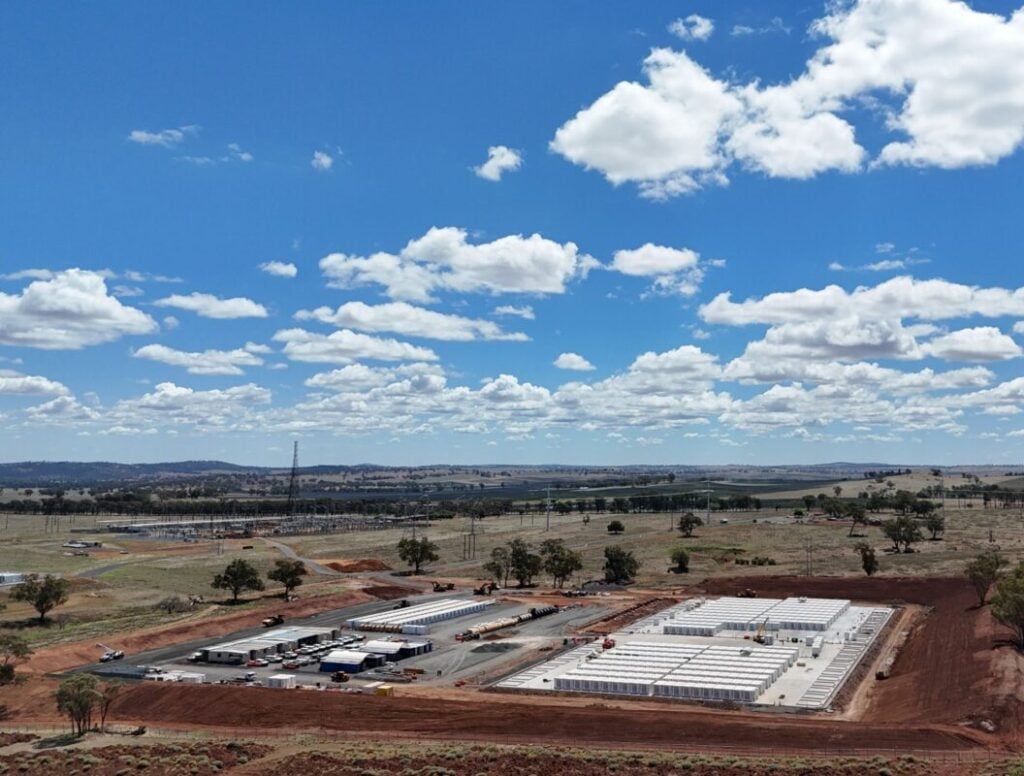
In this contributed article, Madiha Waseem of Fluence explores how strategic procurement and early supplier engagement are reshaping project delivery in the battery energy storage sector, as the industry navigates supply chain pressures, infrastructure competition and the need for flexible commercial models that balance cost certainty with execution agility.
Global energy storage deployment is accelerating at an unprecedented pace. According to BloombergNEF, the industry recently crossed a major threshold with 307GWh of actual installations in 2025 – a record that is expected to be shattered in 2026, with forecasts projecting more than 450GWh of new capacity.
However, the nature of the supply chain challenge has fundamentally changed. A few years ago, the battery energy storage system (BESS) industry was competing fiercely with the electric vehicle (EV) market for battery cells.
Today, that dynamic has flipped. A moderation in global EV sales growth has led to an overcapacity in cell manufacturing, prompting global suppliers to aggressively pivot toward stationary storage. For booming markets like Australia where battery projects now make up nearly half of the Australian Energy Market Operator’s (AEMO) entire connection pipeline, core battery cell supply is more mature and secure than ever.
Try Premium for just $1
- Full premium access for the first month at only $1
- Converts to an annual rate after 30 days unless cancelled
- Cancel anytime during the trial period
Premium Benefits
- Expert industry analysis and interviews
- Digital access to PV Tech Power journal
- Exclusive event discounts
Or get the full Premium subscription right away
Or continue reading this article for free
Instead, the BESS industry is now competing within a much broader local infrastructure boom. There is severe, sustained competition for skilled civil and electrical contractors, specialised logistics, and critical long-lead electrical equipment, such as high-voltage transformers and switchgear.
In this dynamic environment, the traditional assumptions of project planning, where costs predictably declined and rigid fixed-price contracts ruled, are no longer fit for purpose. A procurement strategy built purely around squeezing the lowest capital cost out of a supplier often results in rigid contracts filled with hidden risk premiums.
In response, forward-thinking procurement teams are evolving from a transactional sourcing function into a more strategic part of project delivery.
The case for early works agreements
One of the most effective ways to navigate a dynamic market is shifting how and when we engage with the supply chain. Historically, projects sought to lock in every package at a single point in time.
Today, that approach forces suppliers to guess future market conditions, inevitably leading them to bake massive contingencies into their pricing.
The solution is earlier engagement. By implementing early works agreements (EWAs) and involving original equipment manufacturers (OEMs) and contractors during the project development phase, teams gain crucial visibility into real cost drivers.
Early engagement allows asset owners, project developers, and system integrators to align on scope, identify constructability improvements, and secure long-lead items – like transformers – well before they become a schedule bottleneck.
Asset owners and project developers who have embraced this phased, adaptive approach are already seeing tangible benefits: earlier achievement of project milestones, lower overall execution costs, and a drastic reduction in execution-phase surprises.
Rethinking the balance of plant partnership
This strategic shift is particularly critical for balance of plant (BOP) contractors. Across recent large-scale battery projects, civil and electrical contractors have faced their own set of pressures, from uncertainty around local labour availability to fuel pricing and subcontractor capacity.
When procurement teams force rigid, fixed-price lumpsum models onto BOP contractors, expecting them to blindly absorb the risks of diesel price fluctuations, unpredictable weather delays, and copper market volatility, it creates an adversarial relationship.
Agile procurement models are changing this dynamic. Rather than pushing risk entirely onto the contractor, strategic procurement focuses on flexible commercial structures. This includes introducing indexed pricing mechanisms linked to underlying cost drivers (such as consumer price index or fuel pricing) and aligning price validity periods with key project milestones.
There is also a stronger focus on cost transparency and benchmarking. By working collaboratively with contractors to break down cost structures and challenge assumptions together, procurement teams can identify embedded contingencies and unlock savings without increasing the contractor’s delivery risk. It transforms the BOP relationship from a transactional vendor into a true project partner.
Turning agility into advantage
These changes represent a structural change in how the BESS industry operates. The challenge for the industry is no longer predicting whether prices will rise or fall. It is building the capability to respond quickly and effectively alongside your partners.
As asset owners and project developers increasingly look for both commercial certainty and flexibility, the ability to structure procurement models that balance both is becoming a key differentiator.
For established storage solutions providers like Fluence, this environment presents an opportunity to strengthen supplier and BOP partnerships, embed predictive market intelligence planning stages, and champion more flexible commercial models.
Ultimately, building a resilient procurement framework ensures that asset owners can depend on their delivery partners to build critical infrastructure in an increasingly dynamic global market.
About the Author
Madiha Waseem is a procurement manager at Fluence, where she leads strategic procurement for large-scale battery energy storage projects across Australia. She has built her career across renewable energy, utilities, infrastructure, oil and gas, and services, bringing broad experience in strategic sourcing and supplier relationship management.
Waseem is passionate about building resilient, sustainable supply chains and believes procurement is at its best when it helps create strong partnerships, supports innovation, and delivers long-term value. She holds a Bachelor of Engineering, an MBA, and professional certifications in project management and supply chain.
