A “staged approach” to implementing the EU Battery Passport could be essential if Europe is to improve the information underpinning and resilience of its battery supply chain.
This was an opinion expressed by Daniel Pacner, a policy Advisor at VDA, the German automotive industry association, who spoke to ReCharge’s Ilka von Dalwigk at the Energy Storage Summit at the Battery Show Europe, hosted by Energy-Storage.news publisher Solar Media and co-located with parent company Informa’s The Battery Show Europe in Stuttgart, Germany.
Their conversation followed von Dalwigk’s presentation on the future of the European battery supply chain, during which she expressed concern about Europe’s reliance on Chinese materials and products to build and deploy batteries in Europe.
The Battery Passport, which will come into force from February next year, adds mandatory requirements for supply chain origin and other labelling for all electrochemical batteries, materials, and components placed on the European Union (EU) market. It is part of the EU’s first new Battery Regulation legislation to be introduced since the early 2000s.
Try Premium for just $1
- Full premium access for the first month at only $1
- Converts to an annual rate after 30 days unless cancelled
- Cancel anytime during the trial period
Premium Benefits
- Expert industry analysis and interviews
- Digital access to PV Tech Power journal
- Exclusive event discounts
Or get the full Premium subscription right away
Or continue reading this article for free
The new regulation requires carbon footprint labelling, recycled-content quotas, and other measures that will be phased in gradually, while the Passport itself requires all battery parts and products to feature QR code labelling to denote their origin.
The Battery Passport has also been touted as a means to strengthen the supply chain of the European battery energy storage system (BESS) sector by providing a more robust database of material and component origin and performance.
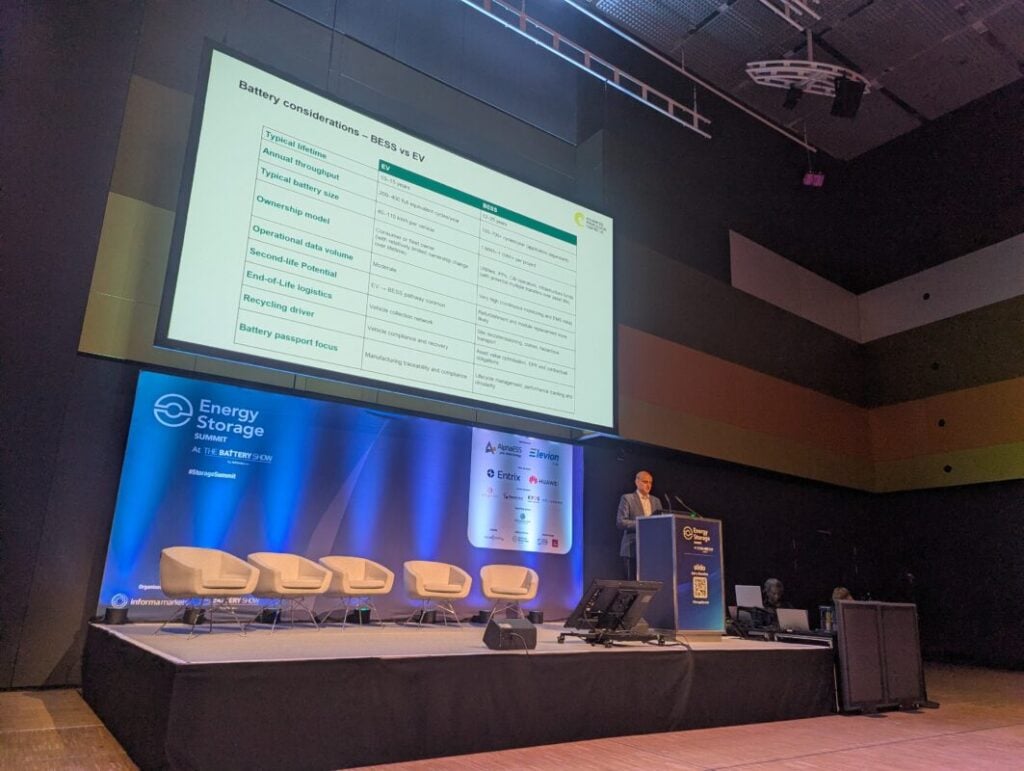
Hadi Moztarzadeh, head of technology trends at the Advanced Propulsion Centre UK, who delivered a presentation on the passport in the hours after Pacner’s panel discussion, said that the upcoming introduction of the Battery Passport means “the era of ‘we’ll figure out battery compliance later’ is over”.
However, Pacner acknowledged that there have been challenges involved in its implementation.
“If everyone calculates the carbon footprint of their battery on a slightly different basis, which is right now the case as there is no standardised basis set, from when they have to go live with their battery passport, we [will] have different kinds of calculations for the carbon footprint,” he explained, using the example of to illustrate a lack of standardisation across the Battery Passport programme.
“Then, you cannot compare the battery passport from Organisation A to the Battery Passport from Organisation B [and] in my opinion, that is one of the most powerful ideas of the Battery Passport.”
“In practice, there are three operational realities following from the structure [of the Battery Passport],” said Moztarzadeh, highlighting the challenges that will need to be overcome simply to input and update information on the passport.
“One is that the passport is dynamic. It’s a live database. The passport needs to be updated and it cannot be a one-time manufacturing record. It has to be a live system, pushing updates to a system identifier. The second is that the access framework is multi-party and multi-layered. There are different groups who can, and should have, access to different groups of data. Thirdly, the data has to flow in from multiple upstream systems,” he added. “The passport is, functionally, a federated read layer over all of them.
Managing this breadth of types of data, integrating information from a range of sources and providing access to the correct parties all pose a range of technical challenges, and contribute to a relatively complex, and perhaps complicated, environment for the Battery Passport.
Pacner expressed concern over a lack of clear legislative direction for the passport, which echoes sentiments expressed throughout the summit, that the German BESS sector would benefit from clearer and more coherent policies from the national government.
While he said that the German automotive sector is “as prepared as it can be” for Battery Passport implementation, the German BESS market, more broadly, still has questions about how the policy landscape will change in the coming years.
‘Staged response’ to ease Battery Passport rollout
In response, Pacner called for a “staged response” to the Battery Passport, calling for European companies to engage with its requirements in two phases to ensure that they integrate “static” data into their reporting first, before moving on to using “dynamic” data points in their Battery Passport reporting.
The information asked for in the passport can be split into each of these categories—a battery’s initial rated capacity is an example of static data, while remaining round-trip efficiency (RTE) is an example of dynamic data—and Pacner called for companies to progressively move from one type of data to the other.
“We see a strong need for a staged approach in order to see the implementation of the Battery Passport done right,” he said. “This staged approach, as we call it, is a two-phase approach where we, first of all, from February 2027, focus on the static data points [to create] a ‘birth certificate,’ and only after that add the complexity of dynamic data points, where they are useful.”
He also stressed that, despite some of the logistical and technical challenges associated with conforming to the passport’s rules, it is worth keeping in mind that it can be a “powerful” tool to address the supply chain imbalance that remains a component of the European battery sector.
“We need to step back and see the advantages that it can have,” Pacner said. “The Battery Passport doesn’t just apply to batteries made in the EU but to batteries made outside; it can be a powerful tool, especially regarding the circular economy. It can also be a huge benefit for our customers; if it’s done right, it can be a huge advantage for our end customers, which I certainly see.”