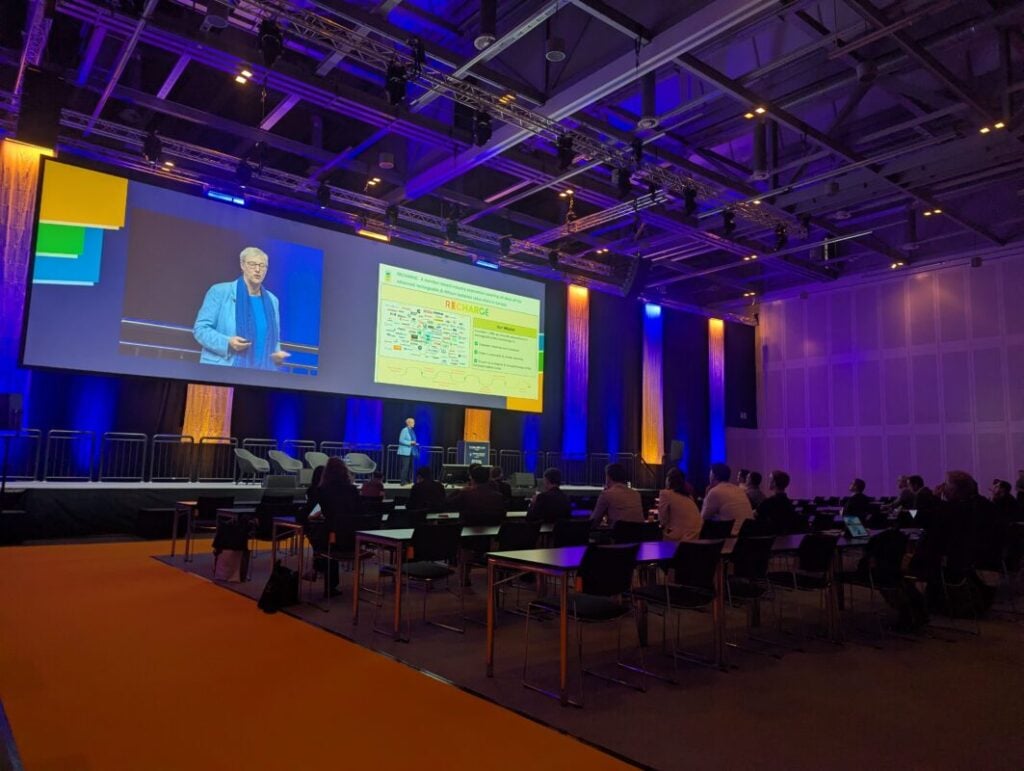
“We are walking with open eyes into new dependencies,” said Ilka von Dalwigk, director general at trade body ReCharge, during a presentation on the future of the European BESS supply chain on the final day of the Energy Storage Summit.
Her comments, made at the beginning of the third day of the Energy Storage Summit at the Battery Show Europe, hosted by Energy-Storage.news publisher Solar Media and co-located with parent company Informa’s The Battery Show Europe, were in reference to Europe’s reliance on Chinese materials and products to meet its demand for battery products.
“The battery value chain is very heavily dependent on the minerals and metals that are going into it,” von Dalwigk continued, using figures from the International Energy Agency (IEA) to illustrate China’s dominance of global battery manufacturing; according to the IEA, China accounted for over 80% of battery cell production in 2025.
“This is not only for one part of the value chain, but all the way from the materials to the final product, not only the cells but the vehicles as well,” she continued.
Try Premium for just $1
- Full premium access for the first month at only $1
- Converts to an annual rate after 30 days unless cancelled
- Cancel anytime during the trial period
Premium Benefits
- Expert industry analysis and interviews
- Digital access to PV Tech Power journal
- Exclusive event discounts
Or get the full Premium subscription right away
Or continue reading this article for free
This separation of upstream and downstream components is important, as von Dalwigk noted that Europe is currently reliant on overseas imports for both: “we have some cell capacity in Europe but the mid- and upstream are still lagging behind,” she said.
Von Dalwigk said that Europe is likely to need to import more “cells and cars” from China into Europe to meet its battery demands, suggesting that the future of the European battery supply chain could be described as either uncertain, or reliant on overseas imports.
In response, von Dalwigk discussed a proposal currently under development by ReCharge that is “a more holistic approach to establishing a battery industry in Europe,” which includes four components: innovating, producing buying and securing batteries
These components require greater attention in Europe and von Dalgwick noted that each component needs to be considered alongside the others, and in relation to other legislation that is currently in effect in Europe.
The potential of more local manufacturing to help Europe to achieve its BESS deployment targets in light of market uncertainty came up as a theme during the morning’s discussions.
A ‘regulatory pendulum’ ahead for Europe
The future of European BESS was linked to the swinging of a “regulatory pendulum” by Coen Hutters, energy transition specialist at RaboResearch, the research arm of Dutch bank RaboBank, who delivered a presentation after von Dalwigk.
The reference to a “pendulum” echoes a metaphor used in a discussion earlier in the summit, and Hutters suggested that the future of European BESS will include both positive and negative developments.
“What we see—and this has been a topic of the last two days—is a regulatory pendulum for BESS,” he said, arguing that inconsistent growth in the UK market could set an example for Europe as a whole to follow. “We see that European BESS has grown in waves; we saw this hockey stick going up, but year to year, if we look at how BESS is growing in the UK, we see that it grew in ups and downs and that is [reflected] across Europe.”
Hutters also argued that the uncertain future of European BESS could create opportunity; he said that RaboBank expects wind and solar generation in Europe in 2040 to be four times higher than in 2020, demonstrating a clear need for continued battery investment and deployment, which will require a range of new financial mechanisms.
“In Germany we now have the inertia market coming up,” he said, echoing an earlier panel discussion on the inertia market in Germany. “This revenue stack, and this whole business model for batteries, is changing. If we look at the fundamentals, as wind and solar grow and natural gas remains in the market, we see slowly that the dayahead spreads are increasing; in the long-term, where we expect batteries to be primarily generating revenues through arbitrage, this is a positive feature of the market.”
Strengthening manufacturing capacity key
Ultimately, according to Jennifer Karle, policy officer at the European Commission, who delivered a presentation to open the summit, Europe is currently “in the key implementation phase” as it looks to navigate this uncertain future.
“[This phase will include] scaling up European manufacturing capacity for net zero technologies, energy intensive industries and their components,” explained Karle.
“The battery booster strategy is the battery-specific strategy and one of the most recent ones we’ve put forward,” continued Karle. “It aims at strengthening the battery ecosystem, particularly in Europe, and to scale-up production here [in] the transition from the initial investment to large-scale production.”