Greater clarity in both government policy and market mechanisms could be essential if the German battery energy storage system (BESS) industry is to realise its considerable potential.
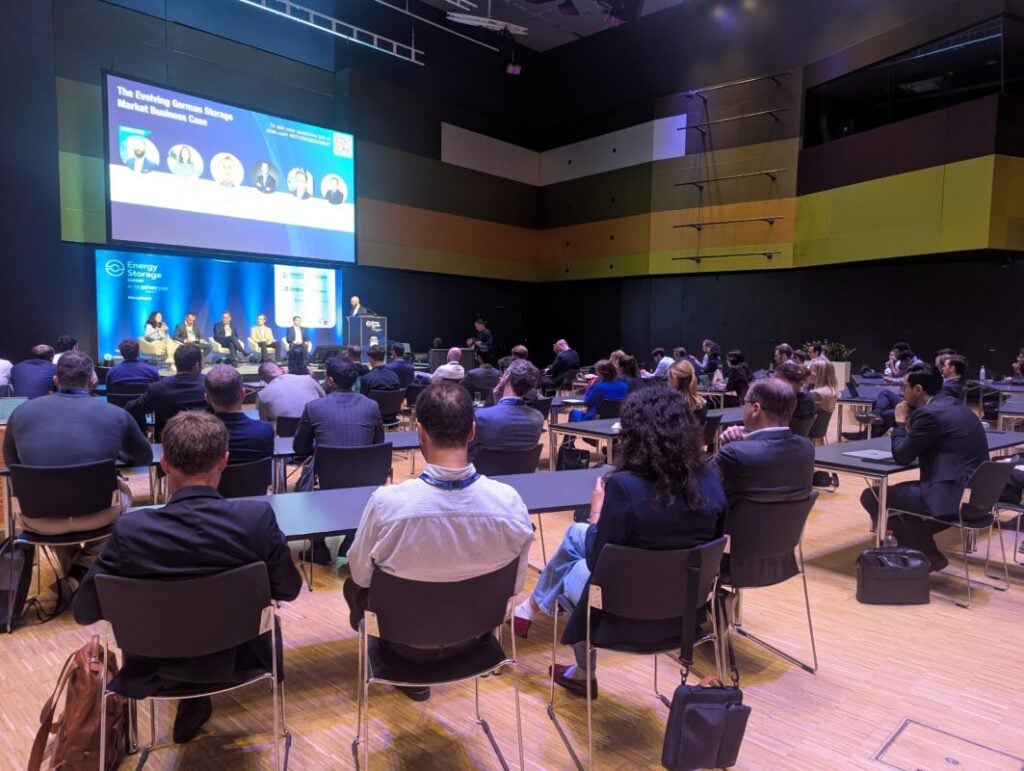
This was an opinion expressed by experts on the first panel of the Energy Storage Summit at the Battery Show Europe, hosted by Energy-Storage.news publisher Solar Media and co-located with parent company Informa’s The Battery Show Europe, this week in Germany.
Jonas Rex-Quincke, senior manager of electrification and climate at ZVEI e.V., who introduced the panel with a presentation, described how there has been “no consensus” in the German policy landscape, likening legislation to a “pendulum” that has swung between highly supportive policies and those that facilitate fewer deployments.
“Pre-2021 we didn’t have a proper definition for energy storage in German law … but even without a proper definition, everyone agreed [that] storage is consumption and production so good luck paying all the fees, taxes and levees for all sides!” he explained.
Try Premium for just $1
- Full premium access for the first month at only $1
- Converts to an annual rate after 30 days unless cancelled
- Cancel anytime during the trial period
Premium Benefits
- Expert industry analysis and interviews
- Digital access to PV Tech Power journal
- Exclusive event discounts
Or get the full Premium subscription right away
Or continue reading this article for free
Even with more recent developments that have been greeted positively by the industry, such as the locking-in of grid fee exemptions until 2029, he said that “for the last six months we were all in despair” as the industry speculated on what the ultimate government decision would be.
“The clarity that we got on the grid fees in the last few weeks was very welcome, certainly from our perspective,” agreed Roberto Jimenez, BW ESS executive director. “The uncertainty that was in the market was unhelpful.”
Perhaps most strikingly, this sustained uncertainty in the German policy landscape was likened to the film ‘Groundhog Day’ by Markus Heiss, shareholder and senior advisor at Atlas Grid Development Partners. Rex-Quincke asked each of the panellists to liken the German market to a film, and Heiss referred to the film in which the lead character is forced to relive the same day repeatedly.
“From an investment return perspective, but at the same time from a very low market entry hurdle perspective, [for] more than 20 years in the industry we’ve seen the situation where it is on the one side a fantastic business case, but a very low market entry hurdle,” said Heiss.
“There needs to be some sort of consolidation, and the market in its current state doesn’t bring consolidation,” he continued, saying that German BESS could benefit from a kind of shake-up that has affected the Italian and Spanish solar PV sectors.
FCAs reflect policy uncertainty, but offer high upside
In this environment, some of the financial mechanisms proposed to facilitate BESS deployments have found themselves on similarly uncertain footing. The panellists discussed flexible connection agreements (FCAs) at length, but Christina Hepp, director of strategy at Green Flexibility, started the conversation by saying that there is noy yet a common understanding of what an FCA is and how it should best be used.
“It’s hard to say what’s misunderstood because there isn’t yet a standard or common practice for an FCA and what it’s for,” said Hepp, who spoke to Energy-Storage.news on this topic ahead of the event. “It’s a good way of integrating storage into the grid because there are real problems behind integrating batteries into the grid … but the way they’re being solved aren’t always the best ideas.”
When asked if investing in BESS through FCAs amounts to throwing darts at a board, Georg Gallmatzer, managing director at ECO STOR said simply that “a bank doesn’t play darts,” highlighting that prolonged policy and market uncertainty in the industry could ultimately prevent projects from even being financed in the first place.
“There is a lot of first explanation required as to why we are doing FCAs at all.”
However, Hepp noted that there is an element of optimism for FCAs, as the relative lack of precedent for the mechanism means there is potential for it to be adopted to the shifting needs of the German energy system.
“Because they’re not very standardised there’s still room to negotiate and discuss,” said Hepp. “I know not every grid operator is open to these discussions, so we start with the grid operators that are open.”
“It’s very important to be able to price an FCA into your investment decision,” she continued, noting that “we don’t see a project without an FCA today”.