
The German regulator BNetzA’s latest draft decision on grid fees from 4 August 2029 onwards still leaves uncertainty for energy storage project business cases.
That’s according to Nina Schmüser, regulatory affairs manager in Germany for independent power producer (IPP) Grenergy, speaking to Energy-Storage.news the day of the draft decision (6 August).
BNetzA’s draft decision document sets a grid fee of approximately €4-7/kW/year (a figure released in May) in Germany, and gives an example based on 2022-2026 data of €5.14/kW/year. It will also implement a dynamic grid fee from 2030 to 2033 that will be location-variable and could be positive or negative, with the aim to reward grid-friendly behaviour, Schmüser explains.
“However, much more than that is not known for dynamic grid fees yet,” she says, adding that the “ongoing discussions around static and dynamic charges have created uncertainty for project business cases”.
Try Premium for just $1
- Full premium access for the first month at only $1
- Converts to an annual rate after 30 days unless cancelled
- Cancel anytime during the trial period
Premium Benefits
- Expert industry analysis and interviews
- Digital access to PV Tech Power journal
- Exclusive event discounts
Or get the full Premium subscription right away
Or continue reading this article for free
Schmüser will be one of nearly 100 speakers taking the stage at the upcoming Energy Storage Summit Germany 2026, which runs on 15-16 September 2026 in Berlin (use our code ESN20 for a 20% discount on tickets).
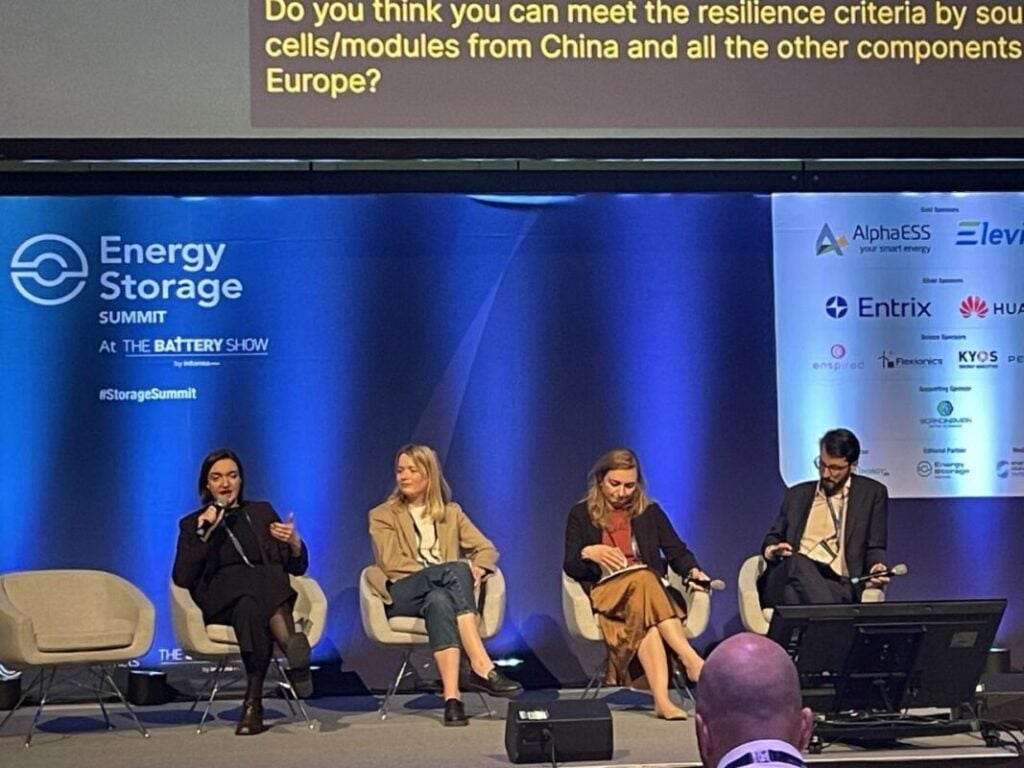
In this Q&A, Schmüser discusses the key regulatory and policy areas in the German energy storage market. Schmüser was also on stage at our Energy Storage Summit at the Battery Show Europe in Stuttgart, Germany, in June, where she discussed the upcoming capacity market (CM).
Grenergy’s battery energy storage system (BESS) activity has to-date mainly been in Chile and Spain, but it has a broader European BESS pipeline including in Germany.
Energy-Storage.news: How would you characterise the current state of the German energy storage market, in terms of the key trends, major successes and achievements, and challenges still to be overcome?
Nina Schmüser: Both the regulatory landscape and the BESS market in Germany are maturing. Over the past few years, falling EPC costs, attractive flexibility revenues, high electricity price spreads, and the exemption from grid fees have driven a rapid increase in utility-scale BESS projects. Grid connection requests grew much faster than grid operators and the regulatory framework could adapt, leaving many operators to integrate a new asset class while maintaining system stability.
Over the past year, the focus has shifted towards establishing a clearer regulatory framework. BNetzA has started shaping grid fee rules for BESS, although the ongoing discussions around static and dynamic charges have created uncertainty for project business cases.
Grid connection charges (BKZ, a one-off construction fee for network upgrades) are now common for new projects and are becoming more standardised, including regional differentiation.
Flexible Connection Agreements (FCAs), which were still a niche topic a year ago, are increasingly becoming the norm for new grid connections. While some operators, such as the E.ON group, have published FCA principles, key questions remain around implementation without undermining project viability.
All four TSOs have introduced project maturity-based grid connection processes, and more DSOs are expected to follow. The draft Grid Package, which is expected to be in Parliament after the summer break, proposes digitalised connection procedures with binding deadlines and maturity-based processes for DSO connections.
Overall, developing BESS projects has become more complex, requiring more technical analysis and documentation. At the same time, the market is maturing, and predicted margins are no longer as attractive as they once were. While this places greater demands for developers, it also reflects a market that is becoming more established, with BESS increasingly recognised as an integral part of the electricity system.
Is there any clarity on what grid fees/network charges will look like for BESS coming online after 4 August 2029?
While the final design of grid fees is not yet fully confirmed, BNetzA provided greater clarity in its presentation at the end of May and in the draft decision published on 6 August 2026. Operators of BESS assets coming online after 4 August 2029 can expect a capacity grid fee of approximately €4-7/kW/year based on the contractually agreed grid connection capacity applicable as of 01/01/2029. This was communicated in May. The value is calculated on a five-year rolling average, where BNetzA provided an example calculation in their latest draft document based on data from 2022-2026, resulting in a fee of €5.14€/kW/year.
Additionally, from 2030 to 2033, BNetzA will implement a dynamic grid fee that will be a location-variable energy charge based on a 15-minute variation. This grid fee can be positive or negative and BNetzA has made clear that they aim to reward grid-friendly behavior leaving BESS operators with an additional revenue stream. However, much more than that is not known for dynamic grid fees yet. Another decision will be made by BNetzA two years prior to the implementation.
Also, the BKZ will be applicable, which is now already applicable for most BESS projects as a one-time charge for grid connection. BNetzA wants to regulate the BKZ from 2027, considering regionally differentiated charges to steer BESS projects to regions where they deliver most value to the grid.
What opportunities and challenges do you see with the capacity market (CM) for energy storage?
The biggest challenge of the German capacity market is that its initial design strongly favours gas-fired generation. The first 9GW of tenders are unlikely to be accessible for today’s BESS projects. This not only adds costs that will ultimately be borne by electricity consumers but also locks in gas capacity for many years while reducing merchant revenues for storage assets. The opportunity is that the framework leaves room to shape the technology-open tenders from 2027 onwards. These should give BESS a fair opportunity to compete as a carbon-free and increasingly cost-effective source of flexibility.
What are the other key policy questions and grey areas which German industry and government still need to find solutions for, to unlock storage’s full potential for the grid?
FCAs
FCAs can be an effective tool to make more grid capacity available for BESS and give grid operators the confidence to connect storage projects while maintaining system security. From a developer’s perspective, we fully recognise this objective. However, FCAs must also provide a bankable and predictable framework for investment. Reasonable restrictions on charging or discharging during periods of grid congestion are acceptable, provided they are transparent, proportionate and based on clear technical criteria. FCAs should not be based on worst case considerations made by the grid operators.
Most importantly, developers need certainty early in the process. The scope of any restrictions, including the maximum curtailed capacity and the conditions under which they apply, should be defined when the grid connection agreement is signed. BESS operators still shall have a say in the definition of the FCA. Only then can FCAs support both faster grid connections and investable BESS projects.
BKZ fees
BNetzA has announced they will regulate BKZ further in 2027 taking into consideration that they will be regionally differentiated, incentivising BESS projects to regions in Germany, where they make most sense. I think this is a step into the right direction as I am convinced that a system-perspective, as BNetzA has, is needed to incentivise BESS to provide their full potential to the grid. In connection with FCAs, which also decrease the overall profitability of BESS projects, I do think BNetzA and the regulators should consider an exemption of BKZ payment when FCAs have been implemented.
Grid connection backlog
Transparent and harmonised grid connection procedures at the DSO level are essential. The maturity-based processes already introduced by the TSOs can be a blueprint. Grid connection procedures should remain as simple as possible, not requesting too detailed documentation, while including binding deadlines for grid operators to review applications and provide timely feedback. Digitalisation is equally important.
Ideally, developers should be able to submit and track applications through standardised processes, supported by a common platform that provides transparent information on available grid capacity. The draft Grid Package moves in this direction by proposing digitalised, maturity-based procedures for DSOs by 2028. Given the pace of BESS deployment, these reforms should be implemented as early as possible.
