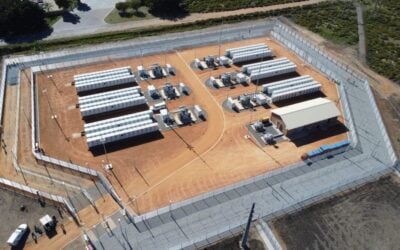
The Ministry of Energy of Uzbekistan has signed an Implementation Agreement (IA) with ACWA Power for battery energy storage system (BESS) projects.
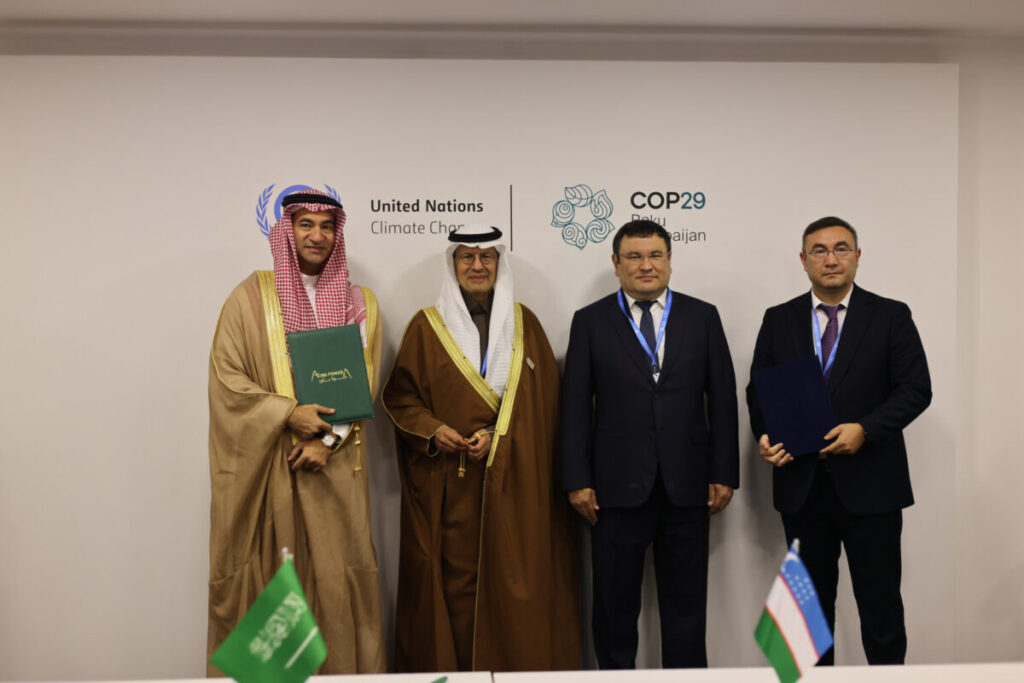
The Central Asian Republic’s government signed the deal with Saudi Arabian renewable energy, desalination and green hydrogen project developer ACWA Power on the sidelines of the United Nations (UN) COP29 climate conference in Baku, Azerbaijan.
ACWA Power will get contractual priority for the development of ‘up to 2GWh’ of standalone BESS projects. The developer said this would enable it to offer ‘competitive tariffs’. The agreement is valid for two years but can be extended by mutual agreement.
ACWA Power announced the agreement earlier this week (17 November), which the developer said is binding. It was signed in the presence of Saudi energy minister Prince Abdulaziz bin Salman bin Abdulaziz Al Saud, Uzbek President Shavkat Mirziyoyev, and Azerbaijan President Ilham Aliyev, with Azerbaijan holding the COP29 presidency.
Try Premium for just $1
- Full premium access for the first month at only $1
- Converts to an annual rate after 30 days unless cancelled
- Cancel anytime during the trial period
Premium Benefits
- Expert industry analysis and interviews
- Digital access to PV Tech Power journal
- Exclusive event discounts
Or get the full Premium subscription right away
Or continue reading this article for free
It follows the formation a few days prior of a joint executive programme to cooperate on renewable energy development by Saudi Arabia’s government and the three Central Asian Republics of Azerbaijan, Kazakhstan and Uzbekistan at the climate conference.
For developer ACWA Power, which counts the Saudi Private Investment Fund (PIF) sovereign wealth fund among its shareholders, it also follows earlier agreements signed with the Uzbekistan government for solar PV and battery storage projects.
In March 2023, the company signed agreements to develop 1.4GW of solar PV and 1.2GW of energy storage, which Uzbekistan’s Ministry of Investment, Industry and Trade would finance.
After signing power purchase agreements (PPA) with the country’s grid operator for the two solar projects and three BESS projects that deal comprised, in May this year, the developer signed a Memorandum of Understanding (MoU) towards further cooperation with the Uzbek state.
In early November, ACWA Power then secured a US$240 million Islamic Equity Bridge Loan (EBL) with the World Bank’s International Finance Corporation (IFC) for that contracted portfolio.
“This Agreement marks a key milestone in the evolution of our ongoing partnership with Uzbekistan. Crucially, as the largest investor in Uzbekistan’s energy sector, with over 13GW of projects under development, this new agreement represents our shared vision for a sustainable future for all,” said ACWA Power vice chair and managing director Raad Al Saady this week.
Uzbekistan is targeting the deployment of 25GW of solar PV and wind by 2030, alongside 2GW of existing hydroelectric power generation for a total 27GW. As of the beginning of 2023, renewable energy capacity including hydro was about 2,300MW; solar PV capacity went from just 3.5MW to 300MW in the country from 2020 to 2023.
Among others, the Uzbekistan government has also signed agreements to develop renewable energy and energy storage with another Middle Eastern state-owned developer, Masdar from the United Arab Emirates (UAE). That includes a 250MW solar PV and 63MW BESS hybrid project, which is set to be Central Asia’s first grid-connected renewables project that features battery storage.