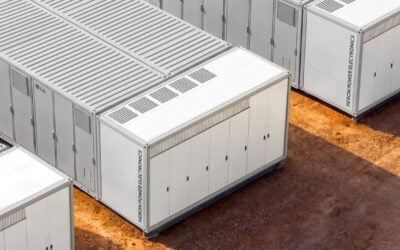
Georgia Power has inaugurated the first battery energy storage system (BESS) project the US utility company has built to own and operate.
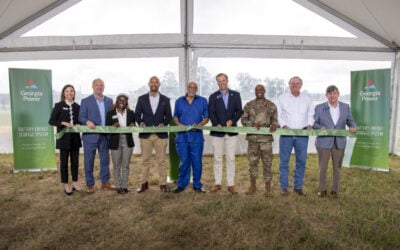
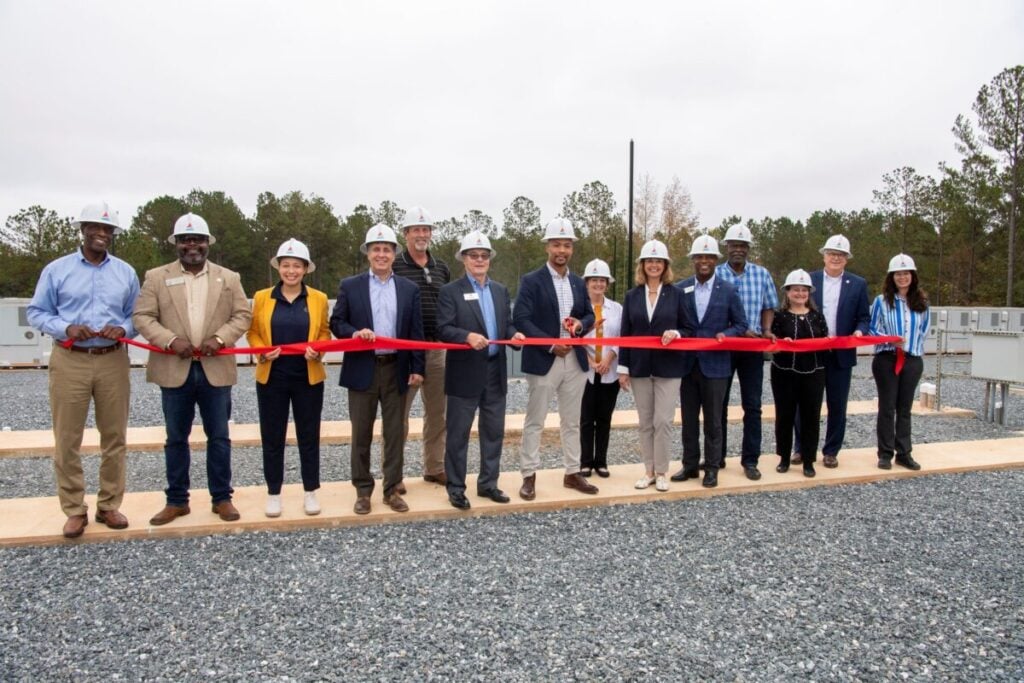
A ceremony was held last week (7 November) at the Mossy Branch Battery Facility site in Georgia’s Talbot County.
The 65MW/260MWh BESS project is part of an initial 80MW portfolio of build-own-operate (BOO) battery assets that Georgia Power included in its 2019 Integrated Resource Plan (IRP).
Georgia Power representatives and dignitaries, including members of the Southern US state’s regulatory Public Service Commission (PSC), state lawmakers, and local politicians from Talbot and neighbouring Muscogee Counties, attended the event.
Try Premium for just $1
- Full premium access for the first month at only $1
- Converts to an annual rate after 30 days unless cancelled
- Cancel anytime during the trial period
Premium Benefits
- Expert industry analysis and interviews
- Digital access to PV Tech Power journal
- Exclusive event discounts
Or get the full Premium subscription right away
Or continue reading this article for free
The Georgia PSC approved Georgia Power’s BOO request for Mossy Branch in 2021, at which time system integrator and BESS manufacturer Wärtsilä was named as the project’s engineering, procurement and construction (EPC) contractor as well as BESS equipment supplier.
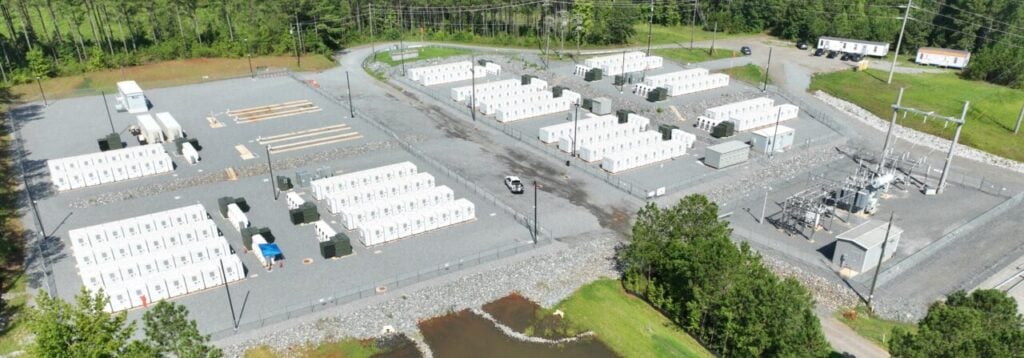
Mossy Branch is also the first standalone battery storage asset connected to the Georgia Integrated Transmission System electricity grid. It will charge directly from the grid when power is cheaper, such as during periods of abundant renewable energy generation and low demand, and discharge stored energy to the network when demand and prices are higher.
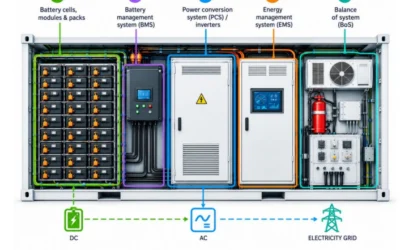
Wärtsilä’s optimisation software platforms, including its GEMS Digital Energy Platform energy management system (EMS), will manage the facility and secure its operations.
Georgia Power grows target portfolio as electricity demand forecast to rapidly increase
At the time of the 2019 IRP, the 80MW BESS build-out was part of an overall 2,260MW procurement of new energy resources, with Georgia Power also pledging to close five coal-fired power plants.
In addition to its BOO strategy, the utility has also determined to contract for energy storage capacity from third party-owned facilities. The first such project Georgia Power contracted for, Hickory Park, is a 196MW solar PV plant paired with 40MW/80MWh of battery storage, which went into commercial operation in June 2022, developed and owned by RWE.
By the time that happened, Georgia Power had in February of that year filed its subsequent 2022 IRP—the long-term plans are filed at three-year intervals—in which it requested the PSC’s permission to own and operate a further 1GW of battery storage.
That figure was halved to 500MW when the IRP was approved in July 2022. The commission did approve a separate project-specific request by the utility to build, own and operate McGrau Ford Battery Facility, a 265MW system in Cherokee County, which Georgia Power said is expected to go into service by the end of 2026.
Last year, Georgia Power updated its IRP in light of growing electricity demand projections, which shot up from an expected 400MW increase by 2030 in the 2022 filing to 6,600MW just a year later.
The utility now intends to procure a further 1GW of BESS resources through competitive solicitations, and a few months ago it announced the locations and megawatt output figures for the 500MW of approved BOO projects.
These are split across four sites. The largest is a second phase expansion to McGrau Ford, also 265MW. Georgia Power said site selections were strategic, leveraging available land and grid infrastructure.
In addition to developing McGrau Ford II on land the company already owns adjacent to the first phase, two projects will be built close to Air Force Bases and co-located with existing solar PV plants, while the fourth will be constructed at the site of a retired coal plant facility.