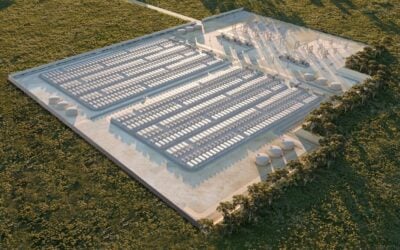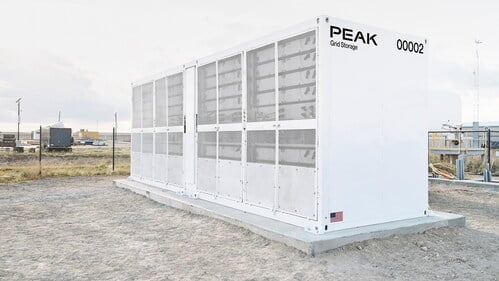
Sodium-ion (Na-ion) battery energy storage system (BESS) startup Peak Energy has announced a multi-year phased agreement with developer Jupiter Power to supply up to 4.75GWh of Na-ion BESS.
Peak will supply the BESS, utilising its sodium-ion phosphate pyrophosphate (NFPP) chemistry, to Jupiter Power for deployment between 2027 and 2030. The total contract value could exceed US$500 million.
A spokesperson for Peak Energy confirmed to Energy-Storage.news that a 720MWh project being delivered in 2027 is a firm order from Jupiter, while the other 4GWh is held under capacity reservation.
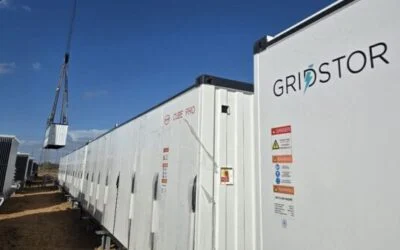
Peak’s BESS is built without moving parts and incorporates active cooling and ventilation, which, according to the company, reduces the most common failure points found in typical BESS systems.
Try Premium for just $1
- Full premium access for the first month at only $1
- Converts to an annual rate after 30 days unless cancelled
- Cancel anytime during the trial period
Premium Benefits
- Expert industry analysis and interviews
- Digital access to PV Tech Power journal
- Exclusive event discounts
Or get the full Premium subscription right away
Or continue reading this article for free
Lithium-ion (Li-ion) battery cells in BESS require active cooling and ventilation to prolong their lifespan and prevent fires.
Reduced system degradation can lower the need for augmentation, so, in theory, operators will not need to add extra batteries or components during the project’s lifetime to preserve storage capacity.
In September, Peak deployed its Na-ion BESS at SolarTAC in Watkins, Colorado. The system is operated in partnership with nine utilities and IPPs.
While the capacity of that project was not disclosed, the goal of the deployment is to gather and share operational and modelling data from the unit during real-world operation among the project’s participants.
In the summer announcement about the company’s NFPP pilot project, the company emphasised the significance of onshoring BESS material manufacturing after the passage of H.R.1, more commonly known as the “One, Big, Beautiful Bill Act” (OBBBA).
In an interview with Energy-Storage.news, after H.R.1 was enacted, Peak Energy’s president and CCO, Cameron Dales, commented on BESS technology:
“In the end, from a national security perspective, it’s one of a handful of really critical technologies that there’s a bipartisan consensus that we need to control our own destiny, and the ability to store energy is one of the critical needs in the economy.”
Near 2024’s end, Peak Energy established a sodium-ion battery cell engineering centre in Broomfield, Colorado, in collaboration with the Colorado Office of Economic Development and International Trade (OEDIT).
The company’s inaugural US cell factory is currently under development and is scheduled to begin production in 2026.
In an upcoming interview with ESN Premium and Mukesh Chatter, President, CEO, and co-founder of another Na-ion energy storage startup, Alsym Energy, Chatter shared similar points about the advantages of the technology’s ability to operate as a safer alternative to lithium-based chemistries.
“I think lithium iron phosphate (LFP) is a good application for low-density applications. But, if you go to high-density applications, 200kWh, 1MWh, multi-MWh, it’s just too dangerous.”
Chatter continued, “Nobody wants a 10MWh plant sitting next to a chemical industry or a metal processing plant. A data centre absolutely doesn’t want lithium batteries sitting right next to their servers.”