Canadian Solar’s quarterly battery storage shipments increased 73% year-on-year, with 3.7GWh delivered in the second quarter of 2026.
The Ontario-headquartered vertically integrated solar PV and battery energy storage system (BESS) manufacturer released its Q2 2026 financial results for the three-month period ending 30 June, last week (27 August). In the same period of 2025, it shipped 2.2GWh of battery storage.
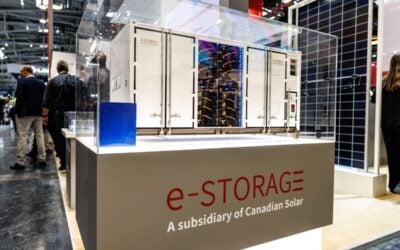
Its BESS subsidiary, e-STORAGE, generated US$426 million revenue during the quarter and its contracted backlog at the end of the period stood at US$3.5 billion. E-STORAGE has 34GWh of operating projects contracted under long-term service agreements (LTSAs). Of the 3.7GWh shipped during the quarter, 471MWh went to Canadian Solar internal projects, with revenue recognised from the remaining 3.3GWh.
While Canadian Solar’s PV module shipments fell 60% year-on-year to 3.1GW, the lowest since Q2 2020, when it shipped 2.9GW of modules mid-pandemic, battery energy storage system (BESS) shipments surged.
Try Premium for just $1
- Full premium access for the first month at only $1
- Converts to an annual rate after 30 days unless cancelled
- Cancel anytime during the trial period
Premium Benefits
- Expert industry analysis and interviews
- Digital access to PV Tech Power journal
- Exclusive event discounts
Or get the full Premium subscription right away
Or continue reading this article for free
You can read coverage of Canadian Solar’s results focused on the solar PV side of the business over at PV Tech, which notes that the company expects an increase in solar module shipments in Q3 as it ramps up its PV manufacturing capacity significantly, particularly in the US through 2026.
Q2 2026 net revenues stood at US$1.2 billion, at the high end of previously offered guidance of US$1 billion to US$1.2 billion. This was a sequential increase of 12% from the previous quarter, but 29% less than Q2 2025’s US$1.7 billion.
Meanwhile, gross margin was 13.9%, less than half the 29.8% reported a year previously for Q2 2025. Canadian Solar posted a net loss of US$77 million for the quarter.
The company offered guidance for Q3 shipments, forecasting 3.5GW to 3.8GW of solar PV module shipments and between 3.4GWh and 3.8GWh of battery storage shipments, revenue between US$1.3 billion – US$1.5 billion and a 13.5% – 15.5% gross margin.
It also gave full-year 2026 guidance, limited only to expected module and BESS shipments to the US market: Canadian Solar expects to ship between 6.5GW and 7GW of PV modules in the US this year and between 4.5GWh and 5.5GWh of BESS.
Canadian Solar CEO: ‘Manufacturing is where our strategic priorities lie’
While Canadian Solar essentially has two businesses: CSI Solar, its manufacturing arm (of which e-STORAGE is a subsidiary) and Recurrent Energy, its project development arm, almost all the company’s revenues come from manufacturing.
Recurrent Energy’s revenue for the quarter was US$117 million, with a gross profit of US$36 million and gross profit margin of 30.7%. Recurrent Energy also racked up an operating loss of US$19 million in Q2.
In addition to about 6GW of solar PV projects in construction and 15.5GW in its opportunities pipeline across North America, EMEA and Asia-Pacific regions, Recurrent Energy is currently building 600MWh of BESS projects in North America, has a backlog of 4,378MWh, an advanced pipeline of 7,841MWh for which grid interconnection has been secured and an early-stage pipeline of 71,238MWh.
The results release is the first since founder and CEO Dr Shawn Qu stepped down to make way for successor Colin Parkin. Parkin, whom Qu introduced in a Q1 2026 results earnings call, was previously the head of e-STORAGE, and Qu has now taken up new roles as Canadian Solar’s chairman and chief technology officer (CTO).
“During the quarter, shipments within our Manufacturing segment were in line with expectations, with slight operational outperformance in battery energy storage, as we continue to navigate global macroeconomic uncertainties with agility,” Parkin said of the latest results.
Parkin said in an earnings call to discuss results that manufacturing, the key driver of Canadian Solar’s financial performance, “is also where our strategic priorities lie.” That includes an energy storage business that the CEO claimed “is scaling rapidly and executing well globally,” with deliveries during the quarter to projects in North America, EMEA, Asia-Pacific and Latin America.
Manufacturing, responsible for US$1.1 billion of quarterly revenues, saw US$131 million gross profit with a 11.9% gross margin. It made an operating loss of US$49 million, which CEO Parkin said was due to “higher unit shipping costs and ramp-up expenses.”
Parkin talked up the company’s vertical integration as a strategic advantage in the battery storage market, claiming that Canadian Solar’s “market value extends well beyond supplying battery containers.”
“We produce our own battery cells, design the SolBank platform, integrate the power conversion and proprietary energy management controls and deliver full EPC and commissioning services and provide ongoing support through long-term service agreements,” Parkin said.
“This end-to-end full-stack model offers customers a single accountable partner while supplying us with real-world operating data to refine future solutions.”
Canadian Solar began transitioning in 2023 from a former white-label business model to manufacturing its own BESS, including cells.
Technology roadmap: 588Ah LFP cells, solid-state transformers and sodium-ion BESS
On the earnings call, executive chairman and CTO Shawn Qu outlined progress and the trajectory of the company’s solar PV and energy storage technology roadmap.
In solar, Canadian Solar is focused on mass production and optimisation of its next-generation heterojunction (HJT) and TOPCon cell architectures through 2028. It expects to begin mass production of premium Tunnel Oxide Passivated Back Contact (TBC) architecture cells to begin in 2028, aimed primarily at the residential market, while perovskite tandem cells targeted for commercial shipment in 2030 could “break through the 30% module efficiency area,” as Qu called it, “our ultimate efficiency frontier.”
In energy storage, Canadian Solar is “exploring” solid-state transformers at 2.5MW, 34.5kV AC to 800V DC solution with over 98.5% conversion efficiency that could potentially replace power conversion system (PCS) units and integrate directly into the BESS platform, Qu said.
This could enable BESS to serve long-duration energy storage (LDES) applications and meet harsh environmental requirements at a lower levelised cost of storage (LCOS), the CTO claimed.
Alongside the current SolBank 3.0 lithium iron phosphate (LFP) BESS, which delivers 5MWh of capacity in a standard 20-foot enclosure using 314Ah cells, e-STORAGE will begin shipping the next iteration in 2027.
SolBank 4.0 increases energy density by 25%, featuring 6.25MWh of storage in the same 20-foot containerised form factor using 588Ah LFP cells.
Qu said Canadian Solar has scaled its power electronics “in tandem” with the growth of the battery systems, transitioning to a new liquid-cooled medium voltage (MV) skid from the company’s current air-cooled version. Skid 2.0 integrates 32x 450kW inverters to put 14.4MW in a 40-foot layout.
In addition, the company is “actively validating” its new sodium-ion (Na-ion) containerised BESS platform, SolBank Na, which Qu claimed will eventually deliver an “exceptional” cycle life of over 15,000 cycles.
The former CEO also talked up sodium-ion’s potential advantages, including abundant raw materials used in production, simplified cooling requirements and reduced thermal runaway risk versus lithium.
Elsewhere, Canadian Solar’s energy storage technology roadmap also includes a high-capacity product designed for deployment in AI data centre server rooms “to deliver millisecond-scale energy management solutions,” Qu said.
“Ultimately, unifying these solar and storage development advances our vision of Canadian Solar as a total energy technologies provider.”
Conference call transcription by The Motley Fool.