The US Department of Energy (DOE) has earmarked up to US$3.5 billion of new capital for battery manufacturing, a week after European gigafactory company Freyr announced it would only be scaling in the US for now.
The funding comes from the Bipartisan Infrastructure Law – the preceding companion legislation to the Inflation Reduction Act – which was signed two years ago, and will be administered by the Office of Manufacturing and Energy Supply Chains (MESC).
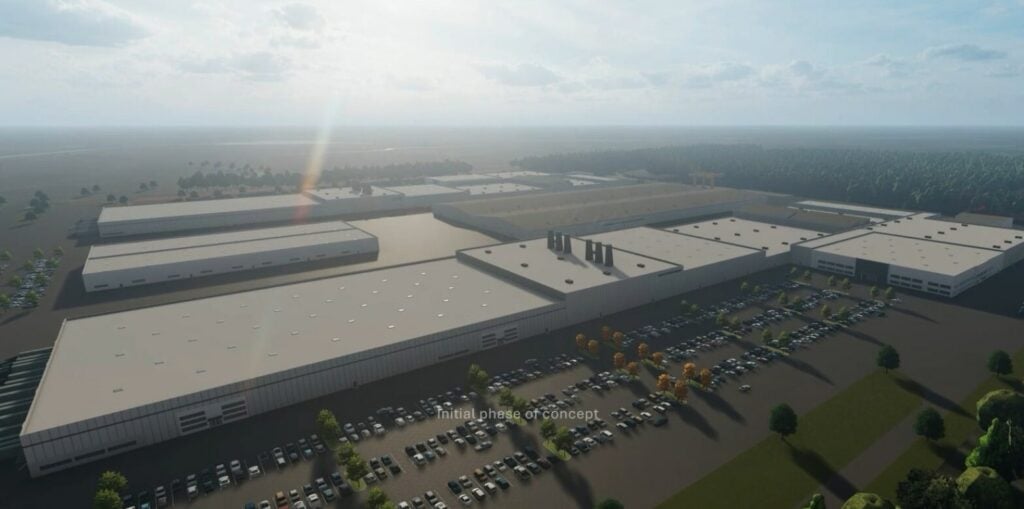
The funding will go towards new, retrofitted, and expanded domestic facilities for battery-grade processed critical minerals, battery precursor materials, battery components, and cell and pack manufacturing, the DOE said. It is the second phase of a total US$6 billion package, and concept papers are required by 9 January 2024 with full applications due 19 March 2024.
The Biden-Harris Administration wants to reach a net zero economy by 2050 and for electric vehicles (EVs) to make up half of all new light-duty ones by 2030.
Try Premium for just $1
- Full premium access for the first month at only $1
- Converts to an annual rate after 30 days unless cancelled
- Cancel anytime during the trial period
Premium Benefits
- Expert industry analysis and interviews
- Digital access to PV Tech Power journal
- Exclusive event discounts
Or get the full Premium subscription right away
Or continue reading this article for free
It said that batteries are critical for not only electric vehicles (EVs) but also renewable energy and making the US competitive for grid-scale energy storage and for energy resilience.
“With the demand for electric vehicles (EVs) and stationary storage alone projected to increase the size of the lithium battery market by five- to ten-fold by the end of the decade, it is essential that the United States invests in the capacity to accelerate the development of a resilient supply chain for high-capacity batteries, including non-lithium batteries,” its announcement said.
“Positioning the United States front and center to meet the growing demand for advanced batteries is how we boost our global competitiveness, maintain and create good-paying jobs, and strengthen our clean energy economy” added US Secretary of Energy Jennifer M. Granholm.
The funding opportunity is on top of generous tax credits for the production of clean energy technologies brought in by the Inflation Reduction Act, which was signed into law a year after the Infrastructure Law.
The Act includes a direct payment of US$35 per kWh of batteries produced in the US which has seen investments in the country’s battery supply chain soar in the past year, with the payment playing a big part in making US-made batteries and battery energy storage systems (BESS) more cost-competitive with China.
Knock-on effect on Europe’s battery industry
This has also made building batteries in Europe much less economical, compared to the US or China, according to Norway-based company Freyr which last week announced it was pausing new investments in all European projects and only scaling in the US. The company’s flagship Giga Arctic battery plant in Mo I Rana, Norway, is one of those which has been paused.
CEO Birger Steen, talking to Energy-Storage.news for an interview which will be published in the coming days, said project level financing for battery manufacturing in Europe was now much harder: “Most of these pools of capital are global, why would they do it in Europe when you can do it in the US for 35% cheaper?”
The current situation is a significant 180 degree turn from 18 months ago when Europe looked like it had done a much better job in fostering the growth of a domestic battery supply chain. Spurred by the Inflation Reduction Act, US investment announcements in the space started to outpace Europe’s late last year and it overtook its Atlantic neighbour for planned capacity earlier this year.
Just recently Energy-Storage.news reported that US firm American Battery Factory had started building its Arizona lithium iron phosphate (LFP) gigafactory while in September China-based Gotion announced plans for a US$2 billion gigafactory in Illinois.
A trade body for Europe’s transportation sector said in March that two-thirds of the continent’s battery manufacturing projects were at risk of delay or cancellation, though Freyr’s recent announcement suggests the situation may actually be more severe.