
The grid-scale energy storage market in Germany is in a strong position but key questions around grid fees, grid connections, FCAs and the upcoming capacity market remain, speakers at the upcoming Energy Storage Summit Germany 2026 said.
Anselm Eicke, partner at consultancy Neon Neue Energieökonomik, and Philipp Hesel, senior associate for Aurora Energy Research, were discussing the big picture topics in the Germany grid-scale energy storage market with Energy-Storage.news.
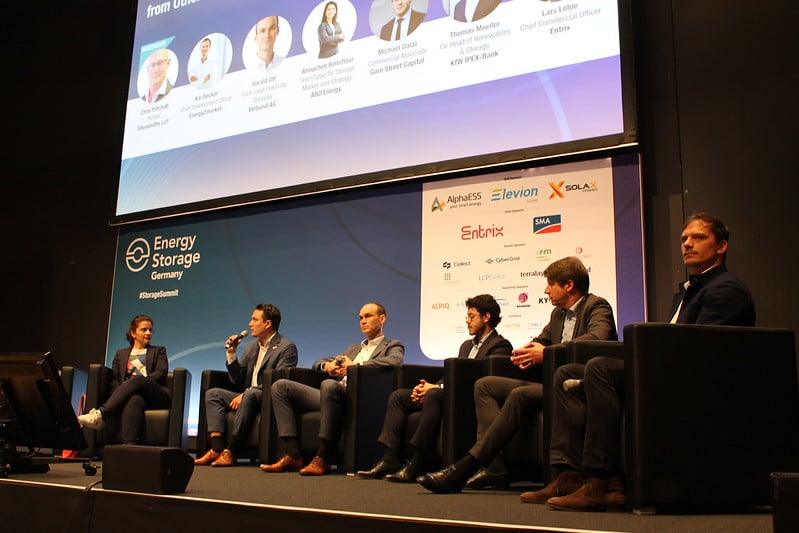
Both will be speaking on panels at the upcoming Energy Storage Summit Germany 2026, which runs on 15-16 September 2026 in Berlin (use our code ESN20 for a 20% discount on tickets), while Eike will also give a presentation on grid fees.
We’ve already heard from other event speakers Maximilian Hüls (8Energies) and Nina Schmüser (Grenergy) ahead of the event.
Try Premium for just $1
- Full premium access for the first month at only $1
- Converts to an annual rate after 30 days unless cancelled
- Cancel anytime during the trial period
Premium Benefits
- Expert industry analysis and interviews
- Digital access to PV Tech Power journal
- Exclusive event discounts
Or get the full Premium subscription right away
Or continue reading this article for free
Big picture
Both agree that the market is in a strong period right now, with larger and larger projects, increasing durations and new markets emerging.
Eicke points to a trend of batteries that are mostly exploiting day-ahead market spreads while Hesel says inertia, dynamic grid fees and a potential capacity market could increase future revenues.
Hesel adds that as more capacity enters the market, the risk for market cannibalisation increases. Eicke meanwhile says that there are still numerous open questions policy-wise, particularly on flexible connection agreements (FCAs) and network charges (grid fees).
Grid fees
As we wrote recently as part of our Q&A with Grenergy’s Schmüser, regulator BNetzA recently confirmed that large-scale energy storage projects coming online after 4 August 2029 will have to pay €4-7/kW/year (US$4.64-8.13/kW/year) in grid fees, also called network charges.
Hesel calls this a: “…downside, but still manageable. This is significantly lower than what was discussed before. Also, no energy-based grid fees must be paid. In general, this is great news for the storage industry.”
BNetzA also said that an additional dynamic grid fee component would be introduced afterwards, not earlier than 2032, varying based on time and location.
However, Eicke says there is a chance this might not happen: “Although the BNetzA seems to converge towards a clear position, I am still sceptical whether we will actually see the dynamic charge in future. There is still very strong opposition from network operators.”
Capacity market
BNetzA also recently set the date for Germany’s first capacity market (CM) auction, for next month. The CM has become a key part of the revenue stack for large-scale BESS in Poland, Belgium, Northern Italy and the UK.
However, as Schmüser said in her Q&A, Eicke and Hesel both agree the two initial auctions this year totalling 9GW will not be available to BESS.
Eicke said the pre-qualification criteria is targeting natural gas plants, with a 10-hour discharging criteria and then 10-hour discharging after only a 3-hour break. It also has local content requirements: cell production needs to be from Europe or associated countries. Hesel agrees that the 9GW tenders are defined in a way that excludes batteries.
However, Hesel adds that there will be duration-agnostic tenders next year totalling 2GW that he expects batteries to be the main participants in.
“I still expect derating factors to be quite harsh, leading to longer battery durations being more competitive. I assume something between 6-hour and 10-hour, but this depends on the derating factors that are not yet publicly available,” he explains.
“For the capacity market details are still outstanding but I assume that gas assets will be favoured and it will be hard for batteries to participate. The government will want to avoid subsidising 4-hour assets that will be built anyway.”
FCAs and grid connection backlog
When asked about which policy areas still need the most work and clarification, both executives primarily discussed FCAs and the work to reform the grid connection backlog. Both mechanisms are in response to there being far more BESS projects hoping to connect than are actually needed.
“You can basically not find a grid connection without any restriction. However, how restricting they are still depends strongly between different system operators; the impact can differ between 1 percentage points IRR delta and 7 percentage points IRR delta. I hope we will see some more standardisation and transparency within the next year,” Hesel said.
For Eicke, the key questions on FCAs are: “How are these regulated? How can it be guaranteed that FCAs are not used by network operators to prevent the connection of new BESS?”
On the grid connection backlog, Hesel and Eicke both say the ultimate outcome of new maturity-based connection procedures are still not clear. Though Hesel says it does make it much more transparent.
The first application round shows that appetite for new projects is still very high, even in the 2030s, but it remains to be seen how many will be accepted.
“In general, I think that the grid connection access is not the main buildout limitation, but rather how restricted your asset is with its FCA and if you get financing,” Hesel adds.
“Only a small share of the grid connection requests will be realised. I am not sure how big this backlog actually is,” Eicke says.
The consultant says the biggest problem in Germany is actually its uniform bidding zone. “In such a big zone, it is impossible to guarantee that storage operation reflects network constraints.”
Business and finance
Hesel says that some level of fixed or contracted revenues are increasingly standard, though some projects are still financed fully merchantly (8Energies’ Hüls discussed its merchant approach in its Q&A).
“Especially for large projects (over 100MW), tolling agreements are needed to get project financing. We see a maturing tolling agreement market, with more and more deals being closed. The interest in tolls from both sides, developers and offtaker, is still very high. However, more and more restrictions (FCAs) complicate the contracts,” Hesel says.
FCAs also complicate the optimisation question: “Optimising BESS under ramps and grid limitations is even more complex, making it even more important to pick a good optimiser.”
Role of TSOs and DSOs
Germany has four major transmission system operators (TSOs) and then hundreds of distribution system operators (DSOs) who manage and control access to the network. As such the relationship and ease of working with them is fundamental to who smoothly the market develops. Both Eicke and Hesel say this can be a big challenge.
“There is lots of uncertainty about how batteries affect network operation. Therefore, network operators are very skeptical about connecting large amounts of storage to the grid,” Eicke says.
Hesel says the big problem is a power imbalance between the operators and the industry, and a lack of digitalisation amongst the former. But, he sees light at the end of the tunnel.
“TSOs and DSOs are increasingly acting as gatekeepers of grid access. Think of them as bouncers at a club: you do everything you can to get in, but if they say no, there’s no negotiating your way past the door. The power imbalance is stark, and the BNetzA has consistently ruled in favour of system operators in cases of doubt, further entrenching their position. The new Netzanschlusspaket reinforces this dynamic even further,” Hesel says.
“At the same time, delayed digitalisation on the DSO side is becoming a serious bottleneck for project development. Even where BESS developers and optimisers are willing to adapt and respond to DSO requirements, the tools and processes simply aren’t there yet to make that collaboration work in practice.”
“That said, the rapid ramp-up of BESS deployment is also a steep learning curve for the system operators themselves. I hope that with more experience, they will streamline their processes, improve FCA conditions, and move towards greater transparency, making grid access more predictable for everyone involved.”
