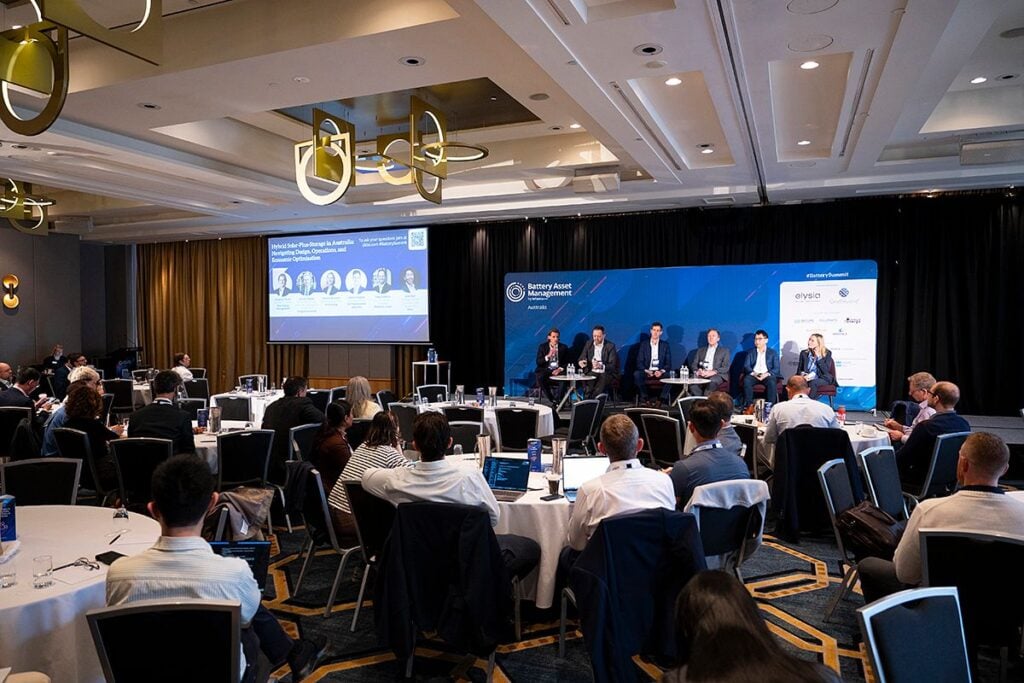
DC-coupled solar-plus-storage projects can reduce the time needed for grid connection approval by “up to six months” compared with AC-coupled designs, according to panellists speaking at the Battery Asset Management Summit Australia 2026 in Sydney today (26 August).
Speaking on the panel “Hybrid Solar-Plus-Storage in Australia: Navigating Design, Operations, and Economic Optimisation” on day two of the event, Alistair Gibson, senior key account executive for utility BESS, hybrid and PV at Sungrow Australia, said the connection process for DC-coupled projects is simpler because the solar and battery components are assessed as a single integrated system rather than separately.
“The process for grid connection with DC-coupled projects is much simpler. What that really leads to is a reduction in the time of the Generator Performance Standards (GPS) or the connection process, by up to six months,” Gibson said.
Gibson noted that DC-coupling also reduces capital costs by requiring fewer inverters, since only a PV inverter is needed rather than separate PV and battery inverters.
Try Premium for just $1
- Full premium access for the first month at only $1
- Converts to an annual rate after 30 days unless cancelled
- Cancel anytime during the trial period
Premium Benefits
- Expert industry analysis and interviews
- Digital access to PV Tech Power journal
- Exclusive event discounts
Or get the full Premium subscription right away
Or continue reading this article for free
He adds that some suppliers, including Sungrow, now integrate DC-DC converters directly into battery containers, eliminating the need to purchase converters separately and further reducing balance-of-plant costs.
Toby Roberts, country director for developer and independent power producer (IPP) Elements Green in Australia, described the underlying distinction in simpler terms.
“DC basically are connected behind the meter before connecting into the grid,” he said, contrasting that with his own project, which uses four separate AC connection points across dual 275kV transmission lines.
Roberts added that the choice between AC and DC coupling is largely irreversible once made.
“It’s very much an early decision-making process in the design and development of a project. You can either do both, but it’s expensive, and it’s effectively a complete redo.”
Jack Han, strategic market expansion and transaction at Tesla, said the right architecture depends on how a developer intends to monetise the asset.
“It really depends on what you’re trying to do revenue-wise. AC-coupled might be a bit more flexible for you,” Han said, noting that DC-coupled projects typically use grid-following rather than grid-forming inverters, meaning developers may still face system strength charges depending on configuration.
Gibson added that some original equipment manufacturers (OEMs), including Sungrow, now offer grid-forming capability on DC-coupled systems as well, which he emphasised “changes the game in terms of making sure those system strength charges can be avoided even with a DC-coupled scenario.”
Battery storage and solar warranty terms are converging around 25 years, but retrofit decisions carry technical risk
The panellists said battery storage warranty terms have lengthened to align more closely with solar asset lifespans. Han said that Tesla now offers a 25-year design life on its battery storage systems.
“I think we’ve essentially approached parity,” he said, though he cautions that developers need to assess whether individual components, and the companies backing them, are likely to still exist over that timeframe.
Gibson said the shift from 20-year to 25-year warranty terms has become a bankability requirement in the Australian market.
“It was initially 20 years that was the requirement for warranties and performance guarantees. Now it’s 25 years, and that’s becoming a bankability requirement as well,” he said.
Simon Franklin, country director for EDP Renewables Australia, said the extended warranty terms matter less for revenue modelling than for financing structure.
“This extension from say 20 years to 25 years is not necessarily hugely important for our financial model,” he said.
“But it can be important from a banking perspective if you can amortise that debt over a 25-year life. That helps you leverage ratios.”
On retrofitting battery storage systems to existing solar PV power plants, Evonne Bennett, chief operating officer at Aula Energy, believes land availability, connection agreements and the age of existing inverter technology all shape whether a project is a viable retrofit candidate.
“It really is a myriad of choices,” Bennett said.
“How quickly can you get this hybrid or retrofit to final investment decision (FID), bankability, and then it is actually built?” becomes a central question as existing power purchase agreements expire and merchant risk exposure grows.
Gibson added that older inverter technology can force developers back through the full grid connection approval process.
“If it’s an old technology, the question is when you actually go in to have a look from the Generator Performance Standards perspective, you actually may lead to potentially having to restart, redo the whole GPS process altogether,” he said.
Data centre demand reshaping how hybrid projects are contracted
Panellists highlighted that the growing demand from data centre operators is changing how hybrid projects are structured and sold.
Bennett said data centre load is emerging as a source of demand that could offset falling midday prices as more solar and battery storage capacity enters the market.
“There’s less arbitrage, but that’s also paired with the energy transition and wanting firm products to replace those baseload coals,” she said.
Franklin believes some counterparties are pushing hybrid projects toward fixed-output contracts that do not reflect how the underlying assets are best operated.
“A lot of the gentailers at the moment are really forcing projects to go to firm products. You’re kind of having to guarantee your output, which is really sort of concerning as a project owner because you expose yourself to a short position risk,” he said.
Roberts adds that educating offtakers on how to extract value from a hybrid asset, rather than forcing it into a flat-load structure, “has been probably one of the biggest challenges for us.”
Franklin also points to a practical constraint on hybrid contracting connection capacity that often prevents a project from generating and discharging simultaneously at full output.
Describing a New South Wales project with a 500MW connection shared between a 450MW battery and 450MW of solar, he said: “We clearly cannot generate both at the same time. I cannot fully sell both assets, or I risk a position where I cannot meet that settlement.”
Never miss an Australian energy storage story. Sign up for our Australia newsletter and get the latest project announcements, policy updates and market analysis delivered directly to you.