The UK battery storage market is suffering a “weak revenue environment”, with assets not able to participate in balancing the GB grid or replacing gas-fired generation to their fullest capability, according to Gresham House Energy Storage Fund.
Gresham House, which is listed on the London Stock Exchange (LSE) under the ticker ‘GRID’, this morning (1 February), provided a trading update on its activities and finances ahead of the publication of audited annual results in April.
It speaks of the company making some tough choices in the face of some industry headwinds and a recent sharp fall in its share price, mentioning that Gresham House’s board and fund manager, “are determined to take a proactive and disciplined approach to capital allocation”.
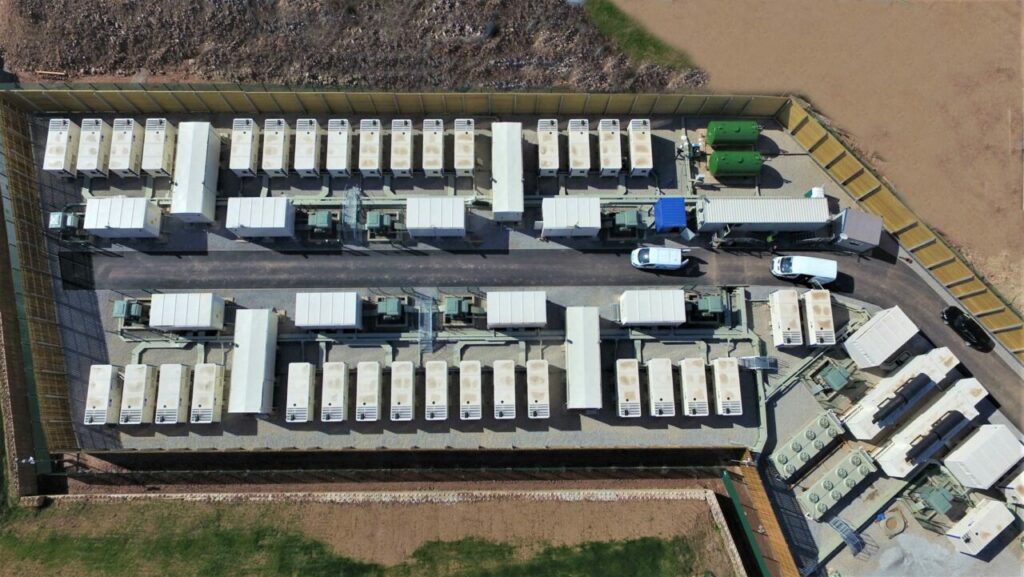
Nonetheless, Gresham House remains on target to reach 1,072MW of operational assets by the end of this year, from 740MW at the time of writing, and will extend the durations of some of its existing assets from 1.2-hour to 1.6-hour, which would be commensurate with a doubling of its present capacity in megawatt-hour terms, the fund said.
Try Premium for just $1
- Full premium access for the first month at only $1
- Converts to an annual rate after 30 days unless cancelled
- Cancel anytime during the trial period
Premium Benefits
- Expert industry analysis and interviews
- Digital access to PV Tech Power journal
- Exclusive event discounts
Or get the full Premium subscription right away
Or continue reading this article for free
However, the fund said there won’t be any fresh project announcements during 2024, with its focus being solely on the completion of projects from its 2023 pipeline. That 332MW of projects are already constructed and at the stage of completing works relating to grid connections.
Those projects and duration extensions at existing facilities will contribute to boosting Gresham House’s portfolio earnings, the fund said. It plans to deploy some of its existing £40 million (US$50.71 million) cash in hand to finance the capex required.
Challenging shift from ancillary services-based business model
GRID’s share price has fallen from £110.20 on 2 January 2024 to £48.91 as of the time of writing. On 1 February last year, the price stood at £161 per share.
The board intends to hold a share buyback in light of this, and the fund will not declare a dividend for the Q4 2023 period. It also noted that if the “current revenue environment” continues, generating enough cash for a dividend will be challenging for this year, but further announcements on that can be expected before the full annual results drop in April.
Gresham House also said it intends to discuss options to amend its borrowing arrangements. That could equal a reduction in its debt facility’s size to reduce the overall cost of funding. The drawdown as of the end of 2023 to date from a total £335 million facility had been £110 million, unchanged from the half-year 2023 mark. Gresham House said a facility of its size may no longer be required.
Gresham House chairman John Leggate said that with the BESS market in the UK – or more specifically on the connected grid of Great Britain (GB) – shifting from an ancillary services-based one to one more focused on energy trading, a “challenging environment continues to persist for the battery storage industry”.
Back in October, Energy-Storage.news Premium reported that although saturation of UK frequency regulation ancillary services markets had occurred in 2023 as anticipated by many in the industry, depressing available revenues, the impact had been far sharper than projected.
One of Gresham House’s fellow LSE-listed BESS investment funds, managed by Gore Street Capital, has said falling revenues in the UK has been one of its motivating factors for expanding internationally.
Diversifying into Ireland, Germany, and the US, Gore Street Energy Storage Fund saw its overseas assets generate on average 2.6X more revenues than its GB grid assets in the first half of its 2023 financial year, it said in December.
Also in December 2023, industry benchmarking and analysis group Modo Energy said average revenues for BESS assets in the GB Balancing Mechanism – the real-time electricity supply and demand-matching tool of the system operator, National Grid ESO – had fallen to their lowest levels since batteries began participating in it.
The flipside to this coin is that wholesale market trading revenues did increase during 2023, growing 45% month-on-month from September to October, again, according to Modo.
Low utilisation of BESS in Balancing Mechanism
Gresham House ascribed the “weak revenue environment” to have come about due to three main factors, one of which is that the Balancing Mechanism (BM) utilisation of BESS assets is very low in National Grid ESO’s half-hour trading blocks.
BESS in the BM are being subjected to high skip rates, where the assets are overlooked in favour of other resources, most likely gas. The ESO has very recently introduced a new platform for managing the BM which is hoped may address this issue. Gresham chair John Leggate welcomed the ESO’s efforts in this, but said they had yet to manifest into positive changes.
Closely related to that is Gresham House’s second cited factor: what it called the “excessive use of legacy gas-fired electricity generation” in the BM. This generation is flexible, albeit polluting of course, and its overuse creates wholesale market oversupply which further erodes revenue opportunities for BESS.
Finally, new project commissionings have been slower than expected, due to extremely lengthy grid connection times for new assets, with it not being unusual for BESS or solar PV developers to be given grid connection dates in the mid-2030s.
“The UK’s need for increased energy storage capacity remains as clear as ever given the rising levels of committed renewable generation coming online over the period to 2030,” Gresham House Energy Storage Fund chair John Leggate said.
“In turn, clean energy dominates energy output more and more frequently, as legacy gas-fired electricity generation continues to be squeezed off the system by cheaper renewables, with battery storage the clear technological leader in tackling the consequential rising intermittency.”
Gresham House’s BM comments somewhat echo the words of Roger Hollies, CTO at UK BESS optimiser Arenko, who said that batteries have a valuable and vital role to play in balancing the network as the country goes to higher shares of renewables. Hollies called on National Grid ESO to work closely with the industry to figure out the best ways to enable this.
In an Energy-Storage.news webinar hosted last week with flexible and distributed energy asset trading and optimisation company GridBeyond, the audience heard a lively discussion of the GB/UK market’s evolving revenue landscape for batteries.
Energy-Storage.news’ publisher Solar Media will host the 9th annual Energy Storage Summit EU in London, 20-21 February 2024. This year it is moving to a larger venue, bringing together Europe’s leading investors, policymakers, developers, utilities, energy buyers and service providers all in one place. Visit the official site for more info.