
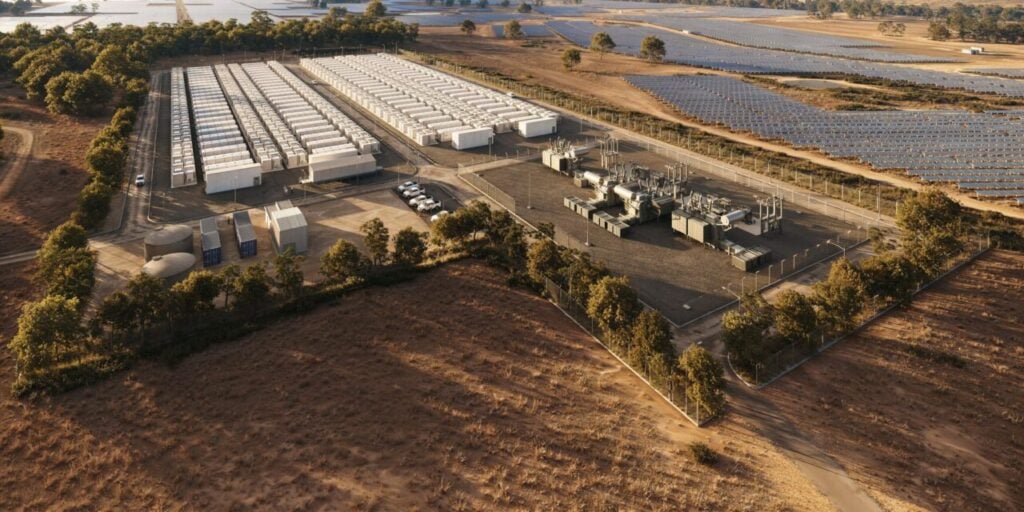
Australia’s battery storage market continues to break new ground, with several notable trends emerging in recent months. Ahead of the Battery Asset Management Summit Australia 2026, taking place 25-26 August in Sydney, we take a look at some of the key debates set to take centre stage at the event.
In some of our ESN Premium and free-to-read articles, we’ve gained insights into the Australian battery storage market from companies such as Fluence, OptiGrid and more. Some of these insights will be expanded on at the upcoming Summit.
Compressing margins are testing the fleet’s revenue strategies
NEM-wide battery price spreads fell 85% in a single year to average AU$51/MWh (US$35/MWh) in the second quarter of 2026, as grid-scale battery storage capacity passed 9,000MW for the first time, according to AEMO’s Quarterly Energy Dynamics report.
Estimated net battery revenue fell from AU$130.5 million to AU$57.5 million over the same period, a direct consequence of narrowing arbitrage margins as more capacity competes to charge during cheap daytime hours and discharge during the evening peak.
Try Premium for just $1
- Full premium access for the first month at only $1
- Converts to an annual rate after 30 days unless cancelled
- Cancel anytime during the trial period
Premium Benefits
- Expert industry analysis and interviews
- Digital access to PV Tech Power journal
- Exclusive event discounts
Or get the full Premium subscription right away
Or continue reading this article for free
Battery discharge set prices in 46% of dispatch intervals during the evening peak in Q2 2026, displacing gas as the dominant price-setter in those hours, even as the volume-weighted average price for battery discharge fell from AU$427/MWh to AU$101/MWh across the year.
That pressure is already visible at the asset level. Australia’s 55 grid-scale battery storage systems tracked by NEMPulse generated a combined AU$17.98 million (US$12.43 million) in estimated gross energy and FCAS revenue during June 2026, with the fleet capturing just 32% of the revenue a perfect-foresight strategy would have achieved, leaving an estimated AU$34.90 million on the table.
Revenue per MW also varied considerably by duration, with one-hour and four-hour-plus systems each earning around AU$3,000/MW compared with AU$1,000/MW for three-hour assets.
OptiGrid: the fleet is still learning how to behave under stress
Sahand Karimi, chief executive of battery optimisation platform OptiGrid, has argued that the gap between theoretical and captured revenue often comes down to decisions made well before a price event arrives.
Speaking to ESN Premium about South Australia’s AU$20,300/MWh price cap event on 21 June, when SA1 hit the market price cap twice in one evening, Karimi said state of charge going into the event was a major driver of outcomes, but that state of charge itself reflected earlier bidding choices.
“Some decisions look obvious after the event. They rarely are in real time,” Karimi said.
The event itself, first reported by Energy-Storage.news, saw the extreme pricing window last two hours and 35 minutes, with an average price across the period of AU$3,900/MWh.
Of the 15 grid-scale battery storage systems tracked in the region, four discharged and captured positive revenue, seven sat idle despite available capacity, and two were caught charging during the cap itself.
Epic Energy’s Mannum BESS delivered the strongest individual performance, discharging from 21.4% to 3.2% state of charge to generate an estimated AU$151,740, while AGL’s Torrens Island BESS added a further AU$107,230 while also committing the largest FCAS volume of any asset during the event.
The two battery charging systems, Iberdrola Australia’s Lake Bonney BESS1 and ZEBRE’s Templers BESS, recorded a combined estimated loss of AU$49,570, which offset much of the AU$324,720 generated by the discharging assets.
Both had started the event at comparatively low states of charge, 13.5% and 4.5% respectively, which may have constrained their ability to participate in the discharge side of the market regardless of price.
Karimi said the growing South Australian fleet is beginning to shape market outcomes rather than simply respond to them, warning that if batteries “discharge too early, they can run out of energy before the highest price intervals arrive,” while if they “all hold back, prices can remain higher for longer during the earlier part of the evening.”
“We are still at the start of learning how large battery storage fleets behave in these conditions,” he said.
Data centre demand is reshaping the commercial case for storage
Australia’s policy framework for large data centres is advancing quickly, with the federal government moving to legislate a requirement that new facilities become net generators of renewable energy rather than net consumers.
The obligation is expected to accelerate the deployment of co-located battery storage as operators seek to meet new firming requirements tied to the certificates they hold.
That framework has advanced on three fronts in recent weeks, with the AEMC setting out four recommendations covering renewable energy certification, firming obligations, market registration, and co-location support, while New South Wales has introduced legislation granting the state energy minister the power to control grid access for large loads.
Federal energy minister Chris Bowen has confirmed that states can add tighter requirements but cannot weaken the national floor, with legislation expected to be introduced to Parliament in early 2027.
The firming obligation at the centre of the framework has direct implications for battery storage, since co-located BESS converts intermittent renewable energy generation into the dispatchable supply that data centres will be required to demonstrate.
Fluence has mapped three commercial use cases battery storage offers data centre operators: load smoothing, cold-start backup and speed to power.
On the last of those, the company’s analysis of the US market found that co-locating battery storage and using it to reduce the firm power commitment required from the grid operator can compress a three-year interconnection wait to as little as 15 months, generating additional revenue for operators during that period.
With AEMO tracking 17 data centre load connection projects totalling 9GW already working through the NEM connection process, the scale of storage procurement attributable to data centre compliance alone could rival the existing utility-scale pipeline.
Circular economy thinking is entering project design earlier
Asset lifecycle planning is also entering the conversation earlier than in previous years. Daniel Elias, senior global environmental manager at Fluence, has written that circular-economy principles need to move from a compliance afterthought to a core part of project planning as renewable energy infrastructure matures and the first generation of assets approaches the end of life.
Elias pointed to regulatory developments overseas as an indication of where the industry is heading, including the EU Battery Regulation, which will require industrial batteries above 2kWh placed on the EU market from 2031 to contain a minimum share of recycled lithium, and mechanisms in Japan that allow manufacturers to collect and recycle battery components across multiple prefectures without local waste-disposal permits.
“As renewable technologies become foundational infrastructure, their sustainability will be judged not only by the power they produce, but by how responsibly they are managed across their full lifecycle,” Elias wrote.
Queensland’s battery storage fleet keeps setting the pace
Queensland’s battery storage fleet continues to demonstrate how quickly storage is becoming a structural part of the grid, rather than a supporting technology.
The state’s battery fleet helped push Queensland to a record 79.5% instantaneous renewables-plus-storage share of consumption on 31 May, with battery storage alone reaching 16.9% of consumption at the same time, according to analysis from Geoff Eldridge of Global Power Energy.
Eldridge noted that a year earlier the comparable battery share figure stood at just 6.4%, describing the near-tripling as evidence of “how quickly storage is becoming material in NEM operations.”
He also flagged that the timing of the record, on the final day of autumn rather than during the usual spring conditions associated with peak renewables share, suggests Queensland’s operating flexibility is no longer confined to seasonal windows.
The record followed Queensland becoming the first NEM state to discharge more than 100GWh from utility-scale battery storage in a single month in April 2026, with the state’s intraday price spreads collapsing as installed capacity ramped up.
Commercial performance across the state’s fleet has varied significantly by bidding strategy, with CleanCo Queensland’s Swanbank BESS earning more than double the monthly revenue of Victoria’s Big Battery over the same period despite a similar capacity, a gap attributed to contrasting merchant bidding approaches between the two assets.
Readers of Energy-Storage.news can get 20% off their tickets to the Battery Asset Management Summit Australia 2026 using the code ESN20 at checkout. Find out more about the Summit on the official website.
