
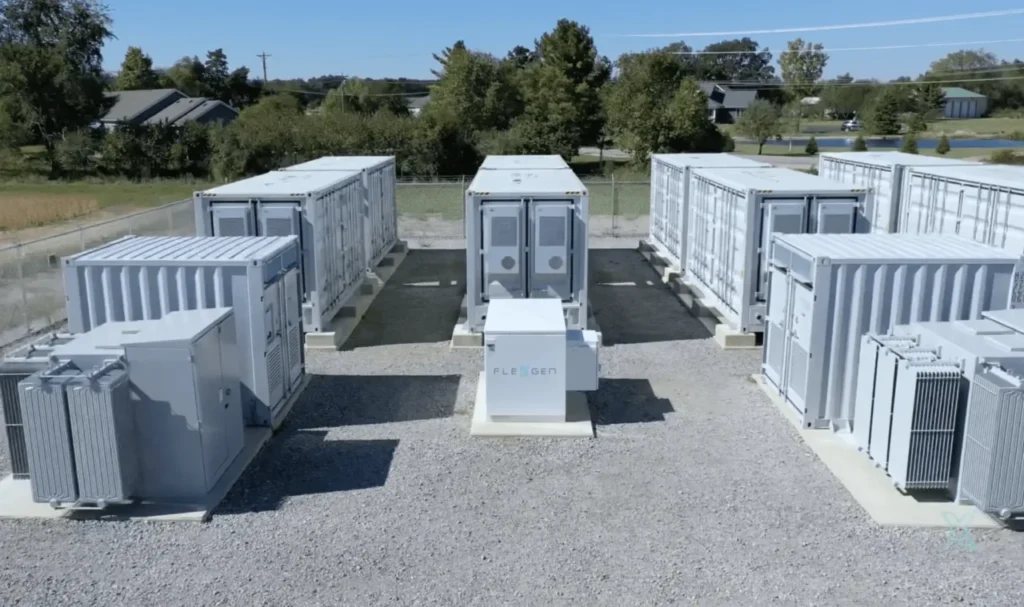
ESN Premium speaks with Jason Abiecunas and Mike Wallace of FlexGen, one of a growing number of US BESS companies establishing operations in Europe.
Just a few years ago, there was no question that the US energy storage market was racing to scale deployment in a way that its counterpart in Europe could barely dream of.
Within Europe, only the UK was a gigawatt-scale annual market for utility-scale storage, while the US had California and Texas as standouts and a few other markets emerging.
That lead has been cut significantly in the past couple of years. In 2023, Europe saw its first year with installations in double figures, with 10.1GW across all market segments, according to consultancy LCP Delta. That same year, the American Clean Power Association (ACP) trade group said the US installed 7.9GW of new storage.
Try Premium for just $1
- Full premium access for the first month at only $1
- Converts to an annual rate after 30 days unless cancelled
- Cancel anytime during the trial period
Premium Benefits
- Expert industry analysis and interviews
- Digital access to PV Tech Power journal
- Exclusive event discounts
Or get the full Premium subscription right away
Or continue reading this article for free
The US has retained its lead since then, however. LCP Delta said Europe deployed 13.5GW/26.4GWh of new electrochemical storage in 2025, while a US Solar Energy Industries Association (SEIA) report put together by Benchmark Mineral Intelligence counted more than 28GW/57GWh of new BESS installations in 2025.
Nonetheless, with the emergence of a variety of markets across Europe by geography and application, US players like software-focused battery storage system integrator FlexGen are seeing big potential across the Atlantic.
“We really spent the last couple of years having conversations in the market, gathering data, learning about the European market,” Jason Abiecunas, FlexGen executive VP for business development, tells ESN Premium.
That includes evaluating similarities and differences with the US market, in which the system integrator is better known, and how the company may want to position itself differently in the new one.
Fundamentally, Abiecunas says, Europe is a “tremendously important market for energy storage.”
“It was a very early mover in renewable energy. You see markets like Spain with very little energy storage currently installed, [but with] a massive need for energy storage to bring stability to the grid following the outage on the Iberian Peninsula almost 18 months ago.”
He also mentions the UK as an early mover in storage and markets that are seeing “tremendous growth” more recently, including the Nordics, Germany and much of Eastern Europe.
“Slightly different use cases from market-to-market, but we see similarities to problems we’ve solved on the US grid in various places, and we see a tremendous growth path in Europe over the next several decades,” Abiecunas says.
FlexGen, which touts its value proposition as “turning batteries on and keeping them on,” has been in business for over 16 years, with a background in complex microgrid integration before the grid-scale BESS business really took off.
Therefore, much of the value of its integration lies in the company’s software and controls platform, the HybridOS energy management system (EMS). HybridOS encompasses power plant controls (PPC) and SCADA, as well as newer applications such as diagnostic analytics.
FlexGen announced its entry into the European market in June, including the opening of offices and the award of projects in the UK and the Nordics.
Although Abiecunas says it is still too early to disclose details of the projects, we are introduced to Mike Wallace, an energy industry veteran who has been appointed FlexGen’s managing director in Europe.
Wallace says a “confluence of factors” brought his new employers into Europe, as he joins our interview. From the highest level, there are the “geopolitical angles”: Europe’s dependency on imported Russian fuels and more recently its exposure to Middle East pricing volatility, coupled with net zero and renewable energy targets.
The economics of energy storage have also become more favourable, with falling costs of lithium iron phosphate (LFP) batteries and EPC costs “falling substantially over the last couple of years.” On the flip side, the trading and optimisation of BESS assets is maturing, while data centres are providing a “burgeoning” use case for battery storage, Wallace says.
Lifecycle challenges for a ‘very flexible technology’
FlexGen claims to have integrated Tier-1 technologies into more than 80 configurations across more than 200 energy storage installations in 10 countries, totalling more than 25GWh.
Abiecunas says FlexGen believes it can add value in the European market with this integration experience, where many customers will be first-time buyers or investors in BESS.
“Europe is so interesting as a truly global market for technology. We bring experience delivering projects with the vast majority of equipment suppliers entering Europe, serving many first-time owners of battery energy storage,” Abiecunas says.
The HybridOS suite is the operating system that integrates the full stack of the project and serves as the backbone of FlexGen’s claims of industry-leading commissioning times and operational uptime and availability. At the same time, the company runs 24/7 monitoring centres and a full lifecycle services team.
For a customer in the Nordic market, for example, FlexGen is deploying the HybridOS software and providing commissioning support. While in the US, the company is also involved in procurement and project delivery, in Europe, at least initially, it will focus on software and services while evaluating additional scopes of work.
Through the lifecycle of a battery storage project, it may be called upon to perform a variety of applications. Again, lessons learned in the US and further afield will help inform FlexGen’s approach to partnering with customers in Europe for the long-term, Abiecunas says.
Over 16 years ago, FlexGen was “founded on the thesis that energy storage solves complex problems for power systems and opens opportunities,” Abiecunas says.
“Over our history, that’s meant a lot of different things because energy storage is fundamentally a very flexible technology that solves a lot of different problems.”
That history includes microgrids and gas engine hybrid projects for oil fields in its earlier days, to large-scale front-of-the-meter (FTM) BESS on the ERCOT grid in Texas and the CAISO grid in California and now data centre applications.
“If you zoom out in Europe, you see that the problems that energy storage solves over time are different, but all of those different applications are really built on the core competencies that we have as an organisation, using batteries in new and different ways to solve energy and power system problems.”
The UK market, for instance, bears many similarities to ERCOT, he says. Assets can be built relatively quickly, and it is an open market from a trading perspective, dominated by short-duration assets in its early stages and now transitioning to longer-duration projects.
“The applications are going to be a little bit different over time, and projects are going to be asked to do different things over time. We have projects in our fleet that were once ancillary services projects, fluttering around 50% state of charge (SoC) all day, that are now running full charge and discharge cycles, doing arbitrage as their primary means of operation,” Abiecunas says.
Wallace adds that FlexGen is a “super-bankable” organisation, committed to partnering with its customers over the 20-year investments they make in batteries, including retrofits and augmentations.
“So, some of the challenges around what was originally planned for those assets might not play out as expected, and we’re here to help with not just the new stuff, but helping customers go through that lifecycle journey,” Wallace says.
Nonetheless, while the US is a patchwork of states, transmission organisations and wholesale markets rather than one homogenised market, Europe similarly is a collection of countries with some shared grid and market regulations. The European Union (EU) alone has 27 Member States, while, for example, the Nordic and Baltic countries have separate and lucrative ancillary services markets.
Various countries in Europe also have their barriers to entry and challenges for success. Take, for example, the industry’s ongoing efforts to end double charging for grid use, where some countries’ regulators still levy fees for both consuming (charging) from the grid and injecting (discharging) into it.
“Like many of these complex problems, it’s really [about] bringing collaboration between suppliers, owners, developers, grid operators, equipment manufacturers, and bringing forth lessons learned from operating energy storage on grids globally to help them tackle their problems locally,” Abiecunas says.
“We’ve got teams working ahead of formal awards, evaluating grid codes and market structures and operating requirements for projects and working with owners to understand how those need to be modelled and submitted to grids in advance of deployment of projects.”
There is a “dramatic variance” required in modelling, performance and testing across the European market, which, he says, is more like 20 or 30 different markets.
Europe’s data centres will need to be ‘good citizens of the grid’
We can’t conclude a conversation about energy storage in 2026 without discussing data centres in a little more detail.
FlexGen has been particularly vocal in positioning itself in the space. In mid-2025, it formed a partnership with data centre developer Rosendin to integrate BESS technology with data centre campuses’ UPS.
At the beginning of this year, FlexGen CTO Hugh Scott told ESN Premium that energy storage is perhaps the technology best suited to mitigate the huge power swings of AI training clusters.
“Things have only gotten more interesting around data centres. Much the same will apply in Europe as it does in the US,” Abiecunas says.
“We began a couple of years ago with the thesis that batteries are absolutely going to be required for the massive-scale data centres that are being built. It took the market a while to catch up with that, and now we’re really at a point where it’s an absolute necessity for every project, grid-connected or not, to include a battery storage component.”
For example, in Texas, ERCOT’s Nodal Operating Guide Revision Request (NOGRR) 282 requires voltage ride-through, frequency ride-through and no more than 10MW of voltage variation within 5 seconds for large computational loads.
“We would expect to see, not identical, but similar considerations in Europe around data centres being good citizens on the grid,” Abiecunas says.
Wallace says that the UK and Germany are currently Europe’s biggest data centre markets, while the Nordics are also interesting, particularly for their colder climate, which means data centres require less auxiliary cooling.
Data centre BESS projects require understanding of the kind FlexGen has already earned in the US, Wallace says, including linear controls, power smoothing, grid-forming, how to handle AI transient loads and LLMs and how to size the battery systems and control gas turbines to smooth the power. “It’s an area which is super-exciting for FlexGen as a business. The past isn’t a proxy for the future on this thing, but I would predict substantial growth for FlexGen in Europe around the data centre space,” Wallace says.
